


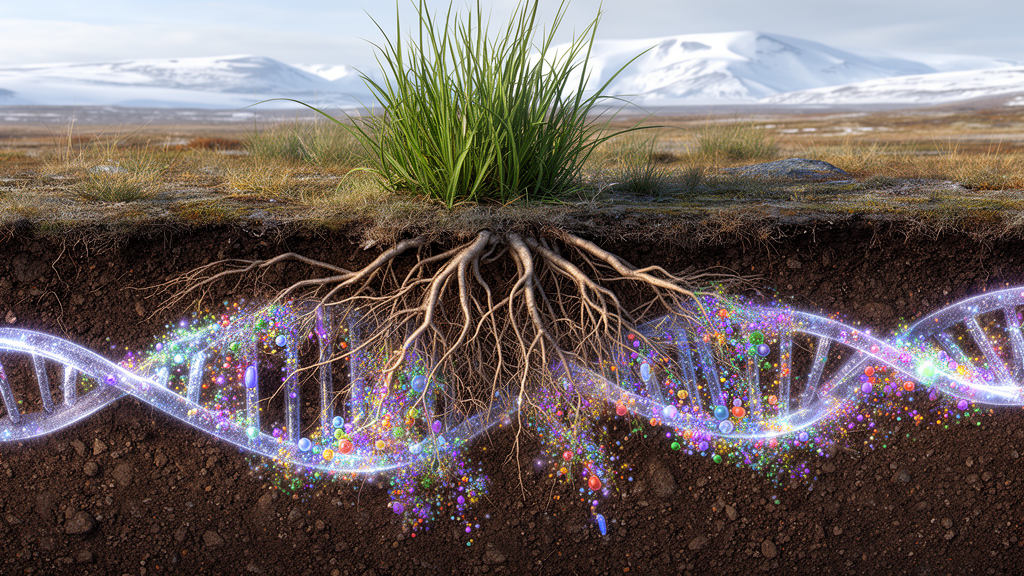
In the high-Arctic tundra of the Zackenberg Valley in northeast Greenland, a team of researchers has shown that a single syringe-full of soil can recover much of the ecological information that a trained botanist would gather from a careful vegetation survey. The researchers then used a joint species distribution model to ask whether the two methods told the same story about how plants, bacteria and fungi respond to their abiotic environment and associate with one another.
The fieldwork drew on an existing dataset. In 2013, Stewart and colleagues recorded the vegetation composition in 200 plots spanning an environmental gradient from 7 metres above sea level up the slopes of Aucella Mountain to 770 metres. In 2017, the team revisited the same plots, which are marked with aluminium pegs, and sampled one soil core of 5 to 10 grams per plot, taken by hand with a sterile syringe to a depth of about 5 centimetres. The researchers note that vegetation turnover in the area is very slow, so the aboveground plant community was likely to have changed little between the two campaigns, and the low Arctic temperatures promote DNA preservation in soil.
At the genus level, the two methods agreed remarkably well. Altogether, the study detected 57 plant genera across 24 families, and 68 percent of these were identified by both eDNA and direct observation. Fifty-one genera were detected by observation and 45 by eDNA, with 21 percent found only by observation and six genera found only by eDNA. Genus-level distribution patterns across the mountain slope were highly similar between the two approaches. At the species level, however, the picture was more complicated: 107 plant species were detected by observation and 82 by eDNA, with only 60 species, or 46 percent of the total, detected by both methods. Of the 47 species seen only by observation, 15 were absent from the local DNA barcode reference library and therefore undetectable by eDNA, while 27 species were detected by eDNA alone.
The researchers attribute much of the species-level mismatch to their strict taxonomic assignment procedure, which accepted only identifications with a probability of at least 90 percent. In groups such as grasses and sedges, where multiple related species coexist, no single species may pass that threshold even when the genus is clear. The choice of genetic marker also mattered. The rbcL a gene region performed poorly at species-level assignment, with only 0.1 percent of reads assigned to species even at a lower 50 percent threshold, compared with 71.4 percent of ITS2 reads at that threshold. The authors suggest that for this high-Arctic flora, the ITS2 marker alone may suffice to produce reliable data on species distributions.
The team then modelled the occurrence of taxa as a function of soil temperature, moisture and pH, using a hierarchical modelling framework that simultaneously estimates species responses to the environment and residual associations among taxa. The model achieved good discriminatory performance, with a mean Tjur R2 of 0.30 and a mean AUC of 0.89, though explanatory power varied widely among taxa and was stronger for observational plant data than for eDNA plant data. Predictive performance under cross-validation was lower than explanatory performance, as expected.
Soil moisture emerged as a factor relevant to all groups of organisms, which the authors consider unsurprising in high-Arctic ecosystems that are typically arid or semi-arid, where soil water limits both plant growth and microbial activity. Plant species richness was predicted to increase across gradients of soil temperature and soil moisture, with generally consistent patterns whether plants were scored by observation or eDNA. For soil pH, both methods suggested no response or a slight decrease in plant richness. Notably, a large proportion of fungi decreased in occurrence with increasing soil temperature, and predicted fungal richness showed a pronounced decline along the temperature gradient, a pattern that deviated from the other organism groups. The authors note that fungi are generally considered more adapted to low-temperature conditions than bacteria, and that fungal activity is more sensitive to soil temperature.
The core question of the study concerned biotic associations. After accounting for joint responses to the abiotic environment, the researchers examined residual co-occurrence patterns between plants and microbes and compared the results obtained when plant occurrence was established by observation versus by eDNA. The signs and perceived prevalence of plant associations with microbes were largely consistent regardless of the detection method. Among statistically supported plant-fungus pairs expected to be mutualistic, such as ectomycorrhizal fungi, endophytes and epiphytic symbiotrophs, positive associations outnumbered negative ones when plants were scored by observation, with 17.5 percent positive versus 5.3 percent negative, while for eDNA the two categories were equal. Only one discrepancy in the sign of an association was observed between the two scoring methods among these groups.
Plant-bacteria associations told a different story. Among bacterial genera expected to engage in antagonistic relationships with plants, such as plant pathogens or intracellular parasites, the estimated associations were fully consistent between the two plant data sources, but unexpectedly showed a preponderance of positive associations, 19.8 percent of taxon pairs, over negative ones, 9.6 percent. The authors caution that a positive statistical association does not necessarily imply a beneficial interaction: just as predators accumulate where prey is dense, antagonistic partners may co-occur more often than expected by chance. They also note that nitrifying bacteria, classified as mutualistic, can indirectly reduce plant productivity by transforming nitrogen into more mobile forms, and that in nutrient-limited Arctic tundra, soil microbes can compete effectively with plants for nitrogen.
Among the fungi, the ectomycorrhizal genera Cortinarius and Cenococcum were positively associated with several plant species, including Minuartia rubella, Trisetum spicatum, Silene acaulis, Saxifraga oppositifolia and Saxifraga cernua, with Cenococcum additionally associated with Stellaria longipes and Salix arctica. The authors suggest that low specialisation by mycorrhizal fungi on Arctic plant species could be an adaptive response to low nutrient availability. They also flag a methodological caveat: the fungal ITS2 primers used may provide a skewed picture of fungal diversity, and a different set of primers would be needed to efficiently detect arbuscular mycorrhizal fungi.
The researchers are careful about what residual associations mean. They stress that co-occurrence patterns alone cannot prove biotic interactions, since some apparent associations may arise from responses to unmeasured environmental gradients, such as snow conditions or soil chemical properties beyond pH, and that experimental tests are required to confirm direct interactions. They also note that a single soil core per one-square-metre plot captures a highly local signal, and that larger sampling areas would require greater sampling effort. Still, their conclusion is that soil eDNA constitutes a promising and easily applicable tool for studying plant-soil microbial associations in the Arctic and elsewhere, offering a way to characterise species occurrences, their environmental drivers and many dimensions of their niches from a single sample type, at times of year and in places where expert botanists are scarce.
Subject of Research: Comparing soil eDNA metabarcoding and vegetation surveys for describing Arctic plant and soil microbial communities
Article Title: Ecological signals of arctic plant-microbe associations are consistent across eDNA and vegetation surveys
Article References: Parisy, B., Schmidt, N. M., Wirta, H., Stewart, L., Pellissier, L., Holben, W. E., Pannoni, S., Somervuo, P., Jones, M. M., Siren, J., Vesterinen, E., Ovaskainen, O., & Roslin, T. (2023). Ecological signals of arctic plant-microbe associations are consistent across eDNA and vegetation surveys. Metabarcoding and Metagenomics, 7, Article e99979. https://doi.org/10.3897/mbmg.7.99979
Image Credits: AI Generated
DOI: 10.3897/mbmg.7.99979
Keywords: environmental DNA, metabarcoding, Arctic, Zackenberg, soil microbes, joint species distribution models, plant-fungus associations, plant-bacteria associations, soil moisture, soil temperature, Greenland tundra, community ecology
Cite Scienmag News
Morgan Morrow. (October 27, 2026). Soil DNA matches plant surveys in mapping Arctic plant-microbe ties. Scienmag. https://scienmag.com/soil-dna-matches-plant-surveys-in-mapping-arctic-plant-microbe-ties/
Morgan Morrow. "Soil DNA matches plant surveys in mapping Arctic plant-microbe ties." Scienmag, 27 October 2026, https://scienmag.com/soil-dna-matches-plant-surveys-in-mapping-arctic-plant-microbe-ties/. Accessed 27 October 2026.
Morgan Morrow. "Soil DNA matches plant surveys in mapping Arctic plant-microbe ties." Scienmag. October 27, 2026. https://scienmag.com/soil-dna-matches-plant-surveys-in-mapping-arctic-plant-microbe-ties/


