Freshwater scarcity bites hardest in dry coastal regions that receive little rain yet sit beneath frequent fog. Because fog is a suspension of micrometre-scale droplets, it can become a local water source if those droplets can be intercepted and drained efficiently. Passive mesh collectors rely on aerodynamic impaction and gravity, so their yield fluctuates with wind speed, droplet-size distribution and collector orientation. Active electrostatic approaches take a different route: ions generated near a high-curvature electrode charge nearby droplets, and an electric field then drives the charged droplets onto a grounded surface. This active forcing is especially useful under low-wind or nearly stagnant conditions, where passive impaction alone performs poorly.
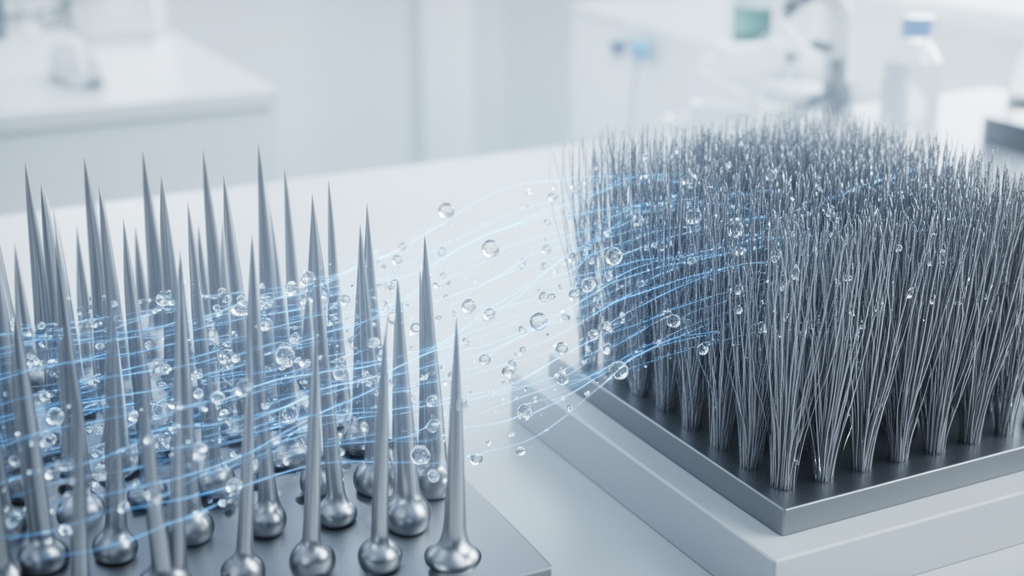
A new study published in Results in Engineering by Qiongdan Xie and colleagues compares two emitter morphologies for such corona-discharge fog collection: rigid conical copper needles and flexible carbon-fibre brushes. Sharp metallic needles are widely used because a small apex radius concentrates the local electric field and lowers the voltage needed to start a corona discharge. Carbon-fibre brushes, by contrast, consist of a 24,000-filament tow dispersed into a brush-like structure only 3 millimetres long, presenting thousands of microscopic fibre tips as potential emission sites. Brushes are flexible and corrosion resistant, and their multitip geometry may alter corona-onset behaviour. Direct experimental comparisons between the two emitter types in fog collection had remained limited, which is the gap the study addresses.
The experimental platform was adapted from the team’s previously reported apparatus. Arrays of vertically aligned emitters were arranged at centre-to-centre spacings of 1.0, 1.5, 2.0 and 2.5 centimetres, corresponding to 8 by 8, 8 by 8, 6 by 6 and 4 by 4 configurations of 64, 64, 36 and 16 emitters respectively. Both the emitter count and the array footprint changed with spacing, from 49 square centimetres at the densest setting to 56.25 square centimetres at the sparsest. The emitter-to-collector gap was fixed at 2.0 centimetres for the main experiments. Fog generated from ultrapure water was delivered at 7.9 plus or minus 0.1 grams per minute, and each condition was tested in three independent runs, with collection measured in successive two-minute windows on an electronic balance.
The current-voltage measurements revealed a fundamental contrast between the two emitter types. For copper-needle arrays, corona inception appeared at roughly 5 to 6 kilovolts, and under positive polarity the discharge current rose sharply at high voltages, particularly at the shortest 1.0-centimetre spacing. Under fog, the maximum needle-array current at that spacing fell from about 590 microamperes in dry air to about 410 microamperes at positive polarity, and from about 520 to 380 microamperes at negative polarity. The carbon-brush arrays behaved differently: their total current peaked not at the minimum spacing but at an intermediate 2.0-centimetre spacing, and fog reduced their current more severely, from more than 500 microamperes to roughly 250 microamperes at negative polarity and from about 350 to 230 microamperes at positive polarity at that spacing.
Normalising the current by emitter number clarified why. When the total current was divided by the number of needles or brushes, the 2.5-centimetre configuration produced the highest current per emitter for both materials, both polarities, and both dry-air and fog conditions, consistent with weaker mutual electric-field and space-charge shielding between widely separated tips. The dense 1.0-centimetre needle array achieved the highest total current above about 11 kilovolts mainly because its 64 needles act as parallel discharge channels, not because each needle worked harder. For the brushes, the intermediate-spacing total-current maximum reflects a balance between a larger number of brushes and the greater electrical output of each more widely separated brush. The authors fitted all 32 primary current-voltage datasets to a piecewise quadratic-onset model, obtaining coefficients of determination between 0.9926 and 0.9998, and found that fog generally reduced post-onset current growth and raised the apparent onset voltage, especially for the brushes.
Polarity effects also depended on emitter morphology. Copper-needle arrays carried slightly higher currents under positive polarity at comparable voltages, which the authors attribute to negative needle-plane corona developing through Trichel pulses, in which accumulating negative-ion space charge periodically suppresses avalanche ionisation, while positive corona can evolve toward streamer-dominated discharge. The brush arrays showed a spacing-dependent reversal: negative polarity gave higher total currents at 1.0 to 2.0 centimetres, but at 2.5 centimetres positive polarity won, reaching 328.5 microamperes at 15 kilovolts against 246.4 microamperes for negative polarity. The authors caution that this reversal cannot be reduced to a universal positive- or negative-corona advantage, and that emitter-to-emitter variability and experimental uncertainty may contribute.
Water collection told a story that current alone could not predict. For the copper needles, spacing mainly shifted the voltage at which the collection rate entered its rapid-growth regime: the 2.5-centimetre array responded earlier, consistent with its higher current per needle, while the 1.0-centimetre array responded later despite its higher total current. At high voltages all needle spacings converged toward approximately 5.5 to 6.0 grams per minute under positive polarity and 5.5 to 5.9 grams per minute under negative polarity. The carbon-brush arrays increased rapidly at lower voltages and then rose more gradually above about 10 kilovolts, with the 2.0-centimetre spacing generally producing the highest mean rates: 5.61 grams per minute at 13 kilovolts and 5.52 grams per minute at 14 kilovolts under negative polarity, and 5.73 grams per minute at 13 kilovolts under positive polarity. Because the error bars overlapped at several voltages, the authors interpret these differences descriptively rather than as statistically significant superiority.
The energy accounting adds an important practical dimension. Defining collection efficiency as the ratio of collected-water mass flow to the fog-source mass flow, the maximum rate of roughly 6.0 grams per minute corresponds to about 76 percent capture for this apparatus, a mass-flow efficiency rather than a thermodynamic one. Using the measured high-voltage-generator input power, which rose from 5.55 watts at 5 kilovolts to 7.49 watts at 14 kilovolts, the specific energy consumption of the 2.0-centimetre negative-polarity brush series fell from about 184 joules per gram at 5 kilovolts to a minimum near 10 kilovolts, where the energy-normalised yield reached approximately 48.5 grams per watt-hour. Above that voltage the collection rate plateaued while generator power kept climbing, so operating at 14 kilovolts maximised neither the water collected nor the energy efficiency. These figures include only the high-voltage supply and exclude the fog generator, fan and instrumentation, so full-system energy demands would be higher.
Spatial imaging distinguished the two morphologies further. Infrared thermography of a microporous copper-film collector showed copper needles producing increasingly resolved, regularly distributed thermal domains as voltage rose from 5 to 14 kilovolts, whereas carbon-fibre brushes produced cooler but more diffuse and less periodic patterns, plausibly because their numerous irregular fibre tips and internal shielding generate a less spatially focused ionic wind. Water-sensitive paper attached behind the film confirmed that fog droplets actually passed through the micropores under the applied field for both emitter types. Schlieren imaging of the downstream region showed voltage-dependent plume structures: the brush pair produced pronounced bright-dark structures already at 7 kilovolts, while the needle pair developed filamentary, folded structures at 11 and 13 kilovolts. The authors stress that these images are qualitative; the thermal maps do not directly measure deposition flux, and the schlieren patterns do not quantify droplet concentration, flow velocity or evaporation rate.
The broader lesson is that neither maximum emitter density nor maximum discharge current guarantees the best fog collection. Droplet charging, residence time, transport trajectories and retention on the collector surface all intervene, and at high fields the authors invoke the Rayleigh limit, at which electrostatic stress can overcome surface tension and fragment droplets into smaller, faster-evaporating daughters, potentially reducing the water ultimately collected. In their tested range, a 2.5-centimetre copper-needle spacing favoured an earlier collection response, while a 2.0-centimetre carbon-brush spacing gave the highest mean collection rates. For engineers designing electrostatic fog harvesters, the message is to consider emitter type, spacing, polarity, the onset of collection-rate growth and deposition uniformity together, rather than simply packing in more emitters or chasing the largest current.
Subject of Research: Electrostatic fog collection using copper-needle versus carbon-fibre brush corona emitters
Article Title: Comparison of copper-needle and carbon-brush emitters for corona-discharge-based fog collection
Article References: Xie, Q., Li, Y., Kong, Z., Han, Y., Xing, K., & Wang, Q. (2026). Comparison of copper-needle and carbon-brush emitters for corona-discharge-based fog collection. Results in Engineering, 32, Article 113709. https://doi.org/10.1016/j.rineng.2026.113709
Image Credits: AI Generated
DOI: 10.1016/j.rineng.2026.113709
Keywords: fog collection, corona discharge, electrostatics, water harvesting, copper needles, carbon fibre, emitter spacing, ionic wind, schlieren imaging, infrared thermography, atmospheric water, high voltage
Cite Scienmag News
Denise Maddox. (October 27, 2026). Needle or Brush? Emitter Shape Steers How Electrostatic Fog Collectors Harvest Water. Scienmag. https://scienmag.com/needle-or-brush-emitter-shape-steers-how-electrostatic-fog-collectors-harvest-water/
Denise Maddox. "Needle or Brush? Emitter Shape Steers How Electrostatic Fog Collectors Harvest Water." Scienmag, 27 October 2026, https://scienmag.com/needle-or-brush-emitter-shape-steers-how-electrostatic-fog-collectors-harvest-water/. Accessed 27 October 2026.
Denise Maddox. "Needle or Brush? Emitter Shape Steers How Electrostatic Fog Collectors Harvest Water." Scienmag. October 27, 2026. https://scienmag.com/needle-or-brush-emitter-shape-steers-how-electrostatic-fog-collectors-harvest-water/