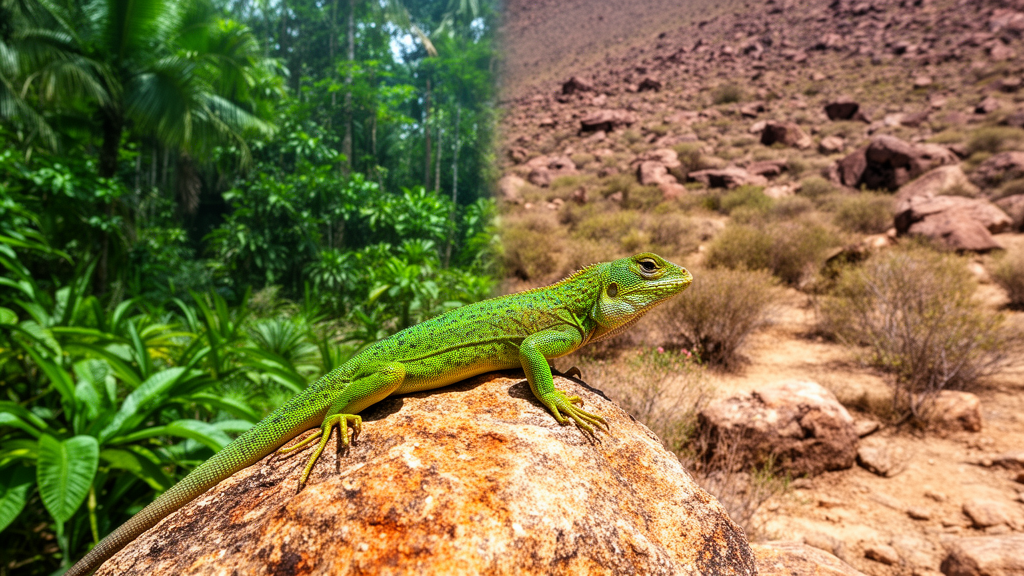
New research into the dietary ecology of Buller’s spiny lizard, Sceloporus bulleri, reveals a complex picture of foraging strategies that defies simple predictions based on elevational gradients. While initial hypotheses suggested that increasing altitude—a factor typically associated with reduced arthropod prey availability and diversity—would force lizards into narrower, more specialized dietary niches, this study found that population-level niche breadth remains remarkably stable across the broad elevational range sampled in Western Mexico. Instead, the research indicates that dietary variation and individual specialization operate independently of elevation, suggesting that microhabitat and individual foraging plasticity play critical roles in maintaining ecological balance within this widespread species.
The study focused on four distinct populations of *S. bulleri* across the Pacific slope of Jalisco, Mexico, spanning an elevational gradient from a low of 252 meters at Las Juntas y Los Veranos to a high of 1,480 meters at San Sebastián del Oeste. This extensive range provides a natural laboratory to test the niche variation hypothesis, which posits that environmental constraints, such as prey scarcity at higher altitudes, should lead to predictable shifts in lizard feeding patterns. Researchers quantified the stomach contents of 43 individuals collected across these sites, identifying 47 distinct prey types, with hymenopterans, hemipterans, and arachnids representing the most diverse groups. The methodology employed rigorous ecological techniques, including Shannon-Weiner and Simpson diversity indices to assess prey-group diversity, and Levin’s Standardized Niche Breadth Index to evaluate trophic niche breadth across the populations.
The initial predictions were clear: the low-elevation populations, benefiting from greater arthropod abundance and diversity, were expected to exhibit higher among-individual dietary variation, while high-elevation populations would show reduced variation. However, the results of the primary analyses contradicted this expectation. Statistical tests, including one-way ANOVAs, demonstrated that there were no significant differences in prey richness, mean prey items per stomach, or overall prey-group diversity among the four populations. For instance, the Shannon and Simpson diversity indices for prey groups showed no significant variation across localities (Shannon: F3,39 = 0.04, p = 0.99; Simpson: F3,39 = 0.23, p = 0.88). Furthermore, the trophic niche breadth, measured by Levin’s Standardized Index, was highly similar across all four sites, ranging from 0.80 to 0.91, indicating that each population utilized a large subset of available feeding resources in each locality, regardless of its specific elevation.
Despite the stability observed at the population level, the study uncovered significant variation at the individual level. To dissect this, the researchers utilized the Proportional Similarity Index (PSi), a metric that quantifies the dietary overlap between an individual lizard and the pooled diet of its own population. PSi ranges from 0, indicating strong individual specialization, to 1, representing a generalist diet matching the population average. The analysis revealed that populations with lower mean specialization values—specifically Las Juntas y Los Veranos and San Sebastián del Oeste—contained a proportionally higher number of dietary specialists when compared to the other two sites. This finding suggests that while the overall resource base and niche breadth of the population remain constant, the internal distribution of foraging strategies within that population is highly variable.
Further complexity emerged when examining the physical characteristics of the captured prey. The researchers classified prey based on hardness (hard, soft, intermediate) and evasiveness (evasive, sedentary, intermediate). Significant differences were found in how populations selected prey based on these physical traits. For example, the population from Talpa de Allende exhibited a preference for intermediate prey hardness and consumed fewer soft prey items than expected. Conversely, the population from Mascota showed a distinct preference for soft prey and consumed less hard prey than predicted by the contingency table. Regarding evasiveness, Las Juntas y Los Veranos lizards were found to capture and consume less intermediate-evasive prey and more highly evasive prey, while the San Sebastián del Oeste population favored intermediate-evasive prey over highly evasive ones. These localized preferences indicate that *S. bulleri* is adjusting its prey selection based on the specific arthropod communities present in its microhabitat, even if the overall taxonomic diet remains broadly conserved.
The ability of *S. bulleri* to maintain a broad, generalist population niche across such a massive elevational range, while simultaneously allowing for individual-level specialization and distinct prey-trait preferences, points toward a highly flexible foraging strategy. This flexibility may be a key mechanism enabling the species to persist across varied landscapes and potentially buffer it against interspecific dietary competition with other co-occurring sceloporine species, which occupy different microhabitats.
Methodological rigor was maintained throughout the study, including addressing potential biases related to sampling effort. Rarefaction curves and abundance-based estimators, such as Chao1, ACE, Chao2, and Jackknife1, were employed to estimate expected prey richness, controlling for the varying number of individuals captured at each site. These analyses indicated that none of the four populations were sampled to complete coverage, with observed richness representing between 47.8% and 74.8% of the estimated total prey pool.
In summary, the study of *Sceloporus bulleri* provides a nuanced view of dietary ecology, moving beyond simple correlational models. While classical trophic niche theory often predicts specialization under resource scarcity, this lizard demonstrates that population-level niche breadth can remain highly conserved across major environmental gradients.
Subject of Research: Dietary ecology and niche breadth variation in Sceloporus bulleri across elevational gradients in Mexico.
Article Title: Spatial variation in the diet of Buller’s Spiny Lizard Sceloporus bulleri from Western Mexico
Article References: Salcido-Amezola, J., Cupul-Magaña, F. G., Barraza-Soltero, I. K., & Escobedo-Galván, A. H. (2026). Spatial variation in the diet of Buller’s Spiny Lizard Sceloporus bulleri from Western Mexico. Neotropical Biology and Conservation, 21(4), 321-338. https://doi.org/10.3897/neotropical.21.e199614
Image Credits: AI Generated
DOI: 10.3897/neotropical.21.e199614
Keywords: Sceloporus bulleri, Dietary Ecology, Niche Variation, Elevational Gradient, Foraging Strategies, Trophic Niche, Mexican Wildlife, Arthropod Diversity, Individual Specialization, Spatial, variation, diet
Cite Scienmag News
Daisy Hatcher. (October 27, 2026). Lizard Diet Stability Across Elevations in Mexico Challenges Niche Variation Theory. Scienmag. https://scienmag.com/lizard-diet-stability-across-elevations-in-mexico-challenges-niche-variation-theory/
Daisy Hatcher. "Lizard Diet Stability Across Elevations in Mexico Challenges Niche Variation Theory." Scienmag, 27 October 2026, https://scienmag.com/lizard-diet-stability-across-elevations-in-mexico-challenges-niche-variation-theory/. Accessed 27 October 2026.
Daisy Hatcher. "Lizard Diet Stability Across Elevations in Mexico Challenges Niche Variation Theory." Scienmag. October 27, 2026. https://scienmag.com/lizard-diet-stability-across-elevations-in-mexico-challenges-niche-variation-theory/