


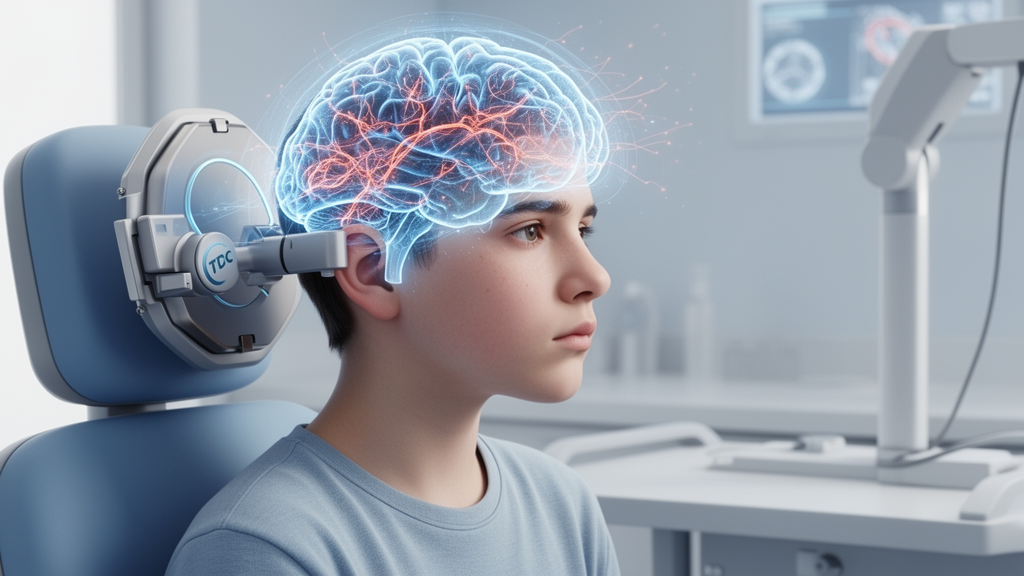
A recent randomized controlled trial investigated the therapeutic potential of integrating cognitive load-based interventions with repetitive transcranial magnetic stimulation (rTMS) to treat major depressive disorder (MDD) in adolescents, revealing that the combined approach yielded superior clinical outcomes compared to either treatment administered independently or a sham control.
The study, conducted at the Shandong Mental Health Center, involved a single-center, randomized, double-blind, sham-controlled trial design. Researchers recruited adolescents aged 11 to 18 years who were diagnosed with MDD from the outpatient department between June 2022 and December 2024. A total of sixty-four participants were randomly assigned to one of four distinct treatment arms: the combined rTMS plus cognitive load intervention group, the rTMS alone group, the cognitive load intervention group paired with sham rTMS, or a control group consisting of sham rTMS and control training.
The intervention protocols were highly specific and tailored to the participants. The combined group received 10 Hz rTMS delivered over the left dorsolateral prefrontal cortex. This stimulation was administered over 10 sessions spanning two weeks. Concurrently, participants engaged in an 8-week cognitive load program. This program utilized activities such as story writing and positive imagery, with the task difficulty being individually adjusted to meet the specific needs of each adolescent.
To assess the efficacy of these interventions, researchers measured both depression and positive affect before and after the treatment period. The primary tools employed for these measurements were the Self-Rating Depression Scale (SDS) to quantify depressive symptoms and the positive affect subscale of the Positive and Negative Affect Schedule (PANAS) to gauge emotional well-being.
The results demonstrated a clear advantage for the combined treatment strategy. The group receiving both rTMS and cognitive load intervention exhibited significantly lower depression scores following treatment, averaging 34.50 ± 3.59. This score was substantially lower than those reported by the cognitive load group (46.67 ± 10.23), the rTMS-only group (42.08 ± 9.87), and the control group (71.75 ± 8.36).
Furthermore, the combined group reported higher levels of positive affect (4.00 ± 0.54) compared to the cognitive load group (3.38 ± 0.90) and the control group (1.99 ± 0.52). The findings indicate that the synergistic effect of combining neurostimulation with targeted cognitive training leads to more robust improvements in both depressive symptoms and emotional state.
It is also noteworthy that both the single-treatment groups (rTMS alone and cognitive load intervention) demonstrated improved outcomes when compared to the control group, suggesting that both components of the intervention hold therapeutic value on their own. Crucially, the study reported no adverse events among the participants, indicating a favorable safety profile for the protocols tested.
The conclusions drawn from these preliminary findings suggest that combining left dorsolateral prefrontal cortex rTMS with cognitive load intervention provides greater reductions in depressive symptoms and larger increases in positive affect than either intervention utilized in isolation or the sham control. These results highlight a promising avenue for treating depression in adolescents.
The authors caution that these findings are preliminary and strongly warrant replication in larger, more extensive trials that incorporate longer-term follow-up to confirm the durability and generalizability of these therapeutic effects. The study was registered with the Medical Research Registration and Filing Information System under registration number MR‑37‑24‑036405.
Subject of Research: The synergistic effect of combining repetitive transcranial magnetic stimulation and cognitive load training to treat major depressive disorder in adolescents.
Article Title: The effect of transcranial magnetic stimulation combined with cognitive load training on adolescents with major depressive disorder: a randomized controlled trial
Article References: Liu, J., Zou, L., Xu, F., Chen, Z., Chen, Z., Fan, H., & Yang, L. (2026). The effect of transcranial magnetic stimulation combined with cognitive load training on adolescents with major depressive disorder: a randomized controlled trial. BMC Psychiatry. https://doi.org/10.1186/s12888-026-08805-4
Image Credits: AI Generated
DOI: 10.1186/s12888-026-08805-4
Keywords: Transcranial Magnetic Stimulation, Cognitive Load Training, Major Depressive Disorder, Adolescent Mental Health, Randomized Controlled Trial, Neuropsychology, Depression Treatment, effect, transcranial, magnetic, stimulation, combined
Cite Scienmag News
Glenn Wilkins. (October 27, 2026). Combined rTMS and Cognitive Load Training Significantly Reduces Depression in Adolescents. Scienmag. https://scienmag.com/combined-rtms-and-cognitive-load-training-significantly-reduces-depression-in-adolescents/
Glenn Wilkins. "Combined rTMS and Cognitive Load Training Significantly Reduces Depression in Adolescents." Scienmag, 27 October 2026, https://scienmag.com/combined-rtms-and-cognitive-load-training-significantly-reduces-depression-in-adolescents/. Accessed 27 October 2026.
Glenn Wilkins. "Combined rTMS and Cognitive Load Training Significantly Reduces Depression in Adolescents." Scienmag. October 27, 2026. https://scienmag.com/combined-rtms-and-cognitive-load-training-significantly-reduces-depression-in-adolescents/


