


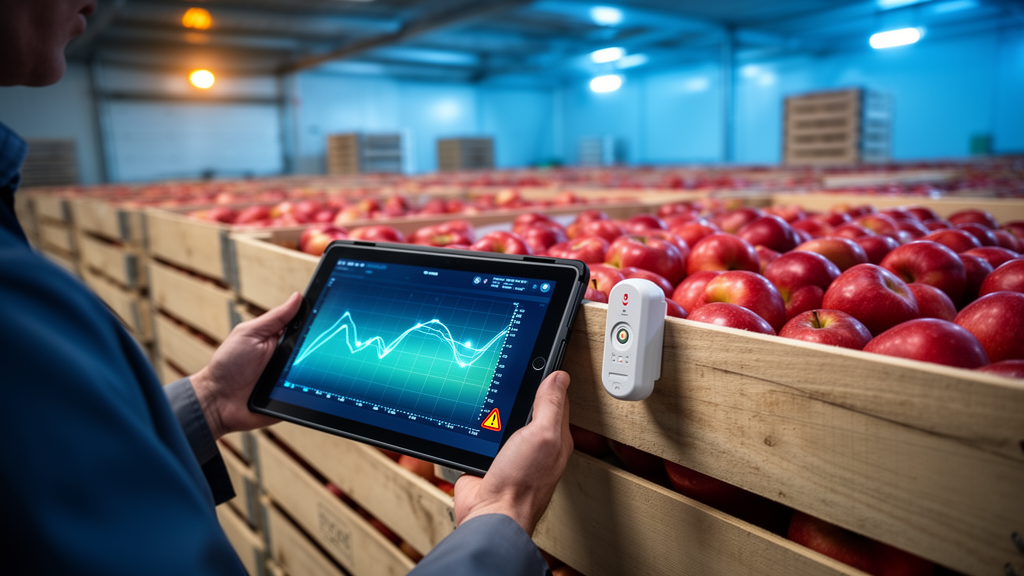
A team of South African researchers has built an artificial intelligence framework that not only forecasts when the temperature inside an apple cold room will drift out of its safe range, but also points to the likely causes before the excursion happens. The study, led by Jeremiah Taguta, Jean Frederic Isingizwe Nturambirwe and Clement Nthambazale Nyirenda at the University of the Western Cape, was published in Frontiers in Artificial Intelligence and focuses on fresh fruit and vegetable cold chains, a domain the authors describe as largely unexplored for this kind of proactive, explainable monitoring. The stakes are considerable.
Global food systems lose roughly 1.3 billion tons of food each year, about a third of all production, and fresh fruits and vegetables account for 38 percent of that waste. In South Africa, post-harvest losses during cold storage and distribution are responsible for 20 to 44 percent of fresh produce losses, and apples carry significant economic and export value for the country. Even brief temperature breaks, periods when storage conditions slip outside the acceptable band, can compromise quality, safety and shelf life, risking consignment rejection or food-borne illness.
Existing internet-of-things monitoring systems can record conditions in real time but cannot predict what will happen next, which is where machine learning enters the picture. The researchers collected data from an experimental cold room at an Agricultural Research Institute in the Western Cape holding 40 crates of sundowner apples, roughly 4,000 fruits. LoRaWAN-based sensors measured ambient temperature, humidity, pressure, carbon dioxide concentration, ambient light and motion, uploading readings to the cloud through a gateway.
Data collection ran from July to December 2024, producing an extended dataset of 3,968 rows after merging, nearly 4.1 times larger than the 966-row set used in the team's earlier conference study. Crucially, the extended data captured a far broader temperature range, from minus 0.2 degrees Celsius up to 30.2 degrees, including extreme cold-chain failure scenarios that were deliberately induced during collection rather than arising from sensor faults. All 702 break observations were upper-threshold excursions; no breaches of the lower threshold occurred, so performance at the cold end could not be assessed separately.
Eight machine learning models were compared against three statistical baselines: a persistence forecast, a three-step recent mean and a second-order autoregressive model. The model roster included a multilayer perceptron, an extreme learning machine, extreme gradient boosting, a standard gated recurrent unit, stacked and bidirectional long short-term memory networks, a bidirectional GRU, and a proposed hybrid combining an LSTM layer with a GRU layer, dubbed LSGR. The hybrid was designed to balance the LSTM's capacity for long-term memory with the GRU's computational efficiency, an arrangement suited to the unstable regimes of a working cold room.
When the models trained on the smaller dataset were tested on the extended dataset, the deep neural networks improved their R-squared by up to 30 percent and their normalized mean squared error by up to 61 percent, demonstrating strong generalization to substantially different operating conditions. The traditional models, by contrast, lost ground. The LSGR proved the most consistent deep model, ranking in the top four on both datasets, and after re-optimization on the extended data it achieved the best overall performance among the recurrent models for both temperature prediction and temperature break prediction, with temperature forecasts off by about 0.9 degrees Celsius on average.
Notably, the simple extreme learning machine topped the raw regression tables, and the statistical baselines actually beat all the learned models on one-step temperature accuracy, because cold room temperature is so strongly autocorrelated that forecasting it resembles a random walk. The real advantage of the deep models lay elsewhere. That advantage showed up in break prediction.
Predicted and actual temperatures were converted into binary classes: a break when readings fell outside the safe band of minus 0.5 to 1 degree Celsius, no break otherwise, following South African regulatory thresholds for apple storage. Every deep neural network flagged break episodes in advance, anticipating onset by between 1.25 and 1.8 hours on the two predictable test events, with the warning persisting through to onset. None of the baselines managed any advance warning, since they can only report that temperature has already left the band.
The LSGR raised the fewest false alarms, about 4.07 per day, and achieved the best precision, F1-score and accuracy among the recurrent models. The authors caution that a false alarm rate of four to five per day remains high for deployment and that requiring consecutive break predictions before alerting could reduce it, though this was not evaluated. Turning black-box predictions into actionable insight required two complementary explainability approaches.
SHAP, or SHapley Additive exPlanations, quantified how much each feature contributed to each prediction, but the researchers stress that SHAP values are inherently associational and cannot distinguish causal influence from correlation or confounding. To probe actual causal structure, they applied two time-series causal discovery algorithms, PCMCI and its extension LPCMCI, which relaxes the assumption that all relevant variables are observed. This matters in a cold room where many drivers, such as oxygen levels, external weather or door openings, go unmeasured.
The authors illustrate the distinction with a vivid example: a naive method might infer that a recent carbon dioxide reading causes a temperature change, when in fact both are being driven by an unobserved common factor such as a door opening. The causal analysis delivered a clear verdict. Both algorithms agreed that lagged temperature is the dominant causal driver of predicted temperature, followed by carbon dioxide, while ambient light was not causal under any tested condition.
LPCMCI, however, doubted most of the links PCMCI reported, removing 89.8 percent of them, and recovered only 5.7 percent of the 3,924 candidate links compared with PCMCI's 55.9 percent. The authors interpret this low detection rate as evidence that major drivers of temperature change remain unmeasured, whether as unrecorded parameters or as interactions among the four monitored ones. Robust partial correlation tests captured far more links than standard ones, and sensitivity analyses across window lengths showed that only lagged temperature was recovered at every window size, with partial reproducibility overall.
The causal findings are therefore presented as exploratory temporal links rather than established mechanisms. The framework's final layer converts prediction into prioritized action. When a break was predicted, each monitored parameter was scored using a weighted blend of its deviation magnitude from the safe range, its causal strength, and its SHAP importance, with causal features receiving a fixed bonus that placed them above all non-causal ones.
After break prediction, the three approaches converged strongly on the same top two critical parameters, temperature and humidity, achieving a top-two ranking agreement of 89.5 percent, which gives operators a consistent signal about what to fix first. The authors emphasize that the weighting scheme is a proof of concept with author-defined heuristics, not validated against expert judgement, and that the study's scope was limited to a single cold room over winter-to-early-summer months, with peak summer conditions and cross-room transfer untested. Future work will add more measured parameters, seasonal data and deployment on low-cost edge hardware.
The researchers argue that this combination of prediction, causality and explainability could reduce waste and strengthen food security from farm to fork, provided the remaining uncertainties about unmeasured drivers and real-world robustness can be resolved.
Subject of Research: Explainable deep learning for predicting temperature breaks and their causal drivers in fresh produce cold chains
Article Title: Explainable deep learning for predicting temperature breaks and identifying their causal drivers in fresh produce cold chains
Article References: Taguta, J., Nturambirwe, J. F. I., & Nyirenda, C. N. (2026). Explainable deep learning for predicting temperature breaks and identifying their causal drivers in fresh produce cold chains. Frontiers in Artificial Intelligence, 9, 1893108. https://doi.org/10.3389/frai.2026.1893108
Image Credits: AI Generated
DOI: 10.3389/frai.2026.1893108
Keywords: deep learning, cold chain, temperature break prediction, causal discovery, SHAP, LPCMCI, fresh produce, food waste, IoT sensors, apples, post-harvest losses, South Africa
Cite Scienmag News
Blake Davidson. (October 27, 2026). AI Flags Cold Chain Temperature Breaks Before They Strike Apples. Scienmag. https://scienmag.com/ai-flags-cold-chain-temperature-breaks-before-they-strike-apples/
Blake Davidson. "AI Flags Cold Chain Temperature Breaks Before They Strike Apples." Scienmag, 27 October 2026, https://scienmag.com/ai-flags-cold-chain-temperature-breaks-before-they-strike-apples/. Accessed 27 October 2026.
Blake Davidson. "AI Flags Cold Chain Temperature Breaks Before They Strike Apples." Scienmag. October 27, 2026. https://scienmag.com/ai-flags-cold-chain-temperature-breaks-before-they-strike-apples/


