


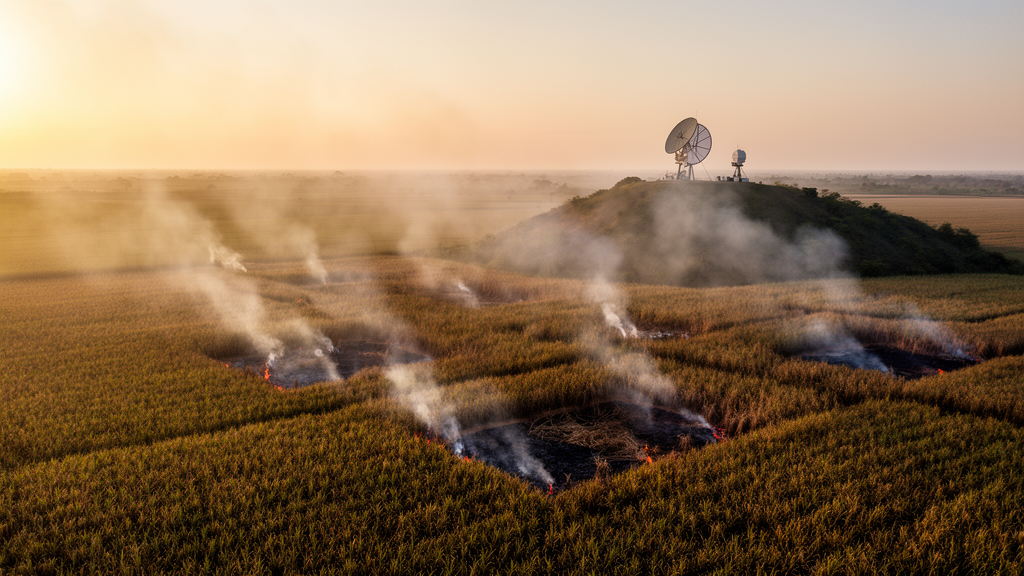
Every year before harvest, vast stretches of the world’s sugarcane belt go up in smoke. Growers burn the leafy trash that cloaks the stalks to speed manual cutting and clear the way for workers and machinery, releasing plumes of fine particulate matter, black carbon, carbon monoxide, nitrogen oxides and greenhouse gases into the atmosphere. A new systematic review of 177 primary studies, published in Frontiers in Environmental Science, has now pulled together a decade of research on those emissions, the tools used to monitor them, and the toll they take on human health, and it delivers a pointed warning: the global monitoring systems we rely on are systematically blind to the very fires that matter most in data-scarce regions such as South Africa.
The review, led by researchers at the South African National Space Agency and partner universities, followed the PRISMA 2020 reporting guidelines. The team searched Scopus and Web of Science for peer-reviewed empirical work published between 2015 and 2025, combining terms covering sugarcane cultivation, agricultural fire emissions, remote sensing platforms such as TROPOMI, MODIS and VIIRS, chemical transport models like WRF-Chem and CMAQ, and health outcomes ranging from respiratory disease to kidney injury. From 3,359 initial records, deduplication and screening against a PECO eligibility framework left a final corpus of 177 studies. Publication activity stayed above ten papers a year for most of the decade, peaking at 22 articles in 2019, with output concentrated in environmental science and atmospheric physics journals such as Atmospheric Chemistry and Physics and Atmospheric Environment.
The geography of that research is strikingly lopsided. The United States leads with 48 publications, buoyed by dense ground monitoring networks and intensive field campaigns such as FIREX-AQ in the Florida Everglades. Brazil follows with 29 studies, many tied to the evaluation of São Paulo State’s Protocolo Agroambiental, the Green Protocol that mandated a phased transition from burned to mechanical green harvesting. China and Thailand contributed 14 studies each, India nine, Mexico eight and Nicaragua six. South Africa, despite ranking among the world’s top 15 sugarcane producers with annual output exceeding 18 to 20 million tonnes concentrated in KwaZulu-Natal and Mpumalanga, accounts for just five studies, only three of which address sugarcane burning directly. That mismatch between where cane is grown and where the science gets done, the authors argue, leaves the health and air quality burdens of seasonal pre-harvest fires in southern Africa largely unquantified.
A central technical finding concerns the failure of coarse-resolution satellite products to detect small agricultural fires. Sugarcane burns are episodic and short-lived, typically lasting 30 to 60 minutes in field blocks smaller than five hectares, which places them below the detection threshold of standard polar-orbiting sensors. In comparative evaluations over Thai cropland, 10-metre Sentinel-2 burn ratio retrievals detected roughly eleven times more burned area than the MODIS product, which consistently missed fragmented field burns. At the global scale, the GloCAB cropland inventory, built from 191,560 individual fields, estimated that cropland burning averages 81 million hectares per year, more than double the 32 million hectares recorded by MODIS. Once-a-day polar overpasses compound the problem by missing over half of the diurnal variation in nitrogen dioxide and particulate pollution, precisely the early-morning and late-afternoon windows when low-intensity smoke accumulates beneath a suppressed planetary boundary layer.
Emission inventories suffer from the same blind spots. A hybrid analysis combining VIIRS active fire detections with sub-hourly diurnal fire cycles from the geostationary Himawari-8 satellite found that dry matter burned in eastern China was 100 to 400 percent higher than global inventories reported. Field-level work in Hubei showed that the widely used GFED inventory underestimated agricultural nitrogen oxide emissions by 47 percent. The root cause is generic parameterisation: global inventories rely on uncalibrated fuel loads and emission factors that do not reflect crop-specific combustion stages, residue moisture or ash composition. Controlled combustion chamber experiments confirm that sugarcane emission factors for PM2.5, black carbon, carbon monoxide, nitrogen oxides, nitrous oxide, heavy metals and carcinogenic polycyclic aromatic hydrocarbons vary drastically between the pre-ignition, flaming and smouldering phases, making locally measured factors essential for accurate modelling.
The health evidence assembled in the review is sobering. Epidemiological studies in São Paulo linked daily spikes in PM10 and nitrogen dioxide from pre-harvest burning to increased paediatric hospitalisations for pneumonia and asthma, and spatial difference-in-differences modelling showed that smoke spillovers raise respiratory admissions in neighbouring non-producing districts, making the total public health impact 78 percent larger than models focused on producing areas alone had suggested. Econometric analysis found that in-utero exposure to sugarcane fire emissions reduces birth weight and shortens pregnancy duration, while fire-driven pollution was associated with a 28 to 40 percent increase in respiratory hospitalisations among children and the elderly. Health impact modelling in India associated seasonal residue burning with elevated adult mortality from chronic obstructive pulmonary disease, lung cancer and ischemic heart disease, and life cycle assessments in Thailand attributed 732,065 disability-adjusted life years and 425 billion Baht in annual economic costs to open crop residue burning.
Occupational exposures are equally severe. Personal breathing-zone sampling on Nicaraguan harvesters recorded respirable dust concentrations of 1.9 milligrams per cubic metre and black carbon at 13.7 micrograms per cubic metre, with 96 percent of airborne burn particles small enough to penetrate deep into the alveolar airways. Cytogenetic biomonitoring of buccal epithelial cells in Mexican workers showed that ash and polycyclic aromatic hydrocarbon exposure induces chromosomal damage, while ocular cytology revealed eye surface injury and altered mucin gene expression from hot ash. Most striking is the kidney research: toxicological experiments in rats and in human proximal tubule cell cultures demonstrated that silica nanoparticles roughly 200 nanometres across, inhaled from sugarcane ash, can travel through the bloodstream to the kidneys, causing tubular cell death, chronic fibrosis and reduced mitochondrial energy production. Prospective clinical studies found that 18.5 to 21 percent of harvesters develop acute kidney injury during a single work shift, driven by dehydration, heat strain and toxic exposure, a mechanism implicated in the epidemic of chronic kidney disease of non-traditional origin among agricultural workers.
Heat compounds the chemical hazard. Field measurements of Wet Bulb Globe Temperature exceeded safety thresholds for 72.7 to 90.9 percent of working shifts among Thai cane cutters, who spend 13 to 15 percent of their shifts at extreme exertion intensities reaching core temperatures of 38.1 to 38.2 degrees Celsius. Yet the review also documents a proven countermeasure: multi-year workplace intervention trials showed that structured Rest-Shade-Hydration protocols, providing hourly 20-minute breaks in shaded tents with cold water and electrolytes, cut incident kidney injury among burned cane cutters from 21 percent down to 1 percent over four harvest seasons while raising cutting productivity by 9 to 19 percent.
On the monitoring side, the review charts a rapidly evolving toolkit. TROPOMI retrievals over São Paulo State captured acute atmospheric formaldehyde spikes exceeding 2.0 times ten to the minus four moles per square metre during the burning season, and the geostationary GEMS spectrometer now delivers hourly trace gas observations that reveal diurnal nitrogen dioxide variations exceeding 50 percent. Machine learning is increasingly woven into these systems: data fusion and random forest approaches improved the correlation of wildfire smoke estimates against ground monitors to 0.95, and deep neural networks trained on satellite aerosol optical depth and 52 ground stations across Equatorial Asia estimated 150,000 to 204,000 annual premature deaths attributable to chronic fine particulate exposure. Chemical transport models such as WRF-Chem and CMAQ simulate plume transport and secondary aerosol formation, and satellite imagery proved decisive in verifying that São Paulo’s Green Protocol cut sugarcane fire carbon dioxide emissions to 4.1 percent of their 2010 peak by 2014.
The review’s closing argument is that technology is not the bottleneck; data are. Across 520 coded mentions of technical challenges, environmental interference such as cloud cover and complex terrain, and input data gaps dominated, while purely computational limits were cited least often. The authors call for a multi-tier strategy coupling high-resolution Sentinel-2 burn scar mapping and sub-hourly geostationary fire tracking with rural low-cost sensor networks, locally derived sugarcane emission factors and workplace health surveillance. For South Africa, where environmental authorities operate under the National Environmental Management: Air Quality Act without a crop-specific empirical baseline, such integration could extend the existing South African Air Quality Information System into the agricultural districts it currently cannot see, and give regulators, farmers and harvesters alike a clearer view of the smoke they live and work within.
Subject of Research: Systematic review of sugarcane pre-harvest burning emissions, satellite monitoring methods and environmental and health impacts
Article Title: Sugarcane burning: a systematic review of emissions, monitoring approaches, and environmental and health impacts
Article References: Molefe, M., Shikwambana, L., Xulu, S., & Dube, L. T. (2026). Sugarcane burning: a systematic review of emissions, monitoring approaches, and environmental and health impacts. Frontiers in Environmental Science, 14, Article 1956965. https://doi.org/10.3389/fenvs.2026.1956965
Image Credits: AI Generated
DOI: 10.3389/fenvs.2026.1956965
Keywords: sugarcane burning, air quality, PM2.5, remote sensing, emission inventories, black carbon, acute kidney injury, chronic kidney disease, South Africa, systematic review, Sentinel-2, occupational health
Cite Scienmag News
Violet Maxwell. (October 27, 2026). Satellites Miss Most Sugarcane Fires, Systematic Review Finds. Scienmag. https://scienmag.com/satellites-miss-most-sugarcane-fires-systematic-review-finds/
Violet Maxwell. "Satellites Miss Most Sugarcane Fires, Systematic Review Finds." Scienmag, 27 October 2026, https://scienmag.com/satellites-miss-most-sugarcane-fires-systematic-review-finds/. Accessed 27 October 2026.
Violet Maxwell. "Satellites Miss Most Sugarcane Fires, Systematic Review Finds." Scienmag. October 27, 2026. https://scienmag.com/satellites-miss-most-sugarcane-fires-systematic-review-finds/


