


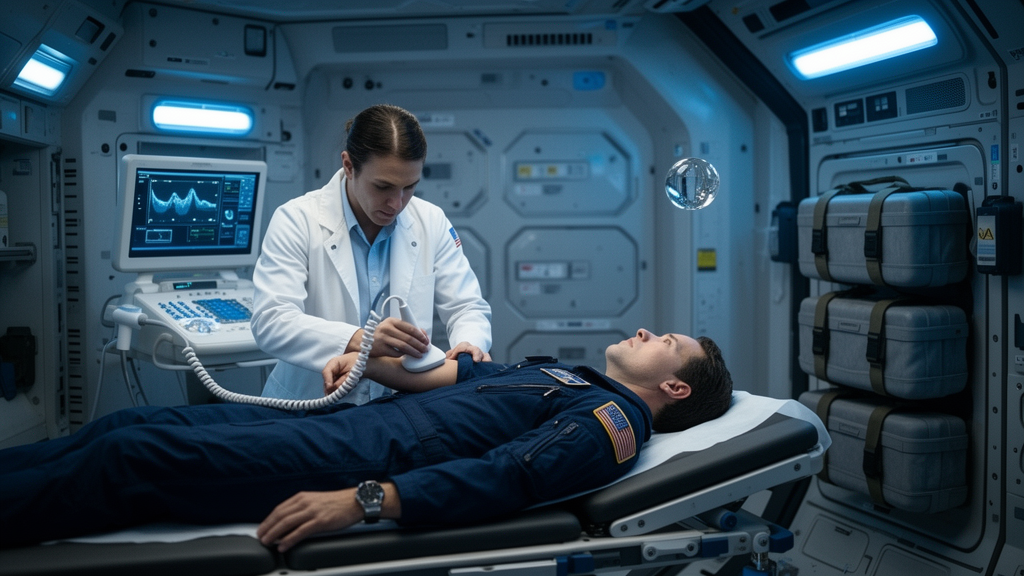
Human exploration beyond low Earth orbit fundamentally alters the core assumptions of healthcare delivery, and a new collection of research argues that the medical systems carried on future deep-space missions cannot simply be adapted versions of the devices used in hospitals on the ground. An editorial published in Frontiers in Space Technologies on 26 October 2026, introducing a Research Topic on innovation in medical space technology, brings together thirteen contributions spanning medical systems, physiological countermeasures, pharmacology, behavioural health, digital medicine, and resource sustainability. Taken together, the editors argue, these works show that future medical capability will emerge not from isolated gadgets but from the integration of technology, clinical evidence, mission operations, and human performance into a single, coherent mission capability.
Once a crew travels beyond low Earth orbit, communication delays reduce the timeliness of ground support and limit its operational availability. Evacuation may no longer be possible at all. Resupply becomes infrequent or unavailable.
Healthcare delivery must therefore become increasingly self-reliant, and every clinical decision must account for strict constraints on mass, volume, power, data, consumables, and crew time. These pressures weaken the operational connection with Earth, which has historically served as the central link between crews in space and ground-based expertise. In the editors' framing, this is precisely why innovation in space medicine must extend far beyond porting terrestrial devices to spacecraft: it requires a fundamental redesign of many medical technologies and of the broader healthcare system into which they are integrated.
Onboard medical capabilities must support prevention, monitoring, diagnosis, treatment, behavioural health, and recovery, and ideally should connect these functions through shared data, resources, and decision pathways. A first theme running through the Research Topic concerns the transition from individual medical devices to integrated healthcare architectures. Lewandowski and colleagues review NASA's work on modifying, developing, and demonstrating medical technologies for exploration missions.
Their contribution shows that commercial devices may provide useful foundations, but that mission-specific constraints often require substantial adaptation and validation before such equipment can be trusted in flight. This finding matters because it punctures a tempting assumption: that the fastest route to a deep-space medical kit is simply to buy off-the-shelf hardware and pack it aboard. The review suggests instead that the gap between a functional commercial product and a flight-qualified medical system is wide, and that closing it demands deliberate engineering and testing against the realities of exploration missions.
Digital integration emerges as equally important in the collection. Kerremans and colleagues examine artificial intelligence techniques for monitoring, imaging, prediction, and decision support. Crucially, they position AI as a complement to telemedicine and clinical judgement rather than a replacement for either.
That framing is significant for mission planning: rather than imagining an autonomous onboard physician algorithm, the work points toward systems that extend the reach of scarce human expertise, supporting decisions when Earth-based specialists are minutes or hours away rather than seconds. Implementing these technologies, the editors stress, requires robust empirical evidence and strictly defined operational autonomy. Dino and colleagues map the current aerospace-health literature and identify a broad but uneven field.
Their synthesis highlights the need for more empirical validation, wider geographical participation, and greater attention to psychosocial and higher-order health needs. In other words, the literature that will underpin future autonomous medical care is still developing in uneven ways, with some domains well covered and others, particularly the psychological and social dimensions of health far from Earth, comparatively thin. The call for wider geographical participation also signals that the evidence base should not rest on a narrow set of spacefaring nations and populations if it is to support crews drawn from an increasingly international exploration enterprise.
A second theme concerns countermeasures that preserve human performance, and here the collection connects neurological science directly to operational outcomes. Soto and Vega examine galvanic vestibular stimulation as a potential non-invasive countermeasure for disorientation, impaired balance, and other sensorimotor effects of microgravity. Treatment efficacy, the collection argues, must be evaluated alongside treatment-related impairment.
Geimer and colleagues demonstrate the value of the psychomotor vigilance task for assessing both motion sickness and the performance effects of medication. The distinction is operationally important: reducing symptoms is insufficient if the intervention also compromises attention or reaction speed. By using a validated performance measure to evaluate both the illness and the cure, the approach gives flight surgeons and mission planners a way to weigh the full operational cost of a treatment rather than only its symptomatic benefit.
Looking further into the future, Weissman and colleagues consider quasi-torpor as a possible strategy for reducing metabolic demand, consumable use, and psychological burden during long missions. The editors are careful to note that the concept remains early-stage and has not been demonstrated for prolonged use in humans. Nevertheless, they argue, it illustrates how medical interventions could eventually influence mission architecture itself.
This is a striking inversion of the usual relationship between medicine and engineering: instead of designing a spacecraft around fixed physiological needs, a medical capability that lowers metabolic demand could reshape how much food, oxygen, water, and habitable volume a mission must carry, potentially changing vehicle design and mission profiles in fundamental ways. A third theme addresses medical independence through better management of resources and pharmaceuticals, an area where hygiene, hydration, and waste management converge into single operational problems. Etlin and colleagues propose an in-suit system for urine collection and water recovery during extravehicular activity, combining hygiene, hydration, waste management, and resource circularity within one integrated design.
Pharmaceutical capability presents a similarly interconnected challenge. Barchetti and colleagues identify major uncertainties in drug stability, pharmacokinetics, pharmacodynamics, and individual response during spaceflight, underscoring how little is known about whether medicines behave in orbit and deep space as they do on Earth. Blum and colleagues extend this discussion through the concept of an on-demand Astropharmacy, and their database of peptide and protein medications provides a foundation for evaluating which biologics may be suitable for local production during deep-space missions.
A fourth theme places the human experience at the centre of technology development, reminding readers that adaptation to space is physiological, psychological, social, and cultural at once. Schlosser and colleagues propose a classification system for assessing the fidelity of analogue environments used in behavioural-health and human-factors research, reinforcing a critical principle: analogue findings matter only when the simulated features relate to the research question. Reuse and Baatout treat culturally familiar food as a potential design attribute of space-food systems, distinguishing biological pathways from psychosocial mechanisms involving identity, familiarity, agency, and social connection.
Ferraz expands the temporal horizon by considering early human development and multidimensional enhancement in future space populations. Across the entire Research Topic, however, one limitation remains clear: much of the available evidence originates from terrestrial medicine, analogue environments, short-duration studies, or conceptual frameworks, and small astronaut populations with heterogeneous mission conditions further constrain validation. Findings must therefore be translated with caution across differing environments and mission profiles.
The editors call for future research to establish traceable validation pathways from laboratory studies to analogues, low Earth orbit, and exploration missions, and to integrate interoperable medical data, human-centred automation, pharmaceutical resilience, behavioural health, and resource management, determining when a technology is not merely functional but clinically useful and operationally sustainable. The central lesson, they conclude, is that medical innovation for space is not a collection of isolated devices but a mission capability, a multidisciplinary frontier that relies on coordinated contributions from diverse clinical, scientific, and engineering fields. Understanding how to keep humans alive, healthy, and capable beyond Earth is not just one component of deep-space exploration; it is what makes deep-space exploration possible.
Subject of Research: Innovation in medical space technology for human deep-space exploration
Article Title: Editorial: Innovation in medical space technology
Article References: Cinelli, I., Das, S., & Oluwafemi, F. A. (2026). Editorial: Innovation in medical space technology. Frontiers in Space Technologies, 7, Article 2030417. https://doi.org/10.3389/frspt.2026.2030417
Image Credits: AI Generated
DOI: 10.3389/frspt.2026.2030417
Keywords: space medicine, deep-space exploration, medical technology, artificial intelligence, telemedicine, pharmacology, behavioural health, countermeasures, resource sustainability, astronaut health, mission architecture, analogue research
Cite Scienmag News
Glenn Wilkins. (October 27, 2026). Beyond Earth: Why Deep-Space Medicine Must Be Rebuilt From First Principles. Scienmag. https://scienmag.com/beyond-earth-why-deep-space-medicine-must-be-rebuilt-from-first-principles/
Glenn Wilkins. "Beyond Earth: Why Deep-Space Medicine Must Be Rebuilt From First Principles." Scienmag, 27 October 2026, https://scienmag.com/beyond-earth-why-deep-space-medicine-must-be-rebuilt-from-first-principles/. Accessed 27 October 2026.
Glenn Wilkins. "Beyond Earth: Why Deep-Space Medicine Must Be Rebuilt From First Principles." Scienmag. October 27, 2026. https://scienmag.com/beyond-earth-why-deep-space-medicine-must-be-rebuilt-from-first-principles/


