


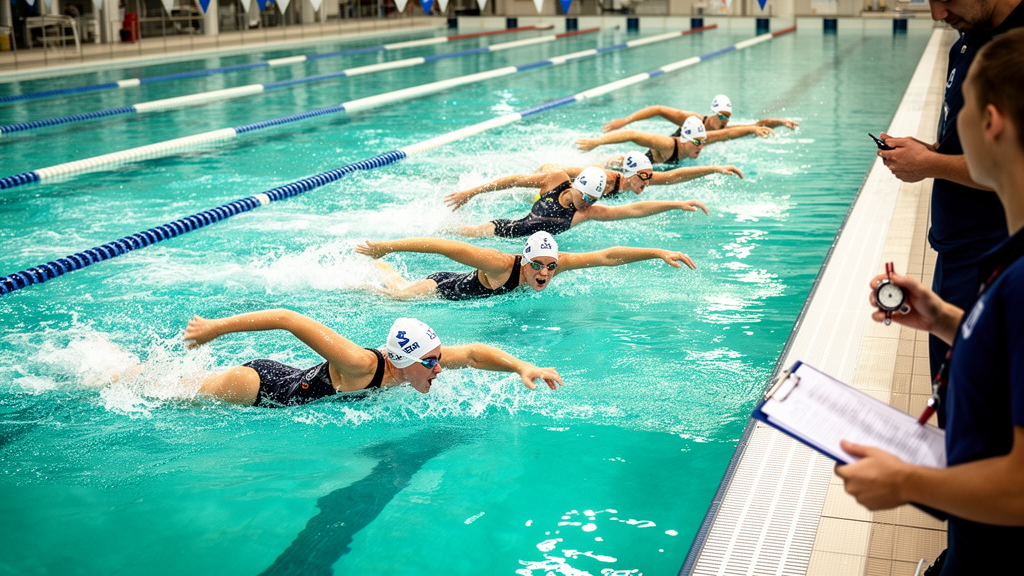
Elite swimmers rarely get to peak just once a season anymore. Modern competition calendars increasingly demand two or more top performances within a single year, a scenario that strains traditional periodization models built around a single annual target. A new longitudinal collective case study, published in Frontiers in Physiology, followed five elite female middle- and long-distance freestyle swimmers across a full 52-week macrocycle designed to produce two competitive peaks at national championships, and mapped how their training intensity, blood chemistry and race results changed along the way.
The research team, based at Beijing Sport University with collaborators at Yale University and Shaoguan University, structured the season around three altitude training camps interspersed with sea-level integration phases and two timed tapers. Training intensity distribution, a metric that has become central to contemporary endurance coaching, was quantified using a three-zone lactate-threshold model, with load descriptors referring to in-water swimming only.
The pattern shifted across the season. During base development phases, the distribution was pyramidal, with most volume concentrated in moderate-intensity work. During the altitude blocks, it became polarized, emphasizing large amounts of easy swimming punctuated by very hard efforts.
In the race-pace sharpening phases before competition, the distribution tilted toward threshold-oriented work. Blood markers were sampled at four time points across the year, tracking hemoglobin, hematocrit, red blood cell count, creatine kinase and cortisol. The hematological effect sizes were largest at Week 27, coinciding with the altitude training period.
Red blood cell count showed a Hedges’ g of 2.32 with a 95 percent confidence interval of 0.64 to 4.01, and hematocrit reached g = 2.04 with a confidence interval of 0.50 to 3.58. These are concentration-based indices, meaning they reflect relative proportions in the blood volume rather than absolute cell mass, a distinction the authors emphasize carefully.
By contrast, creatine kinase and cortisol peaked at Week 17, during a period of heavy loading, and had returned closer to baseline by Week 49. The authors interpret this pattern as compatible with a lower physiological stress state at the later sampling point, consistent with the reduced training load of the taper leading into the second championship. Performance outcomes were assessed through time trials and official competition results. Because the sample contained only five athletes, the researchers prioritized a smallest-worthwhile-change classification for performance, paired with effect sizes and 95 percent confidence intervals for blood markers, rather than null-hypothesis significance testing.
They set the smallest-worthwhile-change threshold at approximately 0.24 percent of performance time. Across 20 athlete-by-event observations, 12 of 20, or 60 percent, exceeded the threshold at the first competition, while 18 of 20, or 90 percent, did so at the second. Most of these changes represented improvements over baseline, and the ordering held across the full defensible range of reference variability, from 0.22 to 0.42 percent.
One of the most striking features of the data was the marked inter-individual heterogeneity in both performance and physiological responses. The authors are explicit about the limitations of their design. With no control group, no randomization, only five participants and just four blood sampling points, alongside several simultaneous interventions and unmeasured confounders including iron status, menstrual-cycle phase and dryland training load, the findings describe associations only.
They present the work as exploratory and hypothesis-generating, drawn from a single elite squad rather than as causal evidence about what any particular periodization strategy achieves. Even so, the detailed season-long map of intensity distribution shifts, hematological responses and competition outcomes offers a rare window into how an elite female distance squad navigated a demanding double-peak year, and a template for the kinds of longitudinal monitoring studies that could eventually test these approaches more rigorously.
Subject of Research: Periodized training, altitude camps and blood marker responses in elite female distance swimmers preparing for two national competitions
Article Title: Collective case study on periodized training in elite female middle- and long-distance swimmers preparing for national competition
Article References: GAO, T., Li, J., Shan, X., Lyu, J., Huang, D., & Gao, J. (2026). Collective Case Study on Periodized Training in Elite Female Middle-and Long-Distance Swimmers Preparing for National Competition. Frontiers in Physiology, 17, 1943799. https://doi.org/10.3389/fphys.2026.1943799
Image Credits: AI Generated
DOI: 10.3389/fphys.2026.1943799
Keywords: elite swimming, periodization, altitude training, training intensity distribution, hematological markers, creatine kinase, cortisol, tapering, double-peak season, case study, exercise physiology, female athletes
Cite Scienmag News
Bethany Barker. (October 27, 2026). Five Elite Female Distance Swimmers Tracked Through a Double-Peak Season. Scienmag. https://scienmag.com/five-elite-female-distance-swimmers-tracked-through-a-double-peak-season/
Bethany Barker. "Five Elite Female Distance Swimmers Tracked Through a Double-Peak Season." Scienmag, 27 October 2026, https://scienmag.com/five-elite-female-distance-swimmers-tracked-through-a-double-peak-season/. Accessed 27 October 2026.
Bethany Barker. "Five Elite Female Distance Swimmers Tracked Through a Double-Peak Season." Scienmag. October 27, 2026. https://scienmag.com/five-elite-female-distance-swimmers-tracked-through-a-double-peak-season/


