


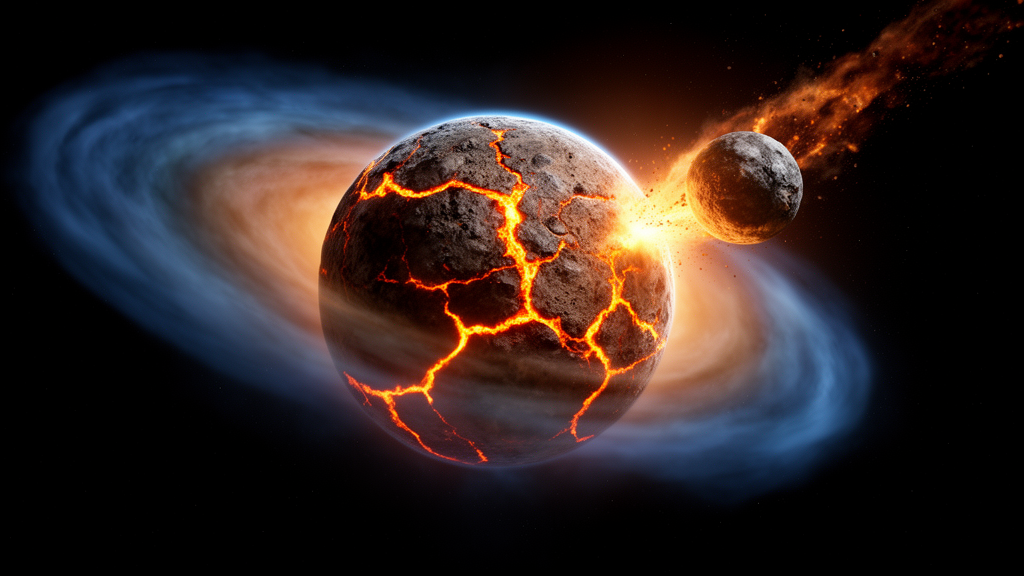
When a rocky planet is struck by a giant impactor late in its formation, the conventional expectation has been that the collision strips away the planet's primordial, hydrogen-rich atmosphere. A new modelling study by Darius Modirrousta-Galian and Jun Korenaga, published in Nature Astronomy, reaches the opposite conclusion: giant impacts may actually favour the retention of these atmospheres, because they increase a planet's gravitational grip on its gas more than they heat the mantle that would otherwise drive the gas away. The puzzle the authors set out to resolve is a genuine tension in planet-formation theory.
Earth-sized and larger rocky planets are expected to experience at least one giant collision during the final stages of assembly, and some of these occur after the protoplanetary disk has dissipated. Such impacts raise surface temperatures, which should promote atmospheric loss, yet they also add mass and therefore deepen the gravitational potential well that binds the atmosphere. Which effect wins had remained unclear.
To answer the question, the researchers modelled the evolution of rocky planets following their largest post-disk giant impact, treating the gravitational binding energy and the mantle's thermal energy self-consistently and simultaneously. The key insight lies in how impact energy is partitioned. The entire accreted mass contributes to the increase in gravitational binding energy, but only part of the impact energy raises the mantle's temperature.
Several processes absorb the thermal budget: mantle melting consumes energy as latent heat, and the impactor's metallic core, being dense, sinks and transfers little energy to the mantle, remaining superheated at depth. The net result is that a giant impact shifts a planet's energy balance toward atmospheric retention rather than loss. This asymmetry has consequences for which planets survive with their atmospheres intact.
Larger, atmosphere-bearing planets emerge preferentially through collisional growth, according to the models. By contrast, smaller planets that never experience such an impact tend to lose their primordial atmospheres under sustained irradiation from their host stars, as the stellar energy input gradually erodes gas that is only weakly bound to a low-mass body. At the population level, the findings carry a provocative prediction: sub-Neptunes should, on average, possess more massive rocky interiors than super-Earths.
If the models are correct, the division between the two populations is shaped substantially by whether or not a planet underwent a late giant impact. The work speaks directly to one of the most striking patterns in exoplanet science, the bimodal radius distribution in which close-in planets cluster around two distinct size classes with a relative scarcity of planets in between. Understanding how primordial atmospheres are gained or lost through impacts, rather than solely through stellar heating, offers an additional mechanism that could help explain why that gap exists.
As with any modelling study, the conclusions rest on the assumptions built into the simulations, including how impact energy is partitioned between the mantle, the impactor's core, and the atmosphere. The authors' figures examine post-impact surface temperatures, the probability of complete atmospheric loss, and how alternative giant-impact assumptions alter the predicted radius distributions, providing a framework that future observations of exoplanet masses and radii can test. If the prediction holds, the giant impacts that once seemed destined to strip young planets bare may instead have been the very events that allowed them to hold on to their first atmospheres.
Subject of Research: Modelling of primordial atmosphere retention on rocky planets during giant impacts
Article Title: Retention of primordial atmospheres through giant impacts
Article References: Modirrousta-Galian, D., & Korenaga, J. (2026). Retention of primordial atmospheres through giant impacts. Nature Astronomy. https://doi.org/10.1038/s41550-026-03006-1
Image Credits: AI Generated
DOI: 10.1038/s41550-026-03006-1
Keywords: exoplanets, giant impacts, primordial atmospheres, sub-Neptunes, super-Earths, planet formation, mantle melting, gravitational binding energy, atmospheric escape, Nature Astronomy, Retention, primordial
Cite Scienmag News
Grant Pearson. (October 27, 2026). Giant impacts may help rocky planets keep their primordial atmospheres. Scienmag. https://scienmag.com/giant-impacts-may-help-rocky-planets-keep-their-primordial-atmospheres/
Grant Pearson. "Giant impacts may help rocky planets keep their primordial atmospheres." Scienmag, 27 October 2026, https://scienmag.com/giant-impacts-may-help-rocky-planets-keep-their-primordial-atmospheres/. Accessed 27 October 2026.
Grant Pearson. "Giant impacts may help rocky planets keep their primordial atmospheres." Scienmag. October 27, 2026. https://scienmag.com/giant-impacts-may-help-rocky-planets-keep-their-primordial-atmospheres/


