


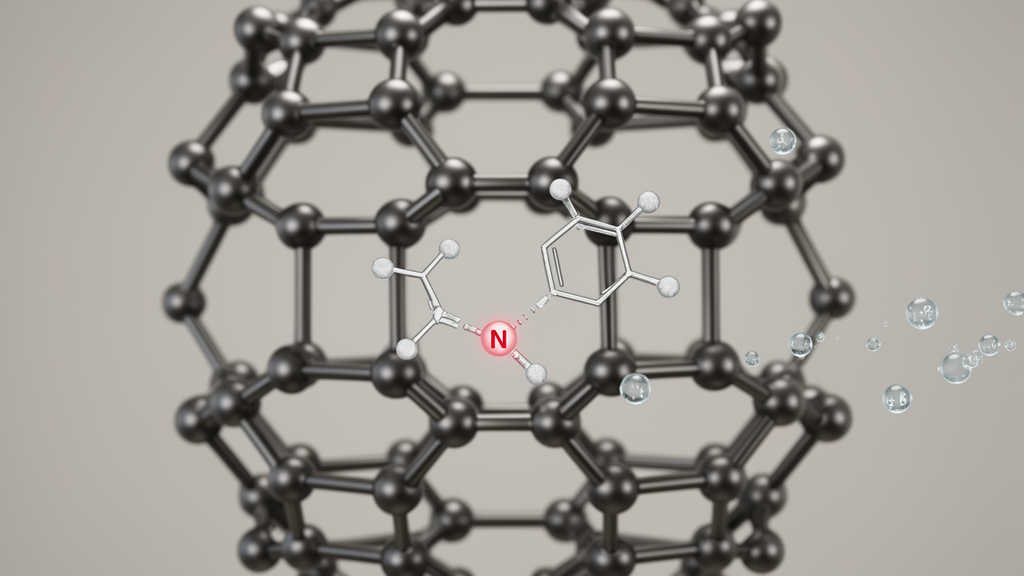
Chemists have engineered an iron-based metal-organic framework that can degrade stubborn water pollutants using only trace amounts of hydrogen peroxide, according to a study published in Nature Communications. The material, dubbed N/MIL-53(Fe), incorporates pyridine nitrogen atoms into the secondary coordination sphere around the iron active sites, and this subtle structural change allowed roughly 90 percent of added hydrogen peroxide to be converted into reactive hydroxyl species during Fenton-like water treatment. The Fenton-like reaction is a mainstay of advanced oxidation processes for water decontamination, in which iron catalysts split hydrogen peroxide to generate hydroxyl radicals that attack organic contaminants.
Two long-standing problems have limited its efficiency: the high energy barrier of the oxygen-oxygen bond cleavage in peroxide, and the short lifetime of free hydroxyl radicals, which often decay before they encounter pollutant molecules. The research team, led by Limin Duan and Kun Yang with colleagues including Zhihui Fu and Daohui Lin, addressed both obstacles at once through the secondary coordination sphere, the chemical environment just beyond the metal's direct bonding partners. In N/MIL-53(Fe), pyridine nitrogen sites interact strongly with the key adsorbed hydroxyl intermediates that form on the catalyst surface during peroxide activation.
According to the study, this interaction lowers the barrier for homolytic cleavage of the peroxide oxygen-oxygen bond, so more peroxide is actually activated rather than wasted. Just as importantly, the nitrogen environment favors the in-situ generation of long-lived adsorbed hydroxyl species instead of fleeting free radicals. Adsorbed hydroxyl accounted for over 90 percent of the total hydroxyl produced, meaning the reactive species stay anchored where pollutants can reach them.
The performance numbers reported for contaminant degradation are striking. Working with a trace hydrogen peroxide dose of 0.5 millimolar, the catalyst achieved 98 percent degradation within five minutes for a suite of representative micropollutants: bisphenol A, tetracycline, phenol, p-chlorophenol and ciprofloxacin. The authors report that the hydrogen peroxide consumption of N/MIL-53(Fe) was equivalent to only 3 to 10 percent of that required by previously reported Fenton-like catalysts for comparable treatment.
The findings, published as an open-access article on 26 October 2026, point to an efficient pathway for treating contaminated water with minimal oxidant input.
Subject of Research: Engineering the secondary coordination sphere of an iron-based metal-organic framework to enable trace-hydrogen-peroxide Fenton-like water decontamination
Article Title: Trace H2O2-triggered Fenton-like reaction by secondary coordination sphere in iron-based metal-organic frameworks
Article References: Duan, L., Fu, Z., Wang, J., Jiang, H., Cai, B., Jiang, K., Wu, W., Lin, D., & Yang, K. (2026). Trace H2O2-triggered Fenton-like reaction by secondary coordination sphere in iron-based metal-organic frameworks. Nature Communications. https://doi.org/10.1038/s41467-026-79095-3
Image Credits: AI Generated
DOI: 10.1038/s41467-026-79095-3
Keywords: Fenton-like reaction, metal-organic frameworks, hydrogen peroxide, hydroxyl radicals, water decontamination, secondary coordination sphere, advanced oxidation processes, iron catalyst, micropollutants, Nature Communications, Trace, H2O2-triggered
Cite Scienmag News
Bethany Barker. (October 27, 2026). Pyridine Nitrogen Tweaks Iron Framework to Squeeze Hydroxyl Radicals from Trace Hydrogen Peroxide. Scienmag. https://scienmag.com/pyridine-nitrogen-tweaks-iron-framework-to-squeeze-hydroxyl-radicals-from-trace-hydrogen-peroxide/
Bethany Barker. "Pyridine Nitrogen Tweaks Iron Framework to Squeeze Hydroxyl Radicals from Trace Hydrogen Peroxide." Scienmag, 27 October 2026, https://scienmag.com/pyridine-nitrogen-tweaks-iron-framework-to-squeeze-hydroxyl-radicals-from-trace-hydrogen-peroxide/. Accessed 27 October 2026.
Bethany Barker. "Pyridine Nitrogen Tweaks Iron Framework to Squeeze Hydroxyl Radicals from Trace Hydrogen Peroxide." Scienmag. October 27, 2026. https://scienmag.com/pyridine-nitrogen-tweaks-iron-framework-to-squeeze-hydroxyl-radicals-from-trace-hydrogen-peroxide/


