


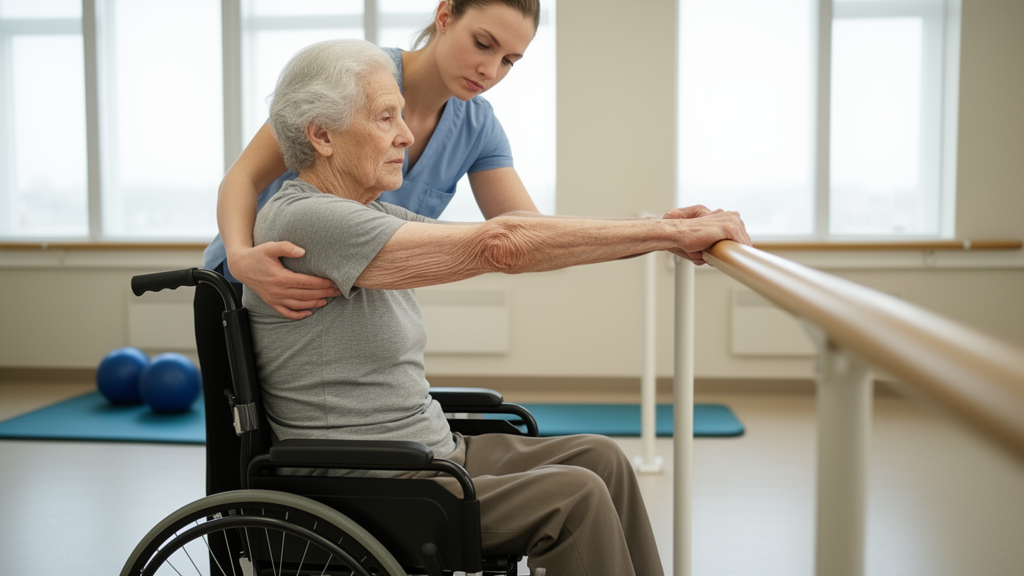
Roughly one in four adults undergoing rehabilitation after a stroke meets the criteria for confirmed sarcopenia, according to a cross-sectional study of 209 stroke survivors admitted for neurological rehabilitation. Using the European Working Group on Sarcopenia in Older People 2 (EWGSOP2) algorithm, the researchers identified confirmed sarcopenia in 55 of 209 participants, a prevalence of 26.3 percent with a 95 percent confidence interval of 20.6 to 32.8 percent. The diagnosis followed the full EWGSOP2 pathway, combining the SARC-CalF screening questionnaire with handgrip strength measurements, the five-times sit-to-stand test, broader physical performance measures, and appendicular skeletal muscle mass quantified by dual-energy X-ray absorptiometry (DXA).
Requiring DXA-confirmed low muscle mass means the 26.3 percent figure reflects confirmed sarcopenia rather than screening-positive cases alone, strengthening the estimate against overdiagnosis. Participants with sarcopenia were older, had lower body mass index, poorer physical performance, and greater motor impairment than those without the condition. To separate genuinely independent associations from overlapping clinical features, the team ran bivariate analyses followed by a multivariable logistic regression model.
Each one-unit decrease in BMI was linked to lower odds of sarcopenia (odds ratio 0.70; 95 percent CI 0.59 to 0.83), a positive SARC-CalF screening result raised the odds more than sixfold (OR 6.37; 95 percent CI 2.03 to 20.05), and each point lower on the Short Physical Performance Battery (SPPB) was associated with reduced odds (OR 0.83; 95 percent CI 0.69 to 0.99). Motor impairment severity, categorized with the Fugl-Meyer assessment, was also independently associated with sarcopenia in the model. The authors conclude that post-stroke sarcopenia is closely linked to functional impairment during rehabilitation and that integrating muscle health assessment with functional evaluation could sharpen clinical decision-making.
Still, the finding that a simple screening tool and routinely collected measures such as BMI and SPPB score flag the highest-risk patients suggests early identification within rehabilitation programs may support more individualized treatment strategies.
Subject of Research: Prevalence and associated factors of confirmed sarcopenia among stroke patients undergoing rehabilitation
Article Title: Prevalence and factors associated with sarcopenia in individuals with stroke undergoing rehabilitation: A cross-sectional study
Article References: Ida, F. S., Silva, E. J. D. M. C. E., Brasil, G. D. S. M., Peregrino, L. M., Silva, C. E. P. D., & Silva, P. Y. F. (2026). Prevalence and factors associated with sarcopenia in individuals with stroke undergoing rehabilitation: A cross-sectional study. PLOS One, 21(10), e0361113. https://doi.org/10.1371/journal.pone.0361113
Image Credits: AI Generated
DOI: 10.1371/journal.pone.0361113
Keywords: sarcopenia, stroke, rehabilitation, DXA, EWGSOP2, SARC-CalF, SPPB, muscle mass, motor impairment, cross-sectional study, Prevalence, factors
Cite Scienmag News
Cassandra Pierce. (October 27, 2026). One in Four Stroke Rehabilitation Patients Shows Confirmed Sarcopenia. Scienmag. https://scienmag.com/one-in-four-stroke-rehabilitation-patients-shows-confirmed-sarcopenia/
Cassandra Pierce. "One in Four Stroke Rehabilitation Patients Shows Confirmed Sarcopenia." Scienmag, 27 October 2026, https://scienmag.com/one-in-four-stroke-rehabilitation-patients-shows-confirmed-sarcopenia/. Accessed 27 October 2026.
Cassandra Pierce. "One in Four Stroke Rehabilitation Patients Shows Confirmed Sarcopenia." Scienmag. October 27, 2026. https://scienmag.com/one-in-four-stroke-rehabilitation-patients-shows-confirmed-sarcopenia/


