

Tuesday, October 27, 2026
Science
No Result
View All Result
  • Login
  • HOME
  • SCIENCE NEWS
  • CONTACT US
  • HOME
  • SCIENCE NEWS
  • CONTACT US
No Result
View All Result
Scienmag
No Result
View All Result
Home Science News

Research report: Hydraulic performance of 14-G hemodialysis catheters versus an 8-Fr arterial cannula in a mock 3-kg small-dog cardiopulmonary bypass circuit

October 27, 2026
in Science News
William Thompson
By William Thompson Scienmag Editorial Profile - Livestock Health and Welfare
Reading Time: 2 mins read
0
Research report: Hydraulic performance of 14-G hemodialysis catheters versus an 8-Fr arterial cannula in a mock 3-kg small-dog cardiopulmonary bypass circuit

Research report: Hydraulic performance of 14-G hemodialysis catheters versus an 8-Fr arterial cannula in a mock 3-kg small-dog cardiopulmonary bypass circuit

65
SHARES
587
VIEWS
Share on FacebookShare on Twitter
ADVERTISEMENT

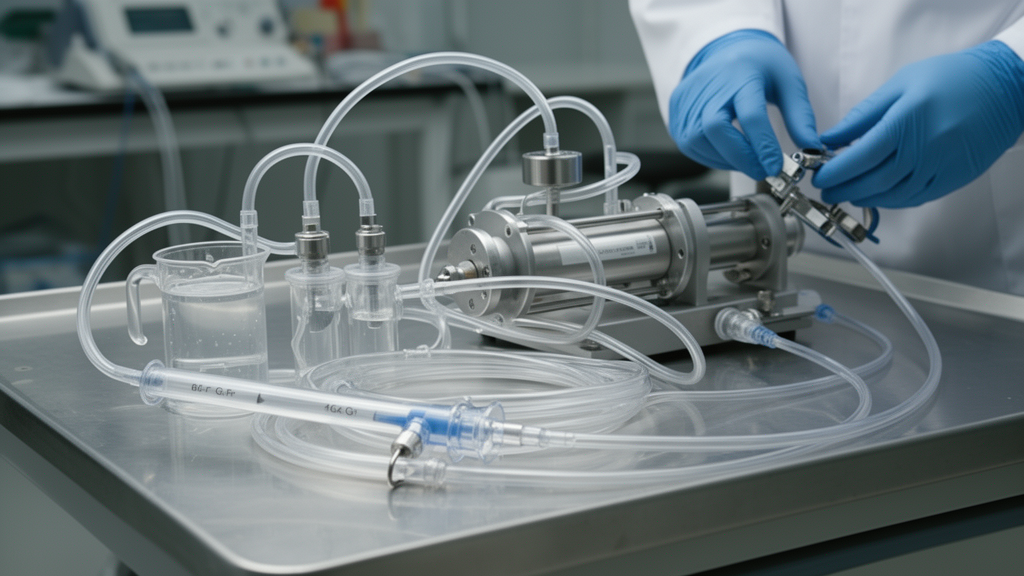
In an in vitro study, researchers compared the hydraulic performance of 14-gauge hemodialysis catheters against an 8-French pediatric arterial cannula in a closed-loop mock cardiopulmonary bypass circuit designed for a 3-kg small dog. Arterial cannulation in such small animals is difficult because vessel diameters may be too narrow for appropriately sized pediatric cannulas, and off-label use of hemodialysis catheters has been reported, but their pressure–flow characteristics under small-dog bypass conditions had remained unclear. The team tested one 8-French pediatric arterial cannula and six 14-gauge hemodialysis catheter specimens.

The catheters included separate side-hole and sealed designs at effective lengths of 25, 32, and 38 mm. A 34% glycerol–water solution by weight, with a viscosity of 2.8 cP at 28°C, served as an approximate Newtonian blood analogue flowing through the circuit. The Stockert S5 pump flow-rate setting was increased from 50 to 350 mL/min.

The researchers prespecified 50–300 mL/min as the primary analysis range, treating the 350 mL/min setting as exploratory. Outlet pressure was recorded 1,000 mm upstream of the test device, while inlet pressure was monitored 300 mm downstream and regulated to 60 mmHg. Six technical runs per condition were conducted using the same physical device and circuit setup.

Within the primary analysis range, outlet pressure reached approximately 136–137 mmHg at 300 mL/min. The mean differences between the 14-gauge specimens and the 8-French cannula ranged from +0.33 to +0.67 mmHg, with 95% confidence intervals spanning −1.33 to +2.15 mmHg. These narrow differences suggest that, at the circuit level, the tested dialysis catheters produced outlet pressures very close to those of the pediatric cannula across the prespecified flow range.

At the exploratory setting of 350 mL/min, outlet pressures were higher for all three side-hole 14-gauge specimens than for the 8-French cannula, indicating that performance differences between device types may emerge at flow rates above the primary analysis range. Catheter design also mattered. At 300 mL/min, outlet pressure was approximately 2–3 mmHg lower for the side-hole specimens than for the sealed specimens across all catheter lengths, a consistent pattern suggesting that side holes reduce resistance in this mock circuit.

The authors emphasized that these findings indicate only small observed circuit-level differences in outlet pressure among the tested devices within this standardized mock small-dog bypass circuit. The results do not establish formal equivalence, device-to-device interchangeability, or clinical validity. As a bench-top evaluation using a glycerol–water blood analogue rather than blood, and a single specimen of the cannula against six catheter specimens, the study's scope is limited to the hydraulic behavior of the devices in the mock circuit.

Clinical performance in living animals, including biocompatibility, insertion feasibility, and outcomes, was not assessed.

Subject of Research: Hydraulic performance of 14-G hemodialysis catheters versus an 8-Fr arterial cannula in a mock 3-kg small-dog cardiopulmonary bypass circuit

Article Title: Hydraulic performance of 14-G hemodialysis catheters versus an 8-Fr arterial cannula in a mock 3-kg small-dog cardiopulmonary bypass circuit

Article References: Wauchi, K., Ikubo, C., Imada, H., Miyata, M., & Tani, K. (2026). Hydraulic performance of 14-G hemodialysis catheters versus an 8-Fr arterial cannula in a mock 3-kg small-dog cardiopulmonary bypass circuit. PLOS One, 21(10), e0361473. https://doi.org/10.1371/journal.pone.0361473

Image Credits: AI Generated

DOI: 10.1371/journal.pone.0361473

Keywords: Hydraulic, performance, hemodialysis, catheters, versus, arterial, cannula, mock, small-dog, cardiopulmonary, bypass, circuit

Cite Scienmag News

William Thompson. (October 27, 2026). Research report: Hydraulic performance of 14-G hemodialysis catheters versus an 8-Fr arterial cannula in a mock 3-kg small-dog cardiopulmonary bypass circuit. Scienmag. https://scienmag.com/research-report-hydraulic-performance-of-14-g-hemodialysis-catheters-versus-an-8-fr-arterial-cannula-in-a-mock-3-kg-small-dog-cardiopulmonary-bypass-circuit/


William Thompson. "Research report: Hydraulic performance of 14-G hemodialysis catheters versus an 8-Fr arterial cannula in a mock 3-kg small-dog cardiopulmonary bypass circuit." Scienmag, 27 October 2026, https://scienmag.com/research-report-hydraulic-performance-of-14-g-hemodialysis-catheters-versus-an-8-fr-arterial-cannula-in-a-mock-3-kg-small-dog-cardiopulmonary-bypass-circuit/. Accessed 27 October 2026.

William Thompson. "Research report: Hydraulic performance of 14-G hemodialysis catheters versus an 8-Fr arterial cannula in a mock 3-kg small-dog cardiopulmonary bypass circuit." Scienmag. October 27, 2026. https://scienmag.com/research-report-hydraulic-performance-of-14-g-hemodialysis-catheters-versus-an-8-fr-arterial-cannula-in-a-mock-3-kg-small-dog-cardiopulmonary-bypass-circuit/

Tags: arterialbypasscannulacardiopulmonarycatheter design impact on flowcatheter length and side-hole effectscatheter pressure-flow characteristicscatheterscircuitflow rate optimization in small-dog modelsglycerol-water blood analoguehemodialysishemodialysis catheter hydraulic performancehydraulicin vitro bypass circuit testingmockpediatric arterial cannula comparisonperformancepressure monitoring in bypass circuitssmall-animal surgical device evaluationsmall-dogSmall-dog cardiopulmonary bypassversusvessel size limitations in small animals
Share26Tweet16
Previous Post

MLP mixer blocks with channel attention sharpen medical image segmentation

Next Post

Research report: Defining clinically meaningful pain reduction after spinal injections using an 11-point numerical rating scale and patient-reported relative reduction of pain

Related Posts

Research report: Defining clinically meaningful pain reduction after spinal injections using an 11-point numerical rating scale and patient-reported relative reduction of pain
Science News

Research report: Defining clinically meaningful pain reduction after spinal injections using an 11-point numerical rating scale and patient-reported relative reduction of pain

October 27, 2026
MLP mixer blocks with channel attention sharpen medical image segmentation
Technology and Engineering

MLP mixer blocks with channel attention sharpen medical image segmentation

October 27, 2026
Defocus Lens Design Slows Myopia Progression in Spanish Children Over 18 Months
Science News

Defocus Lens Design Slows Myopia Progression in Spanish Children Over 18 Months

October 27, 2026
Mushroom Polysaccharide and Plant Phenolic Show Promise Against Steroid-Induced Bone Loss in Mice
Medicine

Mushroom Polysaccharide and Plant Phenolic Show Promise Against Steroid-Induced Bone Loss in Mice

October 27, 2026
AI Model Spots Tiny Power Line Insulator Defects From Drone Cameras in Real Time
Science News

AI Model Spots Tiny Power Line Insulator Defects From Drone Cameras in Real Time

October 27, 2026
Liver Injury Affects One in Eight Patients on Immune Checkpoint Inhibitors in Real-World Study
Medicine

Liver Injury Affects One in Eight Patients on Immune Checkpoint Inhibitors in Real-World Study

October 27, 2026
Next Post
Research report: Defining clinically meaningful pain reduction after spinal injections using an 11-point numerical rating scale and patient-reported relative reduction of pain

Research report: Defining clinically meaningful pain reduction after spinal injections using an 11-point numerical rating scale and patient-reported relative reduction of pain

  • Mothers who receive childcare support from maternal grandparents show more optimized

    Mothers who receive childcare support from maternal grandparents show more parental warmth, finds NTU Singapore study

    27656 shares
    Share 11059 Tweet 6912
  • University of Seville Breaks 120-Year-Old Mystery, Revises a Key Einstein Concept

    1061 shares
    Share 424 Tweet 265
  • Bee body mass, pathogens and local climate influence heat tolerance

    682 shares
    Share 273 Tweet 171
  • Researchers record first-ever images and data of a shark experiencing a boat strike

    546 shares
    Share 218 Tweet 137
  • Groundbreaking Clinical Trial Reveals Lubiprostone Enhances Kidney Function

    531 shares
    Share 212 Tweet 133
Science

Embark on a thrilling journey of discovery with Scienmag.com—your ultimate source for cutting-edge breakthroughs. Immerse yourself in a world where curiosity knows no limits and tomorrow’s possibilities become today’s reality!

RECENT NEWS

  • Research report: Defining clinically meaningful pain reduction after spinal injections using an 11-point numerical rating scale and patient-reported relative reduction of pain
  • Research report: Hydraulic performance of 14-G hemodialysis catheters versus an 8-Fr arterial cannula in a mock 3-kg small-dog cardiopulmonary bypass circuit
  • MLP mixer blocks with channel attention sharpen medical image segmentation
  • Defocus Lens Design Slows Myopia Progression in Spanish Children Over 18 Months

Categories

  • Agriculture
  • Anthropology
  • Archaeology
  • Athmospheric
  • Biology
  • Biotechnology
  • Blog
  • Bussines
  • Cancer
  • Chemistry
  • Climate
  • Earth Science
  • Editorial Policy
  • Marine
  • Mathematics
  • Medicine
  • Pediatry
  • Policy
  • Psychology & Psychiatry
  • Science Education
  • Science News
  • Social Science
  • Space
  • Technology and Engineering

Subscribe to Blog via Email

Enter your email address to subscribe to this blog and receive notifications of new posts by email.

Join 5,151 other subscribers

© 2025 Scienmag - Science Magazine

Welcome Back!

Login to your account below

Forgotten Password?

Retrieve your password

Please enter your username or email address to reset your password.

Log In
No Result
View All Result
  • HOME
  • SCIENCE NEWS
  • CONTACT US

© 2025 Scienmag - Science Magazine

Discover more from Science

Subscribe now to keep reading and get access to the full archive.

Continue reading