


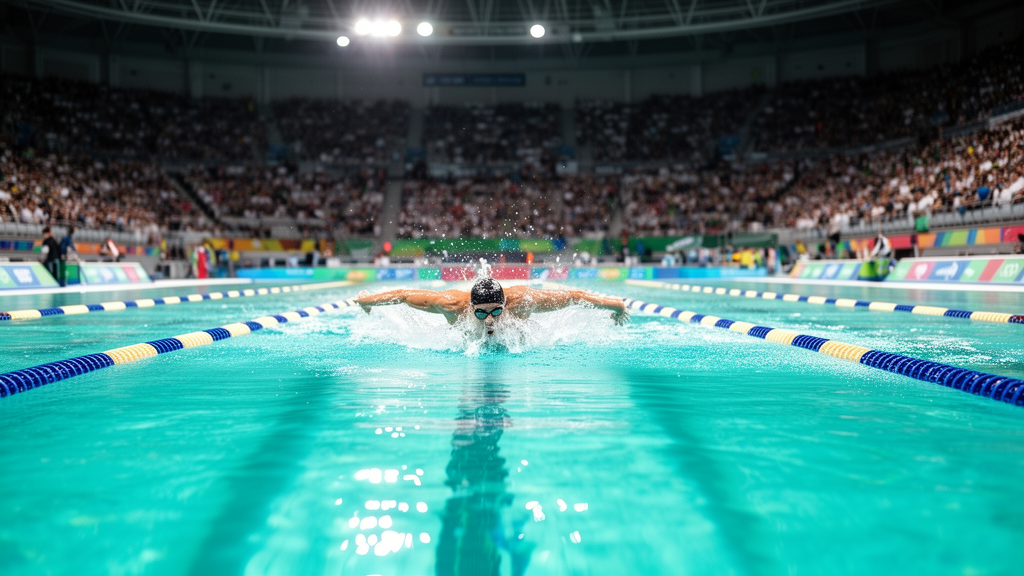
A retrospective analysis of Olympic swimming has traced how finalist performances evolved across 24 Olympic Games, from Paris 1924 to Paris 2024. Researchers extracted race data for 1553 women and 1641 men from the official World Aquatics database, capturing final times, reaction times, and calculated swimming speeds in freestyle, backstroke, breaststroke, and butterfly events at Olympic distances ranging from 50 to 1500 meters.
The study found substantial reductions in final times across all strokes and distances over the hundred-year span. The most pronounced improvements appeared in freestyle and long-distance events, suggesting these disciplines benefited most from the century’s cumulative advances.
Performance gains were not distributed evenly across history. The largest percentage improvements clustered around specific Olympic cycles, notably 1956, 1972, and 2008. According to the researchers, these periods coincided with major developments in pool engineering, competition regulations, training methodologies, and swimsuit technology, linking stepwise leaps in results to technological and regulatory change in the sport.
Swimming speeds increased consistently in all events examined, and reaction-time analyses revealed significant improvements across Olympic Games during the period in which reaction-time data were recorded, indicating that gains extended beyond raw swimming pace to the start of the race itself.
The authors describe the findings as a comprehensive historical overview of performance change across strokes, distances, and sexes, and suggest the results may serve as benchmarks for coaches, athletes, and sports scientists evaluating long-term trends and preparing for future international competitions. As a retrospective analysis of finalist data, the study documents associations between performance jumps and historical developments rather than testing the causal effect of any single innovation.
Subject of Research: Historical trends in Olympic swimming performance from 1924 to 2024
Article Title: Performance evolution in Olympic swimming over the last 100 years: A retrospective stroke-based analysis
Article References: Anameriç, A., Cengizel, E., Dölek, B. E., & Pekel, H. A. (2026). Performance evolution in Olympic swimming over the last 100 years: A retrospective stroke-based analysis. PLOS One, 21(10), e0361289. https://doi.org/10.1371/journal.pone.0361289
Image Credits: AI Generated
DOI: 10.1371/journal.pone.0361289
Keywords: Olympic swimming, performance analysis, freestyle, swimming speed, reaction time, retrospective study, World Aquatics, swimsuit technology, training methodology, Paris 2024, Performance, evolution
Cite Scienmag News
Gavin Prescott. (October 27, 2026). Olympic Swimming Times Have Plummeted Over a Century of Games. Scienmag. https://scienmag.com/olympic-swimming-times-have-plummeted-over-a-century-of-games/
Gavin Prescott. "Olympic Swimming Times Have Plummeted Over a Century of Games." Scienmag, 27 October 2026, https://scienmag.com/olympic-swimming-times-have-plummeted-over-a-century-of-games/. Accessed 27 October 2026.
Gavin Prescott. "Olympic Swimming Times Have Plummeted Over a Century of Games." Scienmag. October 27, 2026. https://scienmag.com/olympic-swimming-times-have-plummeted-over-a-century-of-games/


