


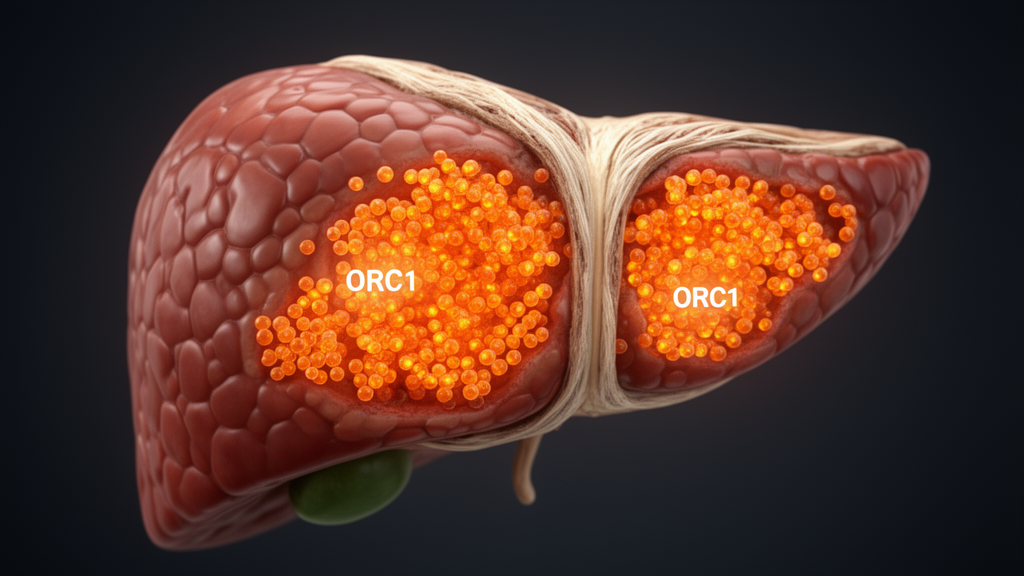
The research, conducted by a team at The First Affiliated Hospital of Guangxi Medical University in Nanning, China, examined ORC1 in HBV-related liver disease and assessed whether it could serve as a marker of disease stage and prognosis. The study enrolled 178 participants divided into two groups. The HBV-positive cohort comprised 124 cases: 49 patients with HBV-associated hepatocellular carcinoma, 33 with HBV-related cirrhosis, and 42 with chronic hepatitis B. The HBV-negative control group included 54 individuals, consisting of 35 patients with non-HBV hepatocellular carcinoma and 19 with hepatic hemangioma.
This design allowed the investigators to compare ORC1 expression across the spectrum of HBV-driven liver disease while controlling for cancer that arises without viral infection. ORC1 in liver tissue was detected by immunohistochemistry. In a subset of 17 HBV-HCC patients for whom serum samples were available, the researchers also measured circulating ORC1 by enzyme-linked immunosorbent assay (ELISA).
Logistic regression was used to identify factors independently associated with high ORC1 expression, and receiver operating characteristic (ROC) curves were used to compare how well tissue ORC1, alpha-fetoprotein (AFP), and des-gamma-carboxy prothrombin (DCP) discriminated HBV-HCC from other disease states. The central finding was that tissue ORC1 was significantly upregulated in HBV-positive patients, and HBV infection itself was independently associated with high ORC1 expression, with a statistical significance of P<0.001. Expression followed a clear gradient across disease stages: ORC1 levels increased progressively from chronic hepatitis B to cirrhosis to hepatocellular carcinoma.
This pattern suggests that ORC1 tracks the proliferative activity that intensifies as HBV-related liver disease advances toward cancer. Because AFP and DCP, the conventional biomarkers for hepatocellular carcinoma, have well-recognized limitations in detecting early-stage disease, the researchers tested whether ORC1 could add diagnostic value. Tissue ORC1 showed only moderate discrimination between HBV-HCC and HBV-related cirrhosis, with an area under the ROC curve (AUC) of 0.64, and between HBV-HCC and chronic hepatitis B, with an AUC of 0.66.
The serum measurements added a cautious note of interest. In the 17 HBV-HCC patients with available serum, tissue and serum ORC1 were moderately correlated, with a Spearman rank correlation coefficient of 0.554 (95% confidence interval 0.085 to 0.822, P=0.021). The wide confidence interval reflects the very small subset size, so the relationship between circulating and tissue ORC1 requires confirmation in much larger cohorts before any clinical use of serum ORC1 could be considered.
Not every association held up. ORC1 expression was not significantly associated with tumor diameter (P>0.05), meaning that within the HCC group, larger tumors did not necessarily express more ORC1. This suggests that ORC1 reflects the proliferative state of the underlying liver disease rather than the physical size of an established tumor.
For prognostic information, the team turned to external validation using TCGA-LIHC, the liver hepatocellular carcinoma dataset of The Cancer Genome Atlas. In that dataset, high ORC1 expression was associated with poorer overall survival, with a hazard ratio of 1.7 and P=0.0026. This independent cohort analysis supports the interpretation that elevated ORC1 marks a more aggressive disease course, although the survival analysis was performed in a public database cohort rather than in the Chinese patient cohort itself.
The authors conclude that ORC1 upregulation is independently associated with HBV infection and increases with disease progression across HBV-related liver disease. They characterize ORC1 as primarily a proliferation- and progression-related marker rather than a stand-alone diagnostic biomarker, given its only moderate discrimination for HBV-HCC.
Subject of Research: ORC1 expression and prognosis in HBV-associated hepatocellular carcinoma
Article Title: ORC1 expression features and its prognostic significance in HBV-associated hepatocellular carcinoma
Article References: Xie, R., Li, Q.-M., Wang, H., Su, T.-M., Yin, Q.-B., Huang, L., Liang, H.-Q., Feng, Y.-F., Lv, Z.-L., Wang, Q., Su, M.-H., Hu, B.-B., & Jiang, J.-N. (2026). ORC1 expression features and its prognostic significance in HBV-associated hepatocellular carcinoma. Frontiers in Oncology, 16, Article 1938736. https://doi.org/10.3389/fonc.2026.1938736
Image Credits: AI Generated
DOI: 10.3389/fonc.2026.1938736
Keywords: ORC1, hepatocellular carcinoma, hepatitis B virus, cirrhosis, chronic hepatitis B, biomarker, AFP, DCP, immunohistochemistry, TCGA-LIHC, prognosis, expression
Cite Scienmag News
Kristina Jarvis. (October 27, 2026). ORC1 Protein Rises with HBV Liver Disease Progression and Flags Poorer Survival. Scienmag. https://scienmag.com/orc1-protein-rises-with-hbv-liver-disease-progression-and-flags-poorer-survival/
Kristina Jarvis. "ORC1 Protein Rises with HBV Liver Disease Progression and Flags Poorer Survival." Scienmag, 27 October 2026, https://scienmag.com/orc1-protein-rises-with-hbv-liver-disease-progression-and-flags-poorer-survival/. Accessed 27 October 2026.
Kristina Jarvis. "ORC1 Protein Rises with HBV Liver Disease Progression and Flags Poorer Survival." Scienmag. October 27, 2026. https://scienmag.com/orc1-protein-rises-with-hbv-liver-disease-progression-and-flags-poorer-survival/


