


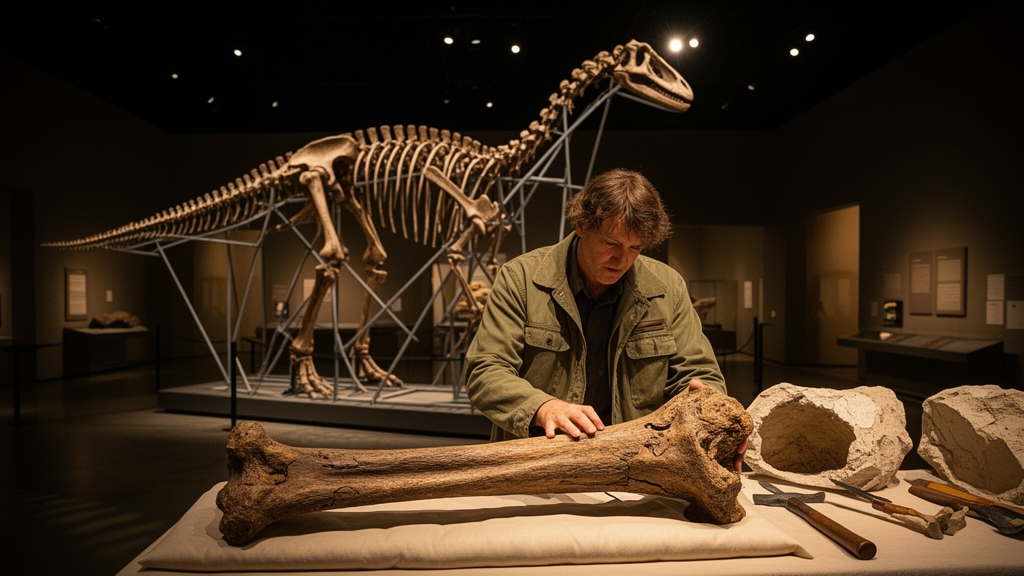
More than two decades after its bones were first pulled from a Surrey clay pit, a dinosaur that sat unremarked in one of Britain's great fossil collections has finally been recognised as a species entirely new to science. The animal, now formally named Paludohadros proudlovii, is a member of the iguanodontians, the group of plant-eating dinosaurs famous for the spiked thumbs that made Iguanodon one of the most recognisable names in palaeontology. The description, published in the Journal of Systematic Palaeontology, draws on specimens held in the collections of the Natural History Museum in London, where the fossil has been cared for since its discovery in 2001.
The find was made at wienerberger's Ewhurst brick and roof tile works in Surrey, the same site that yielded one of Britain's most famous predatory dinosaurs more than a decade earlier. The species name carries a deeply personal story. Will Proudlove, the former manager of the Ewhurst Works, had worked his way up through the ranks at the site and was a keen follower of the fossil discoveries that surfaced as layers of clay were stripped away.
He died at the age of just 35, shortly before the dinosaur was excavated, leaving behind his wife Rachael and their young children Ellie and Matt. The researchers chose to honour him in the scientific name of the animal he never got to see brought into the light. Rachael Proudlove recalled how much the quarry's fossils had meant to her husband.
"Will always had an interest in dinosaur fossils and was fascinated about what, if anything, would be uncovered each time a layer of clay was removed from the quarry," she said. "Sadly, this dinosaur was only discovered the year after he died, but its story has become a part of our lives since then." The family were invited to watch the excavation in 2001, and she described the announcement of the new genus and species, all this time later, as something the family are "absolutely overjoyed and honoured" by, knowing that Will's name and legacy will live on in the dinosaur. Paludohadros proudlovii lived around 125 million years ago, during the Early Cretaceous Period, at a time when iguanodontian dinosaurs were becoming widespread across the world.
The landscape of southern England at that point was dominated by muddy wetlands, and it is this environment that inspired the genus name: 'palus' is Latin for swamp. The animal was a four-legged herbivore, and its remains were recovered from the Weald Clay Formation, the geological unit that preserves the remains of the diverse ecosystems that flourished in those waterlogged lowlands. The individual described in the new paper was around five metres long and would have weighed roughly 1.5 to two tonnes at death, making it comparable in size to a rhinoceros.
Crucially, however, its bones do not appear to have been fully developed, which suggests that this animal was still a juvenile. If it had survived to adulthood, the researchers indicate it could potentially have grown to twice that size, meaning that fully grown Paludohadros would have been substantial animals even by the standards of the large herbivores of the Early Cretaceous. What makes the identification of Paludohadros possible at all is a shift in how scientists have looked at British iguanodontians.
Historically, iguanodontian fossils from southern England were routinely assigned to either Iguanodon itself or to its smaller relative Mantellisaurus. That changed with a detailed redescription of Mantellisaurus published by Natural History Museum scientists in 2023, which clarified the anatomical features that distinguish these animals. With a firmer anatomical baseline in hand, palaeontologists have been able to spot differences in other specimens that had previously been glossed over, and the result has been a flurry of newly named iguanodontians in the past few years, including Brighstoneus, Comptonatus, the sail-backed Istiorachis and now Paludohadros.
The new dinosaur was found not far from another celebrity of British palaeontology. Paludohadros was uncovered just 100 metres away from the Baryonyx site, and the two animals may have had a close and rather grim connection. "While Baryonyx is best known for eating fish, this dinosaur's last meal also included a baby iguanodontian," said senior author Professor Susannah Maidment of the Natural History Museum, London, and the University of Birmingham.
"We can't tell for certain which species this came from, so it's possible that Baryonyx could have been scavenging on the remains of young Paludohadros or even hunting them when it had the opportunity." The naming of Paludohadros is already prompting a wider re-examination of the museum's holdings. Several additional Paludohadros specimens have been identified among material first collected in the 1950s, fossils that had been sitting in drawers for decades without anyone recognising what they represented.
Ricardo Sacamoto, a PhD student at the Natural History Museum, London and the University of São Paulo who led the research, described the personal significance of the find. "Paludohadros is the first species I've ever named and I'm honoured to have been able to work on it," he said. "I still remember the incredible moment when I realised that this was a new species that no one had ever identified before."
That work is set to continue. Sacamoto is now going through the Natural History Museum's iguanodontian collections as part of his PhD, a systematic survey that could lead to the discovery of more new dinosaur species not yet recognised among the material in the museum's care.
Subject of Research: A new iguanodontian dinosaur species from the Early Cretaceous Weald Clay Formation of Surrey, England
Article Title: New UK dinosaur discovered using Natural History Museum’s fossil collections named after devoted dad and husband
Article References: New UK dinosaur discovered using Natural History Museum’s fossil collections named after devoted dad and husband. Original publication (Bibliographic details unavailable.)
Image Credits: AI Generated
DOI: Not provided
Keywords: Paludohadros proudlovii, iguanodontian, dinosaur, Natural History Museum, Early Cretaceous, Weald Clay Formation, Baryonyx, Surrey, palaeontology, new species, Iguanodon, Mantellisaurus
Cite Scienmag News
Violet Maxwell. (October 27, 2026). New swamp-dwelling dinosaur species named in memory of devoted dad from Surrey brickworks. Scienmag. https://scienmag.com/new-swamp-dwelling-dinosaur-species-named-in-memory-of-devoted-dad-from-surrey-brickworks/
Violet Maxwell. "New swamp-dwelling dinosaur species named in memory of devoted dad from Surrey brickworks." Scienmag, 27 October 2026, https://scienmag.com/new-swamp-dwelling-dinosaur-species-named-in-memory-of-devoted-dad-from-surrey-brickworks/. Accessed 27 October 2026.
Violet Maxwell. "New swamp-dwelling dinosaur species named in memory of devoted dad from Surrey brickworks." Scienmag. October 27, 2026. https://scienmag.com/new-swamp-dwelling-dinosaur-species-named-in-memory-of-devoted-dad-from-surrey-brickworks/


