


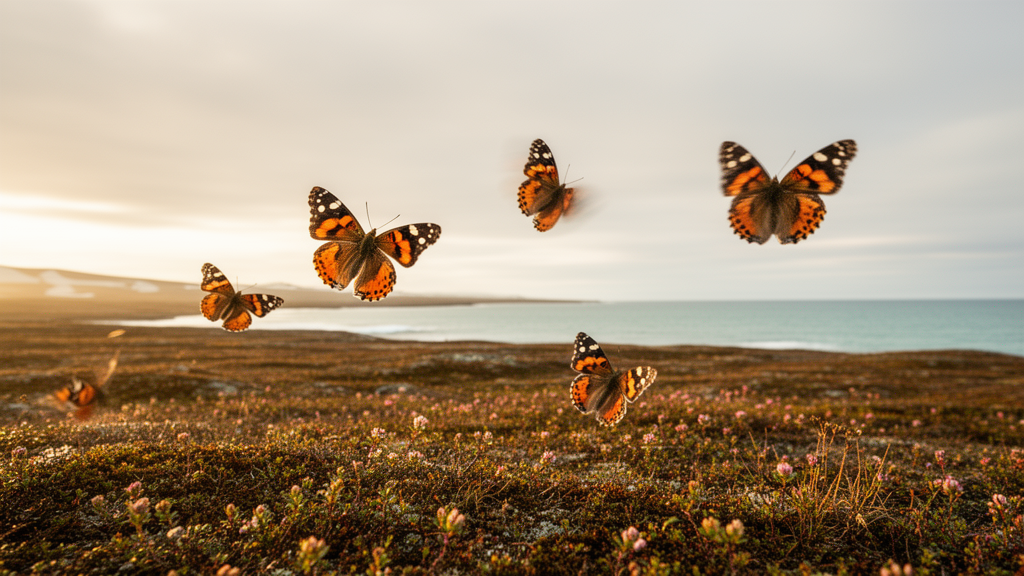
A scarce tortoiseshell butterfly has been recorded at Cape Zhelaniya on the Northern Island of Novaya Zemlya, at 76.95°N, in what researchers report as the first occurrence of a migrant butterfly species on that Arctic archipelago and the second most northerly record of a migrant butterfly anywhere in the world. Two individuals were documented in the summer of 2020: one observed visually on 23 July by park ranger Oleg Valkov, and a second photographed on 23 August by ranger Vadim Zakhariin near the research station of the Russian Arctic National Park. The site lies at the northern margin of the Northern Island, a flat polar desert landscape ringed by a low mountain ridge carrying glaciers and perennial snowfields.
The observations were made during a field season running from 5 July to 18 October 2020. The researchers argue that both butterflies arrived by natural long-distance dispersal rather than by human transport. Ship calls at Cape Zhelaniya took place on 5 and 28 July and on 4, 21 and 24 August 2020, and a helicopter from Naryan-Mar in the Nenets Autonomous Okrug arrived on 13 July; the butterfly records on 23 July and 23 August do not correspond to any of these arrival dates. This timing mismatch is central to the case that the insects flew in on their own, carried by moving air masses.
To place the Novaya Zemlya finding in context, the team compiled a dataset of long-distance migrant butterfly occurrences on Arctic Ocean islands, drawing on literature gathered through Google Scholar and Web of Science and excluding human-mediated introductions and records from subarctic islands such as Iceland and the Faroes. The final dataset contains 15 occurrences spanning 1967 to 2020, covering six islands: Svalbard, Kolguev, Vaygach, Dolgiy, the Northern Island of Novaya Zemlya, and Greenland. The shortest distance from a recorded occurrence to the mainland shoreline ranges from 30 kilometres on Dolgiy Island to 1,090 kilometres in Greenland, underscoring how far across open ocean these insects can travel.
Six species account for all the insular records: the red admiral (Vanessa atalanta), the painted lady (Vanessa cardui), the camberwell beauty (Nymphalis antiopa) and the scarce tortoiseshell (Nymphalis xanthomelas), all nymphalids, together with the black-veined white (Aporia crataegi) and the green-veined white (Pieris napi), both pierids. Most islands have yielded two migrant species so far, while Svalbard and Novaya Zemlya have each produced only one. The most northerly migrant butterfly record in the world remains that of the painted lady on Svalbard, at up to 78.27°N, documented in 1978 at Grumantbyen and in the Sassendalen Valley. The Novaya Zemlya scarce tortoiseshells, at 76.95°N, now rank second, and appear to be the most northerly finding of that species globally.
The 2020 records did not appear in isolation. In mainland Eastern Siberia, the same species was abundant around Yakutsk on 26 July and 7 August 2020 and near the Tiksi settlement, east of the Lena River delta on the Laptev Sea coast, from 30 July to 5 August 2020, where a specimen was collected. These Siberian observations point to a population explosion of the scarce tortoiseshell in Yakutia in 2019 and 2020, an increase so pronounced that it attracted the attention of regional mass media in 2019. The arrival of migrants on Novaya Zemlya coincided with this massive expansion in Eastern Siberia.
The summer of 2020 was exceptionally warm. According to the NOAAGlobalTemp v.5.0.0 database and NOAA’s Global Climate Reports, the third highest July and the second highest August air temperatures since global records began in 1880 were registered during that season. Using the Ventusky web application, the researchers reconstructed air currents and weather conditions over Northern Siberia and Novaya Zemlya for the dates of the butterfly movements. Their reconstruction showed a warm air mass moving from the Polar Urals, the Yugorsky Peninsula and western Yamal along the eastern coast of Novaya Zemlya to the northern edge of the archipelago during 21 to 23 July 2020, a direct distance of roughly 650 kilometres. A second reconstruction revealed an intense movement of warm air from Taymyr towards Novaya Zemlya during 17 to 23 August 2020, covering approximately 580 kilometres. Because daily patterns of air movement and temperature were similar within each period, the team illustrated the situation on 22 July and 22 August 2020, the days before each butterfly occurrence, as representative examples.
On this basis, the authors propose two source areas for the Novaya Zemlya arrivals: the Polar Urals, Yugorsky Peninsula and western Yamal for the butterfly seen on 23 July, and Taymyr for the one photographed on 23 August. The finding demonstrates that this species crossed marine barriers 580 to 650 kilometres wide on warm air currents from the mainland. Air currents are well established as facilitators of long-distance insect dispersal, and wind-borne transport has previously been invoked to explain remarkable journeys such as those of the American painted lady, Vanessa virginiensis, to the Azores, Canary Islands, Madeira, mainland Spain and Portugal, France and Britain. Lepidopterans have also been shown to reach Arctic and Sub-Antarctic islands on air masses; the immigration of the diamondback moth, Plutella xylostella, into Svalbard in 2000, for instance, was associated with a warm southeasterly air mass moving from Russia.
Other insular records in the dataset follow the same logic of continental expansion events spilling over into the Arctic Ocean. A dead camberwell beauty found on the shore of Lake Yangoto in northern Vaygach Island in 2010, at 70.25°N, appears to be the most northerly occurrence of that species globally, and coincided with its expansion towards the Polar Urals in the Kara River basin that year. Painted lady records from Svalbard in 1978, Dolgiy in 2004 and Kolguev in 2009 each coincide with known massive northward migrations of that species; in 2009, an enormous expansion from North Africa and the Mediterranean towards northern Europe and the Urals meant the butterfly was found on 87.5 percent of observation sites surveyed around the Padimey Lakes in the eastern Bolshezemelskaya Tundra. The black-veined white record on Vaygach in 2013 matches a population explosion and intense expansion of that species in European Russia and Western Siberia in 2012 and 2013, although the authors note that its breeding on Arctic Ocean islands such as Vaygach is next to impossible. The green-veined white, by contrast, is a regular resident of subarctic and arctic mainland Eurasia, and its single natural insular record comes from Kolguev in 2009; the Svalbard specimen attributed to this species was accidentally imported.
The scarce tortoiseshell’s own recent history makes the Arctic arrival more comprehensible. Historically distributed from Central and Eastern Europe to temperate Asia as far as Korea and Japan, the butterfly was seen rarely in Europe for over a century and a half before the 2010s, with its most northerly European records from southern Finland and scattered sightings in northern European Russia. It was, however, more widespread in the Urals, occurring up to the Polar Urals, where successful development on dwarf willows such as Salix reticulata has been registered. Massive population explosions were recorded in Yakutia in 1958, 1967 to 1968, 1994 and 2002. From the 2010s, a new expansion began: an extensive migration with mean counts of 900 to 2,700 individuals per hour was observed in the Chuvashia and Mari El republics in June 2012, the species became abundant across the boreal zone of European Russia, the Urals and Western Siberia, and successfully overwintered adults were recorded in Arkhangelsk in April 2014 and in the Subpolar and Polar Urals between 2013 and 2017.
Westward, the range shifted northward from around 2009 and 2010, with settlements appearing in Finland and southeastern Sweden in 2011 to 2013, high abundance across Ukraine in 2012 and 2013, striking immigration events in Estonia between 2012 and 2015, and, in July 2014, abundance throughout Scandinavia, northern Germany, the Netherlands and northern Belgium, including a flock of migrants that crossed the Channel into eastern England. The authors link this wave to the population explosion and massive westward migration in Russia and Ukraine. Abundance in mainland Western Europe and Britain dropped abruptly in the summer of 2015, most likely because overwintered migrant butterflies produced very scarce offspring under unfavourable weather conditions, while the species remained common in Estonia in 2016 and 2017. The team concludes that the recent expansion of the scarce tortoiseshell into Western Europe and the Arctic areas of Siberia and Europe was likely triggered by global climate warming during 2012 to 2020, noting that the species’ European distribution can be explained well by climatic variables and that its range shift to Scandinavia had been predicted under climate warming scenarios. As with the other migrant species, these polar-desert visitors cannot establish permanent populations in the High Arctic, but their arrivals trace how warming summers and moving air masses are extending the reach of long-distance insect migration to some of the northernmost land on Earth.
Subject of Research: Long-distance migration of butterflies to Arctic Ocean islands, including the first record of the scarce tortoiseshell on Novaya Zemlya
Article Title: Long-distance dispersal of migrant butterflies to the Arctic Ocean islands, with a record of Nymphalis xanthomelas at the northern edge of Novaya Zemlya (76.95°N)
Article References: Bolotov, I. N., Mizin, I. A., Zheludkova, A. A., Aksenova, O. V., Kolosova, Y. S., Potapov, G. S., Spitsyn, V. M., & Gofarov, M. Y. (2021). Long-distance dispersal of migrant butterflies to the Arctic Ocean islands, with a record of Nymphalis xanthomelas at the northern edge of Novaya Zemlya (76.95°N). Nota Lepidopterologica, 44, 73-90. https://doi.org/10.3897/nl.44.62249
Image Credits: AI Generated
DOI: 10.3897/nl.44.62249
Keywords: butterfly migration, Nymphalis xanthomelas, Novaya Zemlya, Arctic Ocean islands, long-distance dispersal, air currents, climate warming, Vanessa cardui, polar desert, Svalbard, population explosion, Lepidoptera
Cite Scienmag News
Violet Maxwell. (October 27, 2026). Scarce Tortoiseshell Butterflies Ride Warm Winds to the Edge of the Arctic Ocean. Scienmag. https://scienmag.com/scarce-tortoiseshell-butterflies-ride-warm-winds-to-the-edge-of-the-arctic-ocean/
Violet Maxwell. "Scarce Tortoiseshell Butterflies Ride Warm Winds to the Edge of the Arctic Ocean." Scienmag, 27 October 2026, https://scienmag.com/scarce-tortoiseshell-butterflies-ride-warm-winds-to-the-edge-of-the-arctic-ocean/. Accessed 27 October 2026.
Violet Maxwell. "Scarce Tortoiseshell Butterflies Ride Warm Winds to the Edge of the Arctic Ocean." Scienmag. October 27, 2026. https://scienmag.com/scarce-tortoiseshell-butterflies-ride-warm-winds-to-the-edge-of-the-arctic-ocean/


