


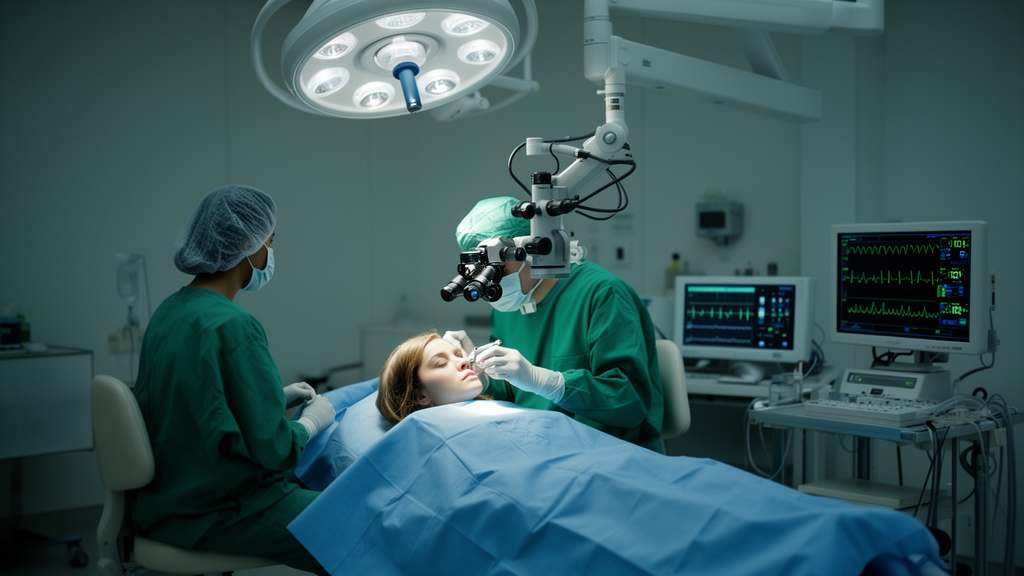
A 61-year-old woman recovering from what should have been a routine retinal repair suddenly lost her ability to walk and speak clearly within an hour of leaving the operating room. Her case, published in Frontiers in Neuroscience, is one of only a handful ever documented, and it carries a warning that surgeons and emergency physicians alike may be missing a rare but devastating complication hiding in plain sight. The operation in question was a pars plana vitrectomy, or PPV, a minimally invasive procedure used to treat retinal detachment, vitreous hemorrhage, and macular disease.
Surgeons insert three tiny instruments through the white of the eye, remove the gel-like vitreous, and often replace it with gas, silicone oil, or perfluorocarbon liquid to hold the retina in place. During the patient's surgery at a hospital in Changsha, China, in April 2025, the retina was successfully reattached after injection of heavy liquid. But as the team prepared to introduce silicone oil, the woman suddenly complained of severe eye pain, broke into a profuse sweat, and described a sensation of impending death.
Her oxygen saturation briefly dropped to 88 percent, and a dome-shaped elevation of the choroid, the vascular layer beneath the retina, appeared in the surgical field. The surgical team halted the procedure immediately, closed the incisions, and administered hemostatic drugs. Blood loss was estimated at just 2 milliliters.
Yet roughly one hour after the operation ended, the patient's family and clinicians noticed something far more alarming than any eye problem: she was confused, her speech was slurred, and she could no longer walk without assistance. An emergency brain MRI, performed on a 1.5-Tesla scanner with a standardized stroke protocol, revealed the answer. Diffusion-weighted imaging, the most sensitive technique for detecting fresh strokes, showed multiple bright lesions with corresponding dark areas on apparent diffusion coefficient maps, the classic signature of acute ischemia.
The infarcts were scattered across the bilateral frontal, parietal, and occipital lobes, the right thalamus, and the corpus callosum, almost entirely in subcortical regions. Strikingly, no air was visible anywhere in the intracranial vessels on MRI or on CT angiography, which also ruled out blockages of the large arteries and pulmonary embolism. Blood tests told their own story: D-dimer, a marker of clot breakdown, was elevated at 932 micrograms per liter, and cardiac troponin I, a protein released by injured heart muscle, reached 2.981 nanograms per milliliter despite a normal electrocardiogram and echocardiogram.
The reporting physicians, Rong Zhang, Guo Wen, and Zhenqun Zhang of the First Affiliated Hospital of Hunan College of Traditional Chinese Medicine, concluded that cerebral air embolism or microembolic infarction was the most likely diagnosis, even though the gas itself could not be seen. Their reasoning rests on a well-described anatomical pathway. During vitrectomy, an infusion cannula delivers fluid or gas into the eye under pressure.
If the cannula dislodges or slips, pressurized air can be forced into the suprachoroidal space, tearing the vortex veins that drain blood from the choroid. These ocular veins are valveless, meaning air can travel freely along pressure gradients. From the vortex veins, gas enters the superior and inferior ophthalmic veins, drains through the cavernous sinus into the jugular vein, and reaches the right atrium of the heart, from which it can be pumped toward the lungs and, in some circumstances, the brain.
The scattered, bilateral pattern of infarcts seen on the MRI raises a further possibility that the authors could not confirm: paradoxical embolism. Venous air bubbles normally lodge in the lungs, where the capillary bed acts as a filter. Even without a shunt, if the volume of gas exceeds the lungs' clearance capacity, bubbles can pass through the pulmonary filter itself.
The gold-standard tests for detecting such shunts, bubble-contrast transesophageal echocardiography and transcranial Doppler with agitated saline, were not performed during the acute event, so the possibility remains unconfirmed and unexcluded, an acknowledged limitation of the report. Why would tiny bubbles produce so many strokes? The answer lies in the behavior of gas in the cerebral microcirculation.
Rather than occluding a single large artery, microbubbles distribute diffusely across subcortical and cortical capillary beds, obstructing small vessels, triggering local vasospasm, activating platelets and the coagulation cascade, and injuring the endothelial lining of the vessels. The result is exactly the pattern observed: multiple small, bilateral, subcortical infarcts with no large-vessel occlusion. Compounding the injury, the physiological stress of surgery, including pain, abrupt pressure changes inside the eye, and activation of the sympathetic nervous system, can promote vasoconstriction, platelet activation, and a hypercoagulable state.
The markedly elevated D-dimer and troponin levels in this patient suggest that systemic inflammation and endothelial dysfunction may have amplified microthrombus formation on top of any direct bubble obstruction. Treatment began quickly and followed established principles for suspected cerebral air embolism. Hyperbaric oxygen therapy was initiated the day after surgery, placing the patient in a pressurized chamber where breathing 100 percent oxygen at elevated pressure accelerates the diffusion of nitrogen out of the bubbles, shrinks their volume, and floods ischemic tissue with oxygen.
Evidence suggests the greatest neurological benefit occurs when hyperbaric therapy starts within six hours of symptom onset, though that evidence comes primarily from observational studies and expert consensus rather than randomized trials. The patient was also admitted to the intensive care unit for intracranial pressure reduction, neuroprotection, antiplatelet and anticoagulant therapy, and cardioprotection. The response was dramatic.
By post-operative day 10 she was walking and had fully recovered her speech and cognition. On day 11, surgeons completed the eye operation, removing the heavy liquid and placing silicone oil. At six-month follow-up her stroke scores were excellent, with a National Institutes of Health Stroke Scale score of 0 and a modified Rankin Scale score of 1, and her retina remained attached.
The authors argue that the true incidence of this complication is almost certainly underestimated. A review of the literature identified only 13 reported cases of ocular venous air embolism during ophthalmic procedures, yet 69 percent of them were fatal, a figure that likely reflects publication bias, since fatal events are far more likely to be written up than near-misses. A survey of vitreoretinal surgeons found that only 20 percent were even aware of ocular venous air embolism as a potential complication, and many cannula displacements are probably corrected before any cardiovascular collapse occurs, meaning they are never recorded.
The authors also point to a broader methodological problem seen across embolization procedures: rare but clinically important adverse events are systematically under-captured in retrospective cohorts and single-center case series, so the absence of large datasets should not be read as evidence of negligible risk. For clinicians, the case distills into a practical algorithm. Any patient who deteriorates neurologically shortly after eye surgery should undergo urgent diffusion-weighted MRI, supplemented by susceptibility-weighted sequences that can detect intracranial air, and magnetic resonance angiography to exclude large-vessel occlusion.
Laboratory markers, arterial blood gases, electrocardiography, and echocardiography should follow in parallel. Crucially, the absence of visible gas on imaging does not exclude the diagnosis, because small bubbles are resorbed rapidly and may never appear on a scan. First-line management is high-flow oxygen, with hyperbaric therapy for significant neurological involvement, careful hemodynamic support, and antithrombotic treatment guided by individual risk.
The authors frame the lesson as a shift in mindset: from guaranteeing safety inside the eye to safeguarding the whole patient, because even a routine operation on the retina can, in rare circumstances, send air traveling a long and dangerous road to the brain.
Subject of Research: Cerebral air embolism following fluid-air exchange during pars plana vitrectomy
Article Title: Case Report: Cerebral air embolism following fluid–air exchange during pars plana vitrectomy: a rare but severe complication
Article References: Zhang, R., Wen, G., & Zhang, Z. (2026). Case Report: Cerebral air embolism following fluid–air exchange during pars plana vitrectomy: a rare but severe complication. Frontiers in Neuroscience, 20, Article 1929675. https://doi.org/10.3389/fnins.2026.1929675
Image Credits: AI Generated
DOI: 10.3389/fnins.2026.1929675
Keywords: cerebral air embolism, pars plana vitrectomy, retinal detachment, suprachoroidal hemorrhage, hyperbaric oxygen therapy, diffusion-weighted MRI, paradoxical embolism, patent foramen ovale, vortex veins, microembolism, case report, ophthalmic surgery
Cite Scienmag News
Ophelia Keating. (October 27, 2026). Rare Cerebral Air Embolism Strikes Woman During Routine Eye Surgery. Scienmag. https://scienmag.com/rare-cerebral-air-embolism-strikes-woman-during-routine-eye-surgery/
Ophelia Keating. "Rare Cerebral Air Embolism Strikes Woman During Routine Eye Surgery." Scienmag, 27 October 2026, https://scienmag.com/rare-cerebral-air-embolism-strikes-woman-during-routine-eye-surgery/. Accessed 27 October 2026.
Ophelia Keating. "Rare Cerebral Air Embolism Strikes Woman During Routine Eye Surgery." Scienmag. October 27, 2026. https://scienmag.com/rare-cerebral-air-embolism-strikes-woman-during-routine-eye-surgery/


