


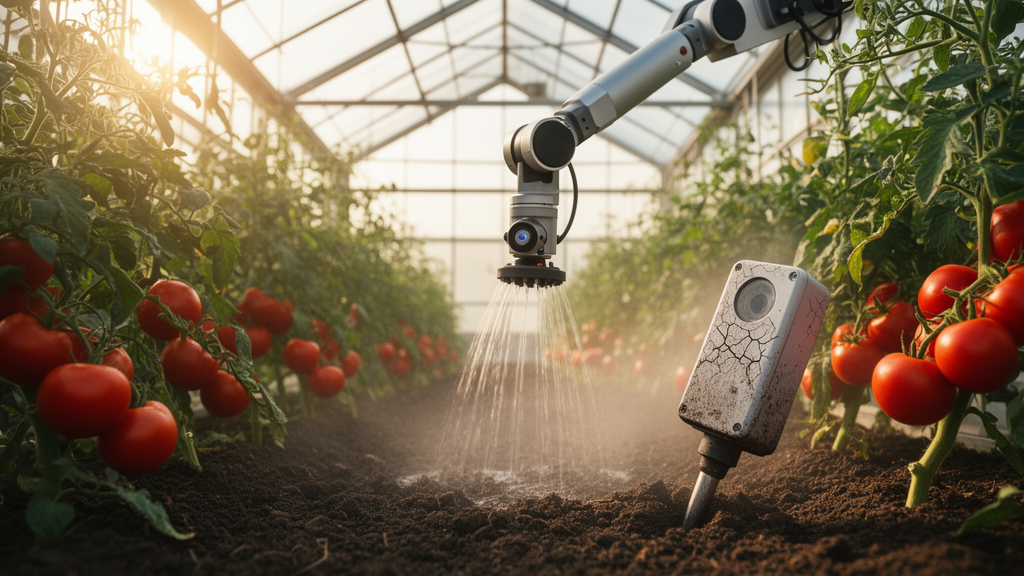
Greenhouse irrigation is a deceptively hard control problem. Every day, a grower or an automated controller must decide how much water to deliver, knowing that the decision will ripple forward through soil water storage, crop transpiration, water stress, biomass accumulation, and ultimately yield. Too little water restricts growth; too much wastes water, drives drainage and nutrient leaching, and undermines the very efficiency that makes greenhouse cultivation attractive.
A new study tackles this problem with a deep reinforcement learning framework that explicitly trains its irrigation policy to cope with faulty sensors, biased evapotranspiration estimates, and irrigation equipment that does not deliver exactly what it is told. AquaCrop is not used merely as an offline evaluator of predefined irrigation treatments, as in most previous studies. Instead, it serves as the transition model of a reinforcement learning environment: each day the agent issues an irrigation depth in millimeters, the model advances the soil water balance, canopy development, water stress, biomass, and yield by one day, and the agent receives a new observation and reward.
This design turns irrigation scheduling into a sequential decision-making problem in which today's water application shapes tomorrow's crop status, allowing the agent to optimize cumulative season-long benefits rather than isolated events. A central challenge the authors address is partial observability. In a real greenhouse, the complete internal state of the crop-soil system is never directly measurable.
Controllers must rely on a limited set of sensors and estimated variables, and those observations are imperfect. Reference evapotranspiration, the standard indicator of atmospheric evaporative demand, is itself an estimate derived from meteorological measurements rather than a direct measurement of crop water use, and greenhouse-specific factors such as radiation transmission through the cover material and ventilation can push it away from the demand the crop actually experiences. Irrigation hardware adds a further layer of uncertainty, since pump pressure, emitter flow variation, and valve performance can cause the delivered water depth to deviate from the commanded amount.
To handle these realities, the team developed a method called HS-LSTM-PPO, built on the proximal policy optimization algorithm. The agent's daily observation vector contains reference evapotranspiration, daily minimum and maximum temperatures, the previous day's irrigation amount, and proxy variables for soil water content and canopy cover, since several internal AquaCrop variables cannot be measured directly in practice. Rather than deciding from a single-day snapshot, the agent stacks the most recent seven days of noisy observations into a moving temporal window and passes them through a long short-term memory (LSTM) encoder that extracts temporal dependencies and latent information invisible to any single observation.
The actor network then outputs a continuous irrigation action, while a critic network estimates the long-term value of the encoded state. Crucially, the training environment is deliberately corrupted. Systematic bias and random noise are injected into temperature observations, reference evapotranspiration, soil water content, canopy cover, and irrigation execution.
Temperature observations receive an additive bias of plus or minus 0.3 degrees Celsius plus Gaussian noise with a standard deviation of 0.2 degrees. Reference evapotranspiration is perturbed with a 20 percent positive bias, representing a conservative overestimation of evaporative demand, together with Gaussian noise of 10 percent. Soil water content receives additive Gaussian errors, canopy cover is perturbed by 10 percent Gaussian noise, and the executed irrigation depth deviates from the command through multiplicative errors with episode-level bias and step-level variation, each with a 5 percent standard deviation.
The authors emphasize that these are representative simulation settings rather than experimentally calibrated error distributions for a specific greenhouse system. Because reinforcement learning needs abundant and varied training data, the researchers expanded greenhouse climate records from a cherry tomato cultivation study into four representative weather scenarios: a baseline, a high evaporative demand case, a mild warming case, and a strong warming case. The expansion preserves the seasonal patterns of the original climate while introducing autoregressive residual perturbations that mimic realistic inter-seasonal variability.
Reference evapotranspiration was expanded jointly with temperature rather than treated as purely temperature-driven, reflecting the Penman-Monteith formulation in which evaporative demand depends on radiation, humidity, vapor pressure deficit, ventilation, and cover-related radiation transmission. The reward function balances multiple objectives, penalizing excessive irrigation water use, decision-related water surplus, runoff and deep percolation, and crop water stress, while rewarding biomass accumulation and final yield formation. Episodes correspond to one full growing season and terminate early if severe water stress, defined as a water stress coefficient below 0.75 persisting for five consecutive days, or invalid simulation states occur, with an additional penalty discouraging infeasible strategies.
The reward weights were tuned in preliminary experiments and then fixed before all final comparisons, which included an AquaCrop rule-based strategy with and without disturbance, plain PPO, LSTM-PPO, Transformer-PPO, and a constant-irrigation baseline. The results show a clear pattern. Under biased evapotranspiration observations, the disturbed AquaCrop rule-based strategy applies the most water, a mean of 453.58 millimeters per season, effectively compensating for the overestimated evaporative demand with conservative, high-volume irrigation events.
Plain PPO swings the other way, using the least water among the learning methods at 379.80 millimeters but suffering the deepest water stress, with a minimum stress coefficient of 0.45 and an average of 8.42 stress days. HS-LSTM-PPO strikes the better bargain: it cuts mean irrigation to 385.79 millimeters, a saving of 67.79 millimeters or roughly 14.95 percent relative to the disturbed rule-based strategy, while holding the mean simulated yield at a comparable 184.82 tonnes per hectare and limiting stress days to 3.77. Its training reward also converged steadily, approaching the disturbed AquaCrop baseline after about 2,000 iterations, whereas Transformer-PPO showed a pronounced performance collapse around the same point, with rewards falling to nearly minus 300, and plain PPO fluctuated widely before settling at a lower level.
An ablation study underlined the value of temporal memory. Extending the observation window from one day to seven days raised the mean evaluation reward from minus 211.11 to minus 131.04, while stretching the window further to 28 days brought no consistent additional gain. A seven-day window therefore appears sufficient to capture the main temporal dependencies, offering a practical trade-off between performance and input complexity.
The learned policy's behavior also differed qualitatively from its competitors: rather than a few large irrigation pulses or a rigid fixed schedule, HS-LSTM-PPO applied relatively large amounts early and late in the season and smaller, more frequent events, mostly below 10 millimeters, during the middle growth period. The resulting soil water content trajectory was correspondingly smoother, rising gradually early on and remaining stable through mid and late season, in contrast to the sawtooth fluctuations produced by the rule-based and fixed-action methods. Verification on the original measured greenhouse weather sequence, rather than the expanded training scenarios, confirmed that the policy trained on expanded data still made effective decisions under the corresponding simulation conditions.
In the second verification scenario, HS-LSTM-PPO reduced irrigation from 392.93 to 330.80 millimeters, a saving of 62.13 millimeters or approximately 15.81 percent compared with the disturbed AquaCrop strategy, while maintaining a comparable mean water stress coefficient, a higher minimum coefficient than most other learning methods, and only two stress days. The authors are careful to frame these as consistent performance across evaluated simulation scenarios rather than independent external generalization, and they note that the learned policy reflects the specific AquaCrop parameterization and reward weighting of this greenhouse tomato system. Nutrient dynamics, disease, spatial heterogeneity, and interactions among temperature, humidity, radiation, and irrigation are not fully represented, and the method has not yet been tested in a real closed-loop greenhouse.
Future work, the team says, will move to multi-season experiments with calibrated sensor and actuator data, online correction of sensing and execution errors, sensitivity analysis across disturbance magnitudes, and transfer across crops and greenhouse environments. Until then, the study stands as a detailed simulation-based demonstration that training irrigation agents on deliberately corrupted observations can produce policies that save water without sacrificing yield.
Subject of Research: Deep reinforcement learning for greenhouse irrigation scheduling under sensing and actuation uncertainties using the AquaCrop crop model
Article Title: Greenhouse irrigation scheduling under sensing disturbances via deep reinforcement learning and AquaCrop
Article References: Xu, Y., Liu, Q., Sun, Z., Gu, W., Xue, X., & Jin, Y. (2026). Greenhouse irrigation scheduling under sensing disturbances via deep reinforcement learning and AquaCrop. Smart Agricultural Technology, 15, Article 102635. https://doi.org/10.1016/j.atech.2026.102635
Image Credits: AI Generated
DOI: 10.1016/j.atech.2026.102635
Keywords: greenhouse irrigation, deep reinforcement learning, AquaCrop, proximal policy optimization, LSTM, evapotranspiration uncertainty, sensor bias, irrigation scheduling, tomato, water-use efficiency, soil water balance, crop modeling
Cite Scienmag News
Alan Morgan. (October 27, 2026). AI Learns to Water Greenhouse Tomatoes Even When Its Sensors Lie. Scienmag. https://scienmag.com/ai-learns-to-water-greenhouse-tomatoes-even-when-its-sensors-lie/
Alan Morgan. "AI Learns to Water Greenhouse Tomatoes Even When Its Sensors Lie." Scienmag, 27 October 2026, https://scienmag.com/ai-learns-to-water-greenhouse-tomatoes-even-when-its-sensors-lie/. Accessed 27 October 2026.
Alan Morgan. "AI Learns to Water Greenhouse Tomatoes Even When Its Sensors Lie." Scienmag. October 27, 2026. https://scienmag.com/ai-learns-to-water-greenhouse-tomatoes-even-when-its-sensors-lie/


