


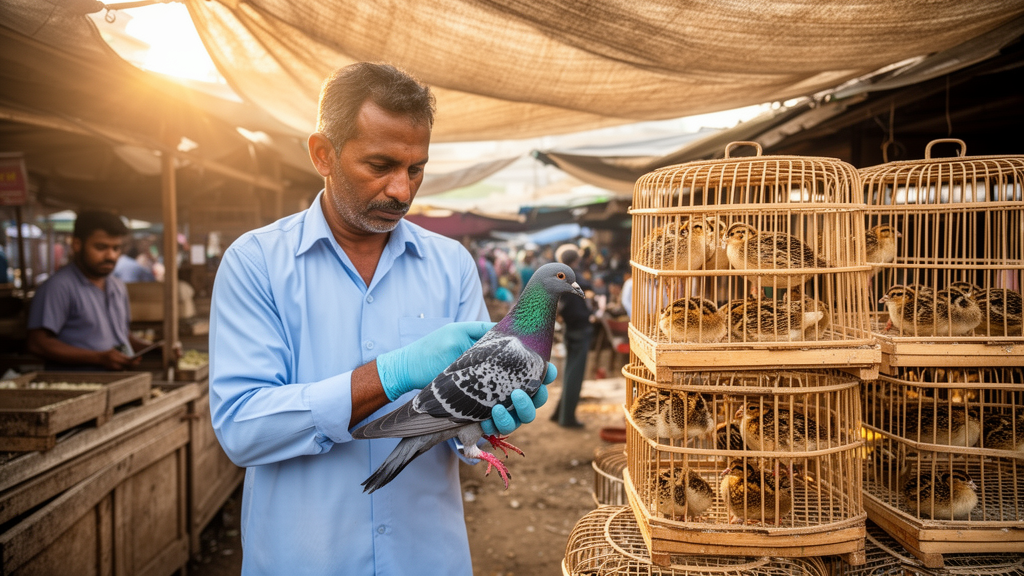
Pigeons and quail, two poultry species rarely included in avian influenza monitoring, may be helping the virus persist and spread within Bangladesh's mixed poultry production and marketing systems, according to a cross-sectional study conducted in Chattogram between November 2021 and April 2022. The research, led by Mohammad Iqbal Habib and colleagues, sampled 300 birds—108 pigeons and 192 quail—drawn from household farms, commercial farms, and live bird markets, and found an overall avian influenza virus (AIV) prevalence of 14.3 percent (95% CI: 10.6–18.8). The investigators collected oropharyngeal and cloacal swabs from every bird and screened them for the AIV matrix gene using real-time reverse transcription polymerase chain reaction (rRT-PCR), followed by subtype-specific testing for the H5, H7, and H9 hemagglutinin types.
Quail carried a substantially higher prevalence than pigeons: 18.2 percent (95% CI: 13.0–24.4) versus 7.4 percent (95% CI: 3.3–14.1). Among the subtypes detected, H9 dominated at 11.3 percent (95% CI: 7.9–15.4), followed by hemagglutinin-untyped viruses at 2.7 percent (95% CI: 1.2–5.1) and H5 at just 0.3 percent (95% CI: 0.001–1.8). H7 was not detected in any sample.
Statistical modeling of risk factors reinforced the pattern. After adjustment, quail had roughly four times the odds of AIV positivity compared with pigeons (adjusted odds ratio [aOR] = 4.1, 95% CI: 1.8–10.6). Birds that were clinically sick at sampling had nearly triple the odds of testing positive (aOR = 2.9, 95% CI: 1.4–6.2), and birds sourced from household farms also showed elevated odds (aOR = 2.8, 95% CI: 1.2–6.5) relative to other settings.
The authors emphasize that both species are widely reared and traded alongside chickens and ducks in Bangladesh, often under conditions of inadequate biosecurity that could create an overlooked ecological niche for viral circulation, reassortment, and potential zoonotic spillover. The study's design was cross-sectional, meaning birds were sampled at a single point in time rather than followed longitudinally. This approach can estimate prevalence and identify associations but cannot establish whether the risk factors measured—species, health status, and production system—caused infection, nor can it capture seasonal variation in virus circulation.
The sampling frame was limited to Chattogram and to 300 birds, so the confidence intervals around subtype-specific estimates, particularly for the single H5-positive sample, are wide and should be interpreted cautiously. Nevertheless, the findings carry practical implications for surveillance policy. The authors conclude that integrating pigeons and quail into routine AIV surveillance is necessary to strengthen early detection, inform control strategies, and reduce the risk of zoonotic spillover.
Subject of Research: Avian influenza virus prevalence and risk factors in pigeons and quail across poultry production systems in Chattogram, Bangladesh
Article Title: Epidemiological characterization of avian influenza virus circulation in pigeons and quail across different production systems in Chattogram, Bangladesh
Article References: Habib, M. I., Sayeed, M. A., Islam, M., Sarker, M. F. R., Shakil, S. S., Hassan, M. M., Forwood, J. K., Ahad, A., & Islam, A. (2026). Epidemiological characterization of avian influenza virus circulation in pigeons and quail across different production systems in Chattogram, Bangladesh. PLOS One, 21(10), e0361561. https://doi.org/10.1371/journal.pone.0361561
Image Credits: AI Generated
DOI: 10.1371/journal.pone.0361561
Keywords: avian influenza, pigeons, quail, Bangladesh, H9N2, surveillance, live bird markets, zoonotic spillover, poultry production systems, rRT-PCR, cross-sectional study, biosecurity
Cite Scienmag News
Kristina Jarvis. (October 27, 2026). Research report: Epidemiological characterization of avian influenza virus circulation in pigeons and quail across different production systems in Chattogram, Bangladesh. Scienmag. https://scienmag.com/research-report-epidemiological-characterization-of-avian-influenza-virus-circulation-in-pigeons-and-quail-across-different-production-systems-in-chattogram-bangladesh/
Kristina Jarvis. "Research report: Epidemiological characterization of avian influenza virus circulation in pigeons and quail across different production systems in Chattogram, Bangladesh." Scienmag, 27 October 2026, https://scienmag.com/research-report-epidemiological-characterization-of-avian-influenza-virus-circulation-in-pigeons-and-quail-across-different-production-systems-in-chattogram-bangladesh/. Accessed 27 October 2026.
Kristina Jarvis. "Research report: Epidemiological characterization of avian influenza virus circulation in pigeons and quail across different production systems in Chattogram, Bangladesh." Scienmag. October 27, 2026. https://scienmag.com/research-report-epidemiological-characterization-of-avian-influenza-virus-circulation-in-pigeons-and-quail-across-different-production-systems-in-chattogram-bangladesh/


