


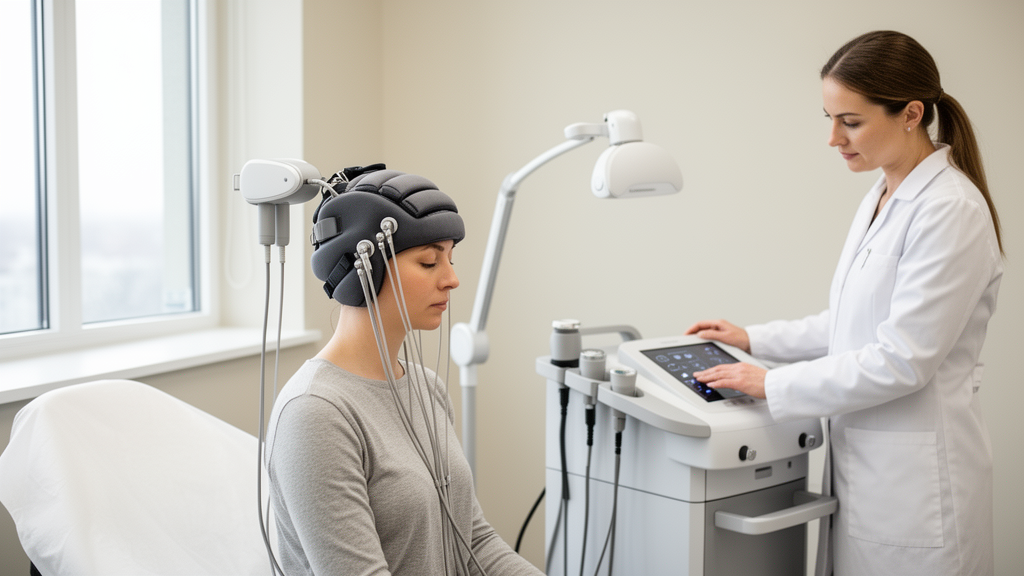
But according to a new opinion article published in Frontiers in Psychiatry by Carmen Concerto and Fabrizio Bella of the University of Catania, the field risks mistaking speed for progress. The authors argue that accelerated protocols should be judged not by how quickly sessions can be delivered, but by whether they meet prespecified standards for clinical benefit, durability and safety at an acceptable burden for patients and clinics. Repetitive transcranial magnetic stimulation, or rTMS, is already an established treatment for major depressive disorder, typically delivered once daily over four to six weeks.
That schedule works for many patients, but repeated attendance creates a substantial burden, particularly for people who live far from treatment centers or who must balance therapy with work and caregiving. Accelerated TMS encompasses a family of interventions that attempt to reduce that burden, ranging from shorter individual sessions to intensive courses of ten or more sessions packed into a single day. The Catania authors propose treating the choice among these options as a constrained optimization problem: select the least burdensome protocol that still satisfies clinical, durability and safety requirements.
A central point of the article is that the word accelerated actually describes three distinct changes that are often conflated. Calendar acceleration compresses treatment into fewer days. Session shortening reduces the duration of each visit.
Dose intensification increases the number of daily sessions or pulses. None of these, on its own, guarantees faster clinical improvement, and shorter sessions do not necessarily reduce overall resource use, because accelerated schedules may demand longer clinic stays, higher pulse doses or expensive neuronavigation. The authors therefore evaluate each protocol across four domains: stimulation parameters, circuit delivery, clinical scheduling and implementation burden.
Success in one domain does not establish success in the others. The evidence base for these protocols is uneven, and the authors are careful to distinguish what randomized trials actually show. The THREE-D trial demonstrated non-inferiority of once-daily intermittent theta-burst stimulation, or iTBS, to conventional 10-hertz high-frequency rTMS in 414 randomized patients, but its roughly three-minute sessions represent session shortening rather than calendar acceleration.
A randomized comparison of accelerated high-frequency rTMS delivering three sessions per day over six days found no demonstrated superiority or faster response compared with once-daily treatment at the same cumulative dose. Reviews comparing accelerated with conventional schedules report heterogeneous findings, and the authors stress a key statistical point: a statistically nonsignificant difference between two approaches does not demonstrate that they are equivalent. For accelerated iTBS specifically, a meta-analysis of five double-blind randomized trials involving 239 participants favored active stimulation for study-defined response, but it combined unipolar and bipolar depression and rated certainty as low to moderate, limiting diagnosis-specific conclusions.
The Stanford sequence, which evolved from open-label Stanford Accelerated Intelligent Neuromodulation Therapy into randomized trials of Stanford Neuromodulation Therapy, must also be read step by step. The first sham-controlled trial analyzed 29 participants and favored active treatment on the four-week change in Montgomery-Åsberg Depression Rating Scale scores. A recent replication randomized 48 participants and reported a one-month remission advantage, but the authors caution that this estimate carries imprecision, interim stopping, a short primary follow-up and additional assigned treatment before the endpoint.
Open-label remission rates, they note, should never be treated as randomized efficacy estimates. Other recent trials add nuance rather than clarity. Ramos and colleagues randomized 100 outpatients to scalp-targeted accelerated iTBS or sham over 15 weekdays, with the primary week-5 outcome on the 17-item Hamilton Depression Rating Scale favoring active treatment.
This supports that specific regimen, not equivalence to the Stanford protocol or a guaranteed response within days. An H1-coil trial randomized 104 participants and met its week-6 non-inferiority criterion, but because stimulation pattern, intensity, session count and continuation all differed from the comparator, the trial cannot isolate the effect of calendar compression itself. The authors also flag that the trial's companion patient-reported-outcome publication describes the same study rather than an independent replication.
Parameter associations pose a similar trap. Meta-regression and dose-response analyses have linked pulse dose and intersession spacing with outcomes, including an association with intervals of roughly 30 to 75 minutes, but the Catania authors warn that such cross-study associations can be confounded by correlated pulse and session counts, protocol family, treatment resistance, baseline severity, targeting, sham methods and small-study effects. Direct randomized evidence does not support a single optimal interval.
In one trial, 182 participants receiving twice-daily bilateral dorsomedial prefrontal iTBS were assigned 0-, 30- or 60-minute intervals with total pulses held constant, and no significant differences emerged in improvement, response or remission. That finding challenges any universal optimal interval, though it does not settle spacing for high-dose left dorsolateral prefrontal protocols. Targeting raises parallel questions.
In a small estimation trial, 40 participants were randomized to connectivity-based or scalp-based targeting, and the connectivity approach showed larger median MADRS reductions at one month, with binary outcomes pointing in the same direction. But the targets were derived prospectively from a 41-minute multiecho scan and a convergent depression circuit that differs from the Stanford subgenual-anticorrelation procedure, and split-half reproducibility does not establish between-day reliability or portability across scanners. The authors conclude that this supports further testing of the specific pipeline, not of precision targeting in general, and that confirmatory studies must report processing failures and test whether added benefit justifies imaging and navigation costs.
Safety and durability deserve equally careful treatment. Safety cannot be inferred from pulse totals alone, and trials recorded adverse events so differently that the authors advise against casual pooling. In the accelerated high-frequency comparison, scalp discomfort affected 11 of 58 participants versus 2 of 57, with three withdrawals for discomfort or migraine.
The Ramos trial reported week-1 scalp pain in 17.4 percent versus 4.4 percent, no manic switches and 89 of 100 completers, while the SNT replication reported no serious adverse events but did not record expected stimulation-site discomfort as an adverse event. Small trials cannot exclude rare seizures or mood switches, and safety observed in specialist centers with strict eligibility criteria may not transfer to routine practice. On suicidality, a sham-controlled crossover study of 50 participants found no superiority of accelerated iTBS over sham among the 32 with baseline suicidal ideation, and the authors stress that an antidepressant effect does not demonstrate a specific antisuicidal effect.
Durability data are similarly thin: in an uncontrolled SNT cohort of 46 participants, 32 remitted initially but only 15 remained in remission at 12 weeks, and beyond three to six months, controlled evidence is insufficient to define an optimal maintenance schedule. They emphasize these are author-proposed targets, not validated thresholds or clinical deadlines, and that benefit counts as sustained only without intervening relapse or unplanned rescue. Their decision rule is to choose the least burdensome protocol among those meeting prespecified requirements, since an expedited pathway that exceeds tolerability or durability limits fails the framework.
They also note that economic assessments of once-daily iTBS cannot automatically be applied to high-dose accelerated protocols, because costs and benefits distribute differently among patients, providers and payers. In their view, the next advance is not a faster protocol but a testable, protocol-specific balance between clinical benefit and implementation burden, with adoption guided by evidence for actual parameters and populations while uncertainty about component necessity and long-term prevention remains explicit.
Subject of Research: Optimizing accelerated transcranial magnetic stimulation protocols for treatment-resistant depression
Article Title: Accelerated transcranial magnetic stimulation for depression: optimizing dose, spacing, targeting, and durability rather than speed alone
Article References: Concerto, C., & Bella, F. (2026). Accelerated transcranial magnetic stimulation for depression: optimizing dose, spacing, targeting, and durability rather than speed alone. Frontiers in Psychiatry, 17, Article 1968733. https://doi.org/10.3389/fpsyt.2026.1968733
Image Credits: AI Generated
DOI: 10.3389/fpsyt.2026.1968733
Keywords: accelerated TMS, transcranial magnetic stimulation, intermittent theta-burst stimulation, major depressive disorder, treatment-resistant depression, Stanford Neuromodulation Therapy, dorsolateral prefrontal cortex, treatment durability, suicidality, neuronavigation, clinical trial design, neurostimulation
Cite Scienmag News
Glenn Wilkins. (October 26, 2026). Faster Brain Stimulation for Depression Needs Dose, Spacing and Durability Proof, Not Just Speed. Scienmag. https://scienmag.com/faster-brain-stimulation-for-depression-needs-dose-spacing-and-durability-proof-not-just-speed/
Glenn Wilkins. "Faster Brain Stimulation for Depression Needs Dose, Spacing and Durability Proof, Not Just Speed." Scienmag, 26 October 2026, https://scienmag.com/faster-brain-stimulation-for-depression-needs-dose-spacing-and-durability-proof-not-just-speed/. Accessed 26 October 2026.
Glenn Wilkins. "Faster Brain Stimulation for Depression Needs Dose, Spacing and Durability Proof, Not Just Speed." Scienmag. October 26, 2026. https://scienmag.com/faster-brain-stimulation-for-depression-needs-dose-spacing-and-durability-proof-not-just-speed/


