


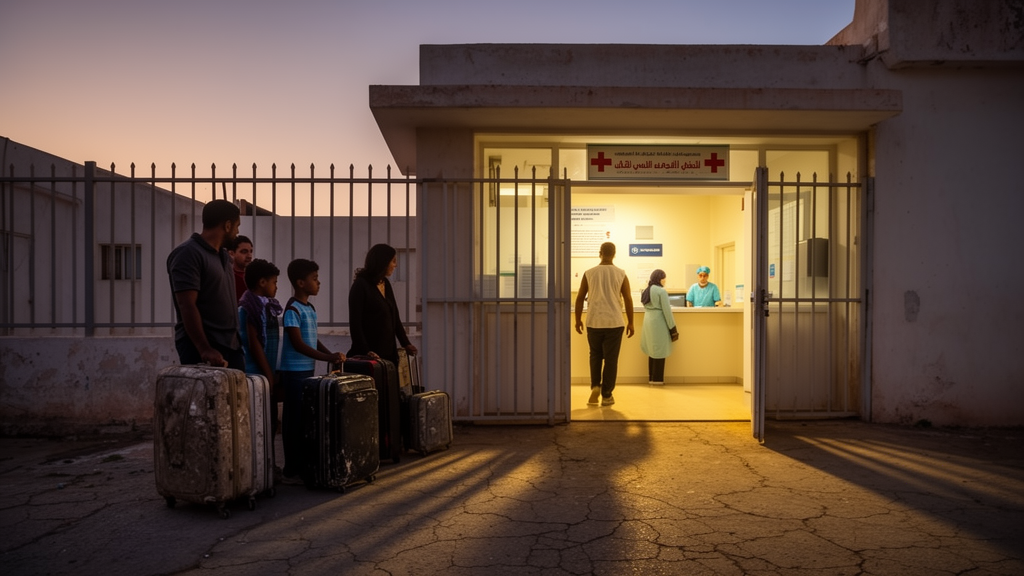
Migrants living in Tunisia face health inequities that stem less from individual behaviour than from structurally embedded legal and socioeconomic exclusion, according to a qualitative study published in the International Journal for Equity in Health. The research, based on data collected between May and December 2023, found that irregular legal status acted as a key upstream determinant, restricting access to employment, social protection, and healthcare, and setting off a cascade of intersecting vulnerabilities that ultimately worsened health outcomes. Tunisia occupies a distinctive position as both a transit and destination country, making it an unusual middle-income setting in which to examine how structural barriers shape health equity.
Most existing evidence on migrant vulnerability comes from high-income countries, leaving a gap in understanding of how these dynamics unfold in resource-constrained transit contexts. The study aimed to address that gap by exploring how multidimensional vulnerabilities are produced and experienced among migrants in Tunisia and how they influence healthcare utilisation. The researchers conducted a qualitative secondary analysis using data gathered across four Tunisian cities: Tunis, Sousse, Sfax, and Medenine.
Using purposive sampling, they recruited 163 participants, including 87 migrants and refugees, 33 migrant community leaders, and 43 staff members of non-governmental organisations. Data collection involved 33 semi-structured interviews and 16 focus group discussions, conducted in participants' preferred languages of French, Arabic, and English, with recruitment continuing until thematic saturation was achieved. Thematic analysis followed a hybrid inductive-deductive approach informed by the International Organization for Migration's Determinants of Migrant Vulnerability framework, which treats vulnerability as a condition shaped by interacting structural, social, and individual determinants rather than as a fixed personal attribute.
This framing allowed the team to trace how different layers of disadvantage accumulated and reinforced one another over time. The analysis revealed that vulnerability operated as a dynamic and cumulative process driven by interacting structural, socioeconomic, and social determinants. Irregular legal status sat at the top of this hierarchy of disadvantage, functioning as a gateway barrier that limited access to formal employment, social protection schemes, and healthcare services.
Beneath it, economic precarity, housing instability, family obligations, racial discrimination, gendered power asymmetries, and language barriers each contributed to unmet health needs and eroded participants' trust in public services. Participants reported carrying a dual burden of infectious and chronic conditions, alongside substantial unmet mental health needs. NGO staff working with migrant communities corroborated these accounts, pointing to systemic failures within the health system, including administrative exclusion, the absence of interpreter services, and a lack of culturally competent care.
These converging testimonies from migrants and service providers strengthened the picture of exclusion as structural rather than incidental. Perhaps the most striking finding concerns the coping strategies migrants adopted in response to these barriers. Faced with inaccessible formal services, participants turned to self-medication, informal support networks, and delayed healthcare utilisation.
The researchers observed that these strategies paradoxically exacerbated health risks and reinforced the very structural inequities that produced them, creating a self-perpetuating cycle in which exclusion breeds coping behaviours that deepen vulnerability. The study's conclusions carry direct implications for policy. The authors argue that healthcare inequities among migrants in Tunisia are driven less by individual behaviours than by structurally embedded forms of legal and socioeconomic exclusion, and that addressing upstream legal, administrative, and financial barriers is essential to promote equitable access to healthcare.
As a qualitative study drawing on secondary data from a single country, the research has inherent limitations: it documents lived experiences and systemic patterns rather than measuring the prevalence of specific health conditions, and its findings describe the Tunisian context specifically. Nevertheless, by grounding migrant health inequities in the interplay of legal status, economic precarity, and discrimination, the study offers a detailed account of how vulnerability is produced in a middle-income transit setting, an evidence base that has been largely missing from a literature dominated by high-income country perspectives.
Subject of Research: Multidimensional vulnerabilities and healthcare access barriers among migrants in Tunisia
Article Title: Multidimensional vulnerabilities and health inequities among migrants in Tunisia: a qualitative study
Article References: Maatoug, T., Ouahchi, A., Seedat, F., Deal, A., Khelifi, A., Douagi, M., Mansour, W., Mtiraoui, A., Assarag, B., Zenner, D., Requena-Méndez, A., & Evangelidou, S. (2026). Multidimensional vulnerabilities and health inequities among migrants in Tunisia: a qualitative study. International Journal for Equity in Health. https://doi.org/10.1186/s12939-026-03079-4
Image Credits: AI Generated
DOI: 10.1186/s12939-026-03079-4
Keywords: migrant health, health equity, Tunisia, qualitative research, irregular status, social determinants, healthcare access, mental health, discrimination, transit migration, Multidimensional, vulnerabilities
Cite Scienmag News
Courtney Benton. (October 26, 2026). Irregular Status Drives Layered Health Inequities for Migrants in Tunisia, Study Finds. Scienmag. https://scienmag.com/irregular-status-drives-layered-health-inequities-for-migrants-in-tunisia-study-finds/
Courtney Benton. "Irregular Status Drives Layered Health Inequities for Migrants in Tunisia, Study Finds." Scienmag, 26 October 2026, https://scienmag.com/irregular-status-drives-layered-health-inequities-for-migrants-in-tunisia-study-finds/. Accessed 26 October 2026.
Courtney Benton. "Irregular Status Drives Layered Health Inequities for Migrants in Tunisia, Study Finds." Scienmag. October 26, 2026. https://scienmag.com/irregular-status-drives-layered-health-inequities-for-migrants-in-tunisia-study-finds/


