

Monday, October 26, 2026
Science
No Result
View All Result
  • Login
  • HOME
  • SCIENCE NEWS
  • CONTACT US
  • HOME
  • SCIENCE NEWS
  • CONTACT US
No Result
View All Result
Scienmag
No Result
View All Result
Home Science News Space

Forecasting gravitational wave tests of f(Q, T) modified gravity

October 26, 2026
in Space
Grant Pearson
By Grant Pearson Scienmag Editorial Profile - Observational Astronomy
Reading Time: 2 mins read
0
Forecasting gravitational wave tests of f(Q, T) modified gravity

Forecasting gravitational wave tests of f(Q, T) modified gravity

65
SHARES
587
VIEWS
Share on FacebookShare on Twitter
ADVERTISEMENT

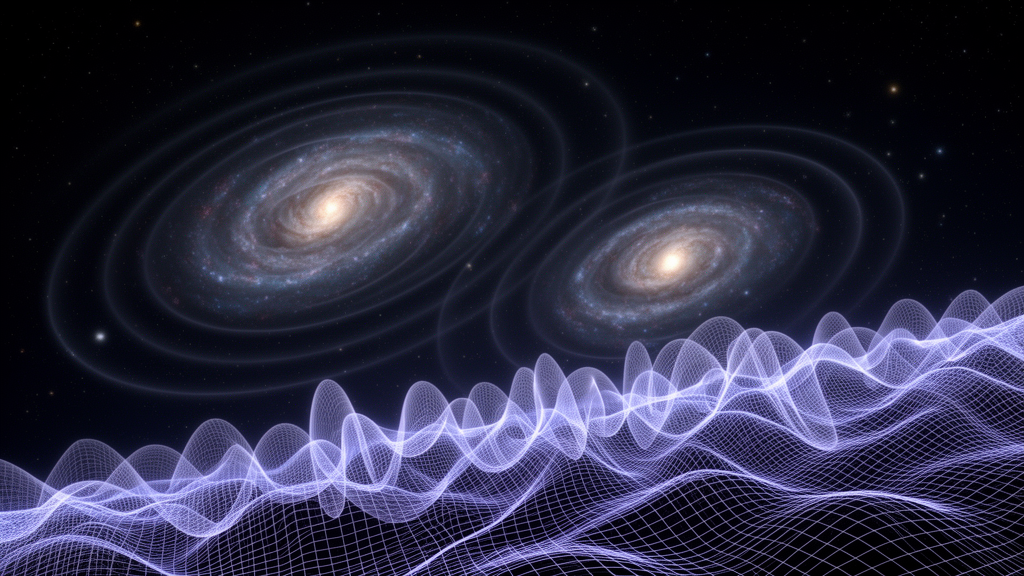
Gravitational waves have become one of the most powerful independent probes of gravity beyond General Relativity, and a new theoretical study asks what future detections could reveal about a class of modified gravity known as f(Q, T) gravity. Because both quantities enter the field equations, the theory modifies how matter and geometry couple, altering the way gravitational waves propagate across an evolving universe. The research, published in General Relativity and Gravitation by S. Davood Sadatian, Zahra Davari and S. Mohamad Reza Hosseini, derives the gravitational wave propagation equation within a separable f(Q, T) framework and computes the corresponding modified gravitational wave luminosity distance induced by the altered cosmological background evolution.

Rather than analyzing real observations, the team conducted a forecast study built on a fiducial ΛCDM mock cosmology. They generated simulated gravitational wave standard-siren catalogs corresponding to three detector generations: current LIGO-Virgo instruments, the planned space-based LISA observatory, and the next-generation Einstein Telescope. The authors considered two representative functional forms of f(Q, T) and constrained their parameters using mock GW standard-siren datasets for each detector configuration.

The analysis emphasizes that the resulting parameter estimates are sensitivity indicators for the adopted mock realization rather than definitive observational constraints. This distinction matters: the numbers describe how well future catalogs could in principle pin down the model, given the assumed fiducial cosmology, not what the universe has actually been measured to do. The forecast results show that increasing the number of standard sirens substantially improves sensitivity to the background cosmological parameters, with an Einstein Telescope-like catalog delivering the most pronounced gains.

Significant degeneracies remain, however, among the parameters describing the non-metricity sector and the matter-geometry coupling. In practical terms, different combinations of the model's free functions can produce nearly indistinguishable gravitational wave signatures, meaning that even a rich standard-siren catalog may not fully disentangle the individual contributions of Q and T to the gravitational action. The study highlights the strong potential of next-generation gravitational wave cosmology to test the fundamental nature of gravity and assess the viability of f(Q, T) gravity.

Because the gravitational wave propagation equation and the luminosity distance are derived directly from the modified field equations, the framework connects detector-level observables to the deepest layer of the theory, where the roles of non-metricity and the energy-momentum trace are encoded. The authors note that their results demonstrate the prospective sensitivity of future observations to the model parameters, while the persistence of degeneracies in the non-metricity and coupling sectors marks the key challenge for turning mock forecasts into genuine tests of modified gravity.

Subject of Research: Gravitational wave signatures and forecasts in f(Q, T) modified gravity

Article Title: Gravitational wave signatures and forecasts in f(Q, T) modified gravity

Article References: Sadatian, S. D., Davari, Z., & Hosseini, S. M. R. (2026). Gravitational wave signatures and forecasts in f(Q, T) modified gravity. General Relativity and Gravitation, 58(10), Article 124. https://doi.org/10.1007/s10714-026-03628-w

Image Credits: AI Generated

DOI: 10.1007/s10714-026-03628-w

Keywords: Gravitational, wave, signatures, forecasts, modified, gravity, scientific research

Cite Scienmag News

Grant Pearson. (October 26, 2026). Forecasting gravitational wave tests of f(Q, T) modified gravity. Scienmag. https://scienmag.com/forecasting-gravitational-wave-tests-of-fq-t-modified-gravity/

Grant Pearson. "Forecasting gravitational wave tests of f(Q, T) modified gravity." Scienmag, 26 October 2026, https://scienmag.com/forecasting-gravitational-wave-tests-of-fq-t-modified-gravity/. Accessed 26 October 2026.

Grant Pearson. "Forecasting gravitational wave tests of f(Q, T) modified gravity." Scienmag. October 26, 2026. https://scienmag.com/forecasting-gravitational-wave-tests-of-fq-t-modified-gravity/


Tags: constraints on f(QEinstein Telescope next-generation detectorsf(Qforecastsfuture gravitational wave detector sensitivitygravitationalgravitational wave luminosity distancegravitational wave propagation in alternative theoriesgravitational wave standard-siren catalog simulationsgravitational wave tests of modified gravityGRAVITYLIGO-Virgo gravitational wave analysisLISA space-based gravitational wave observatorymock cosmology for gravitational wave forecastsmodifiedmodified gravity impact on cosmological backgroundScientific ResearchsignaturesT) gravity cosmologyT) gravity parameterswave
Share26Tweet16
Previous Post

Global review finds desertification model booming but rarely validated

Next Post

No Single Motor Skill Predicts Preschool Executive Function, Study Suggests

Related Posts

Neptune’s Building Blocks May Have Migrated Far Before Forming the Ice Giant
Space

Neptune’s Building Blocks May Have Migrated Far Before Forming the Ice Giant

October 26, 2026
Lumina simulation recreates the universe’s first 2 billion years in unprecedented detail
Space

Lumina simulation recreates the universe’s first 2 billion years in unprecedented detail

October 26, 2026
Biodiversity Emerges as a Key Priority for European Municipalities, Survey Finds
Space

Biodiversity Emerges as a Key Priority for European Municipalities, Survey Finds

October 26, 2026
Lava world TOI-561 b reflects most of its starlight, Webb observations reveal
Space

Lava world TOI-561 b reflects most of its starlight, Webb observations reveal

October 26, 2026
Covalent Organic Framework Anchors Nanotubes in Ultralight Films for High-Power Flexible GaAs Solar Cells
Space

Covalent Organic Framework Anchors Nanotubes in Ultralight Films for High-Power Flexible GaAs Solar Cells

October 26, 2026
Charmonium surprise in a thick target: SHiP measures fewer J/psi decays than simulations predict
Space

Charmonium surprise in a thick target: SHiP measures fewer J/psi decays than simulations predict

October 26, 2026
Next Post
No Single Motor Skill Predicts Preschool Executive Function, Study Suggests

No Single Motor Skill Predicts Preschool Executive Function, Study Suggests

  • Mothers who receive childcare support from maternal grandparents show more optimized

    Mothers who receive childcare support from maternal grandparents show more parental warmth, finds NTU Singapore study

    27656 shares
    Share 11059 Tweet 6912
  • University of Seville Breaks 120-Year-Old Mystery, Revises a Key Einstein Concept

    1061 shares
    Share 424 Tweet 265
  • Bee body mass, pathogens and local climate influence heat tolerance

    682 shares
    Share 273 Tweet 171
  • Researchers record first-ever images and data of a shark experiencing a boat strike

    546 shares
    Share 218 Tweet 137
  • Groundbreaking Clinical Trial Reveals Lubiprostone Enhances Kidney Function

    531 shares
    Share 212 Tweet 133
Science

Embark on a thrilling journey of discovery with Scienmag.com—your ultimate source for cutting-edge breakthroughs. Immerse yourself in a world where curiosity knows no limits and tomorrow’s possibilities become today’s reality!

RECENT NEWS

  • No Single Motor Skill Predicts Preschool Executive Function, Study Suggests
  • Forecasting gravitational wave tests of f(Q, T) modified gravity
  • Global review finds desertification model booming but rarely validated
  • Crayfish Guts Tell Two Stories: Pond Feed Drives Growth, Rice Paddies Build Stress Resistance

Categories

  • Agriculture
  • Anthropology
  • Archaeology
  • Athmospheric
  • Biology
  • Biotechnology
  • Blog
  • Bussines
  • Cancer
  • Chemistry
  • Climate
  • Earth Science
  • Editorial Policy
  • Marine
  • Mathematics
  • Medicine
  • Pediatry
  • Policy
  • Psychology & Psychiatry
  • Science Education
  • Science News
  • Social Science
  • Space
  • Technology and Engineering

Subscribe to Blog via Email

Enter your email address to subscribe to this blog and receive notifications of new posts by email.

Join 5,151 other subscribers

© 2025 Scienmag - Science Magazine

Welcome Back!

Login to your account below

Forgotten Password?

Retrieve your password

Please enter your username or email address to reset your password.

Log In
No Result
View All Result
  • HOME
  • SCIENCE NEWS
  • CONTACT US

© 2025 Scienmag - Science Magazine

Discover more from Science

Subscribe now to keep reading and get access to the full archive.

Continue reading