Uranus and Neptune have long been treated as planetary twins, but new research argues that their chemical makeup tells a different story. An international team of scientists, including staff from the Southwest Research Institute (SwRI), reports that Neptune’s deep atmosphere appears substantially richer in oxygen than Uranus’s, a contrast that hints the materials making up the two planets came from different regions of the protoplanetary disk. The study, published in the September 2026 issue of Astronomy & Astrophysics, suggests that despite their striking similarities in size, mass and atmospheric conditions, the two ice giants have significantly different chemical origins.
“Uranus and Neptune may resemble twins today, but their chemistry is telling us that they are more like cousins with very different histories,” said Dr. Olivier Mousis, a program director in SwRI’s Solar System Science and Exploration Division in Boulder, Colorado, and a co-author of the paper. Mousis also served as a doctoral co-advisor for the paper’s first author, Tom Briand. “Their atmospheric compositions may be connected to different regions of the protoplanetary disk where the planets formed, which would make their similarities a noteworthy coincidence.”
The comparison rests on atmospheric chemistry models combined with observations of carbon monoxide levels in the two planets’ atmospheres, including recent measurements from the Atacama Large Millimeter/Submillimeter Array (ALMA). From these data, the researchers found that Neptune’s deep atmosphere contains more oxygen than Uranus’s, producing significantly different carbon-to-oxygen ratios between the two worlds. That difference in the ratio of carbon to oxygen is the central clue in the new analysis, because it links the planets’ present-day atmospheres to the chemical character of the solid and gaseous material they accreted more than four billion years ago.
“We can’t directly access the deep atmospheres of Uranus and Neptune, but chemical tracers allow us to probe the conditions hidden beneath their visible clouds,” Mousis said. “Studying carbon monoxide, or CO, is particularly useful because of its abundance in the upper troposphere. Using this data, we can model the chemical evolution of the protoplanetary disk and the origins of its materials.” Because no spacecraft has sampled these atmospheres in situ, disequilibrium chemistry in the observable upper layers serves as a window onto compositions thousands of miles below.
The ice giants themselves are unlike terrestrial planets in fundamental ways. Uranus and Neptune do not have solid surfaces like Earth’s. Instead, they are enveloped by thick blankets of gas made up of heavy elements such as water, ammonia and methane, which extend thousands of miles deep toward their interiors. A thin outer layer of lighter elements gives the planets their characteristic greenish-blue appearance. Any account of their origins must therefore explain not just the gases seen at the cloud tops but the composition of the vast, hidden reservoirs beneath.
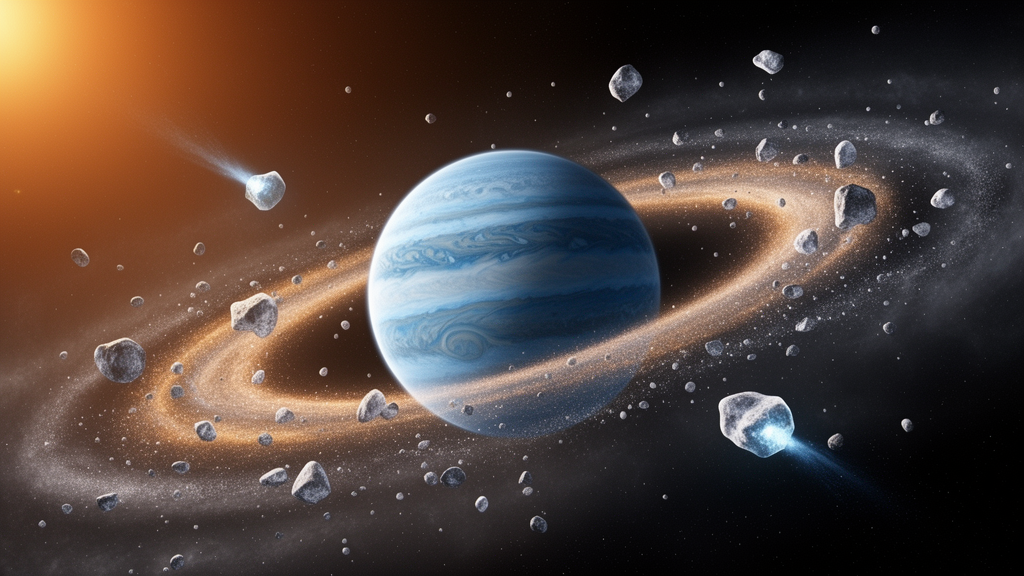
To interpret the measured chemical differences, the team turned to models that illustrate the chemical evolution of dust and gases in the protoplanetary disk, the rotating disk of material surrounding the young Sun in which the planets formed. SwRI’s models provided insight into how the disk’s different volatile compounds condensed into solids at different distances from the Sun, creating chemically distinct reservoirs as the disk cooled. Planets forming in different zones of the disk would then accrete material with different compositions, imprinting measurable differences in their carbon-to-oxygen ratios.
Mousis compared the inferred carbon-to-oxygen ratios of the two planets using these protoplanetary disk models, simulating the conditions that lead to planetary formation. The results point to a surprising conclusion about Neptune. Scientists have traditionally thought that Uranus and Neptune formed from materials originating in their nearby cosmic neighborhoods, but the new models suggest that Neptune’s building blocks originated closer to the young Sun before experiencing an outward migration to the region where Neptune eventually accreted them.
“Neptune’s chemistry is difficult to reconcile with the idea that it formed where we see it today, pulling from the same reservoir of cosmic materials as Uranus,” Mousis said. “Instead, our models lead us to believe that its building blocks traveled a long way to where Neptune could accrete them. In short, two superficially similar worlds may have reached their present locations and formations through two very distinct evolutionary paths.” Both planets are thought to have formed around the same general timeframe in the solar system’s history, roughly 4.5 billion years ago, which makes the chemical divergence between them all the more striking.
The researchers are careful to note the limits of what can currently be known. Because of the lack of in situ access to the atmospheres of Uranus and Neptune, the full scope of understanding regarding their composition, interiors and formations remains fundamentally limited. The findings are model-based inferences drawn from atmospheric tracers and disk chemistry simulations rather than direct measurements of the planets’ deep interiors, and future observations or spacecraft measurements could refine or revise the picture.
The implications, Mousis argued, extend well beyond the solar system’s two outer giants. “Our findings have implications beyond Neptune and Uranus and even far beyond our Solar System,” he said. “Planets comparable in size to Uranus and Neptune are common around other stars, which is why Uranus and Neptune are essential benchmarks for understanding how planets form and evolve throughout the galaxy, and it is precisely why missions like NASA’s planned Uranus Orbiter and Probe, expected to launch sometime in the next decade, are so important.” The Uranus Orbiter and Probe is a mission concept recommended as a high-priority Flagship-class mission by the 2023-2032 Planetary Science Decadal Survey, a publication produced by NASA and other U.S. agencies for the U.S. National Research Council. Dr. Robin Canup, vice president of SwRI’s Solar System Science and Exploration Division, served as a co-chair for that survey. If the new analysis is correct, the twin-like appearance of the solar system’s ice giants conceals two very different formation histories, and untangling them may require finally sending instruments to one of the most poorly explored pairs of worlds in the solar system.
Subject of Research: Contrasting carbon-to-oxygen ratios in the atmospheres of Uranus and Neptune and their implications for the planets' formation histories
Article Title: SwRI staff contribute to new ideas about origins of Uranus, Neptune
Article References: SwRI staff contribute to new ideas about origins of Uranus, Neptune. Original publication (Bibliographic details unavailable.)
Image Credits: AI Generated
DOI: Not provided
Keywords: Uranus, Neptune, ice giants, protoplanetary disk, carbon-to-oxygen ratio, carbon monoxide, ALMA, atmospheric chemistry, planet formation, Southwest Research Institute, Astronomy & Astrophysics, Uranus Orbiter and Probe
Cite Scienmag News
Grant Pearson. (October 26, 2026). Neptune’s Building Blocks May Have Migrated Far Before Forming the Ice Giant. Scienmag. https://scienmag.com/neptunes-building-blocks-may-have-migrated-far-before-forming-the-ice-giant/
Grant Pearson. "Neptune’s Building Blocks May Have Migrated Far Before Forming the Ice Giant." Scienmag, 26 October 2026, https://scienmag.com/neptunes-building-blocks-may-have-migrated-far-before-forming-the-ice-giant/. Accessed 27 October 2026.
Grant Pearson. "Neptune’s Building Blocks May Have Migrated Far Before Forming the Ice Giant." Scienmag. October 26, 2026. https://scienmag.com/neptunes-building-blocks-may-have-migrated-far-before-forming-the-ice-giant/