


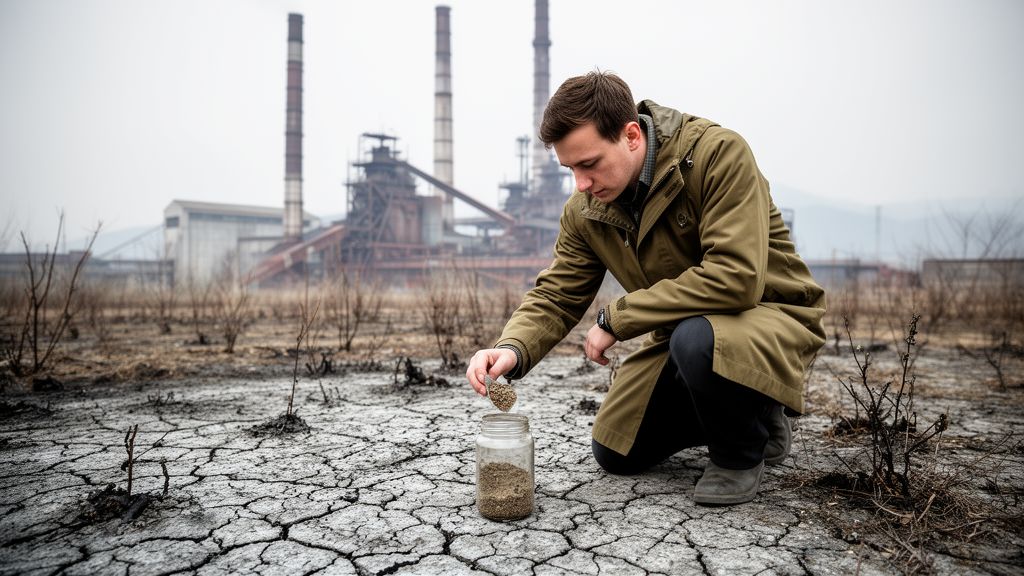
Soils around the KCM-2000 lead-zinc smelter near Plovdiv, Southern Bulgaria, carry heavy-metal burdens far above national guideline limits, and a new field survey of the area shows that the total number of soil bacteria falls sharply as that burden rises. At the most polluted site, 0.5 kilometres south of the smelter, total bacterial abundance estimated from 16S rRNA gene copies was 87 percent lower than at the least contaminated reference site, while the count of cultivable heterotrophic bacteria had dropped by 56 percent. The study, based on topsoil samples collected in June 2020, correlated bacterial abundance with soil physicochemical properties and with zinc, lead and cadmium concentrations along the contamination gradient spreading from the non-ferrous metal processing plant, the largest lead-zinc smelter in the country.
The research team sampled the top 20 centimetres of soil at five points selected from a monitoring map that considered the direction of diffuse pollution spread. Site KCM_1, described as the green belt of decorative trees, lies 0.5 kilometres south of the smelter on technogenic soil; KCM_2 lies 2 kilometres south; KCM_3, close to the village of Dolni Voden, lies 3 kilometres south; KCM_4 lies 1 kilometre south-east; and KCM_5 lies 1 kilometre east. Five subsamples per site were pooled for analysis. All soils were classified as alluvial and crop managed except at KCM_1. The soils were sandy loam in texture, with pH values between 6.7 and 7.2 measured in 0.1M calcium chloride, and total organic carbon ranging from 6.45 to 14.07 grams per kilogram. Nitrate nitrogen was especially abundant at KCM_1 and KCM_2, which the authors attributed probably to soil fertilization.
Heavy-metal concentrations were measured with an ELAN 5000 inductively coupled plasma mass spectrometer after aqua regia decomposition for total forms and extraction with 0.01M calcium chloride for bioavailable forms. Lead was the most serious pollutant in the area. Its total concentration exceeded the maximum permissible concentration allowed under Bulgarian Regulation 3/2008 by roughly 100 times at KCM_1, 57 times at KCM_4, 13.7 times at KCM_2 and 3 times at KCM_5. Cadmium exceeded the limit 92.45 times at KCM_1, 43 times at KCM_4, 7.85 times at KCM_2 and 4.0 times at KCM_5, while zinc exceeded it 29.5, 21.0, 4.8 and 2.0 times respectively. At KCM_3, zinc was below and lead and cadmium only slightly above the guideline values, so this site was treated as the control, with a Nemerow pollution index of exactly 1.00.
The Nemerow pollution index, which integrates the overall heavy-metal load of each sample, classified all soils as heavily contaminated except KCM_3, which showed only precautionary values. The index reached 73.27 at KCM_1, 37.46 at KCM_4, 8.74 at KCM_2 and 3.11 at KCM_5. Bioavailable forms told a different story from totals: bioavailable cadmium peaked at 9 milligrams per kilogram at KCM_1, and bioavailable lead was actually highest at the control site KCM_3 at 2.6 milligrams per kilogram, exceeding the values at KCM_2 and KCM_4 by 2.5 times. This detail later proved important when the team tried to explain why bacterial abundance at one site did not follow the general pattern.
To quantify bacterial abundance, the researchers used two complementary approaches. Cultivable heterotrophic bacteria were enumerated as colony-forming units on R2A medium at 25 degrees Celsius over two days, with a 10 to the power of minus 4 dilution plated in triplicate and 10 to 100 colonies per plate accepted for counting. Total bacterial abundance, including cells that do not grow in culture, was estimated by real-time quantitative PCR of the 16S rRNA gene with universal bacterial primers, using a SYBR Green supermix and a protocol with a PCR efficiency of 90 percent and an R squared of 0.9879. Genomic DNA was extracted from half a gram of soil with a commercial soil DNA kit and checked by spectrophotometry and agarose gel electrophoresis.
The results revealed a high overall bacterial abundance across the area, ranging from 1.49 times ten to the tenth to 17.80 times ten to the tenth 16S rRNA gene copies per sample, and from 1.30 to 3.70 million colony-forming units. Only KCM_2, 2 kilometres south of the smelter, bucked the declining trend: its bacterial abundance was about 27 percent higher in colony-forming units and 55 percent higher in 16S rRNA gene copies than at the control site. The authors suggested this inconsistency could reflect the toxicity of the much higher bioavailable lead concentrations in KCM_3 soil, or the modulating effects of the higher total organic carbon, nitrate nitrogen and phosphate concentrations measured at KCM_2. At the remaining sites, bacterial reduction in the contaminated soils varied between 45 and 56 percent for colony-forming units and between 54 and 87 percent for 16S rRNA gene copies, with KCM_5 showing a relatively low decrease of only 17 percent in gene copies, which the team explained by its comparatively low pollution index of 3.11.
Principal component analysis was used to condense the soil variables into an integrated pollution indicator. The first principal component explained 65.7 percent of the total soil variation and correlated negatively with total and bioavailable heavy-metal concentrations, nitrate nitrogen, soil pH and silt particles, while the second component explained 17.7 percent and correlated positively with sand and negatively with total organic carbon and phosphates. The ordination showed a clear gradient of contamination level and differences in soil characteristics between the sampling sites, so the first-component score for each site was regarded as an integral index of heavy-metal pollution across the study area. On this scale, KCM_3 with a score of 1.6 and KCM_2 with 1.57 were the least impacted soils, followed by KCM_5 at 1.7, while KCM_4 at 0.486 and KCM_1 at minus 5.35 were highly impacted.
When the first-component pollution scores were plotted against bacterial abundance, an exponential relationship emerged. The correlation between the integrated pollution index and 16S rRNA gene copies was strong, with an R squared of 0.8251, and was statistically significant according to a Student T-test with a p value of 0.017. The plot indicated both a dramatic decrease of soil bacterial abundance at KCM_1 and an exponential increase in gene copies along the gradient away from the most contaminated soil. The same analysis conducted with heterotrophic bacterial counts, however, found only a low relationship between soil characteristics and colony-forming units. The authors assumed this lack of significant correlation might have resulted from the limitations of the cultivation technique or from the high ecological tolerance of the cultivable representatives of the bacterial communities, citing earlier work suggesting that cultivable bacteria can be classified as r-strategic opportunists that grow fast, tolerate environmental fluctuations and resist outside impacts.
The findings fit into a wider body of work on how heavy metals shape soil microbial communities. Earlier studies cited by the team reported reduced diversity and abundance of soil microorganisms near a lead-zinc mining area, with zinc identified as the largest selective factor, and significant phylogenetic and functional shifts in bacterial communities exposed to lead, cadmium and zinc. Soil physicochemical properties such as pH, texture and organic matter are known to moderate the toxicity of heavy metals and play a key role in shaping community diversity and structure. The present results were consistent with the team’s previous studies in long-term soils contaminated with copper, zinc and lead around a copper mine and smelter, where both colony-forming units and 16S rRNA gene copies decreased, and with other reports of reduced counts under long-term heavy-metal pollution. Fajardo and colleagues have explained decreases in bacterial abundance under heavy metals by a decline in the metabolic activity of bacteria within soil microbial communities, although other authors have reported the opposite trend, in which copper, zinc, lead and cadmium affected abundance only slightly while strongly altering community diversity.
The authors concluded that bacterial abundance expressed as 16S rRNA gene copies is a more valuable indicator of heavy-metal contamination effects on soil inhabitants than heterotrophic bacterial abundance, whose cultivation-based estimation appears limited by the tolerance of the cultivable fraction. The reduction of bacterial abundance in the heavily contaminated soils indicated that soil properties such as pH, total organic carbon, inorganic ions and texture can modify the effects of the metals and the response of microorganisms to that stress in long-term contaminated soils. Because soil is highly heterogeneous, the team noted that microbial communities need to be investigated at different sites and scales, and further studies are needed to investigate the shifts in bacterial community structure in this area in response to the heavy-metal contamination gradient.
Subject of Research: Correlation between soil bacterial abundance, physicochemical soil properties and heavy-metal contamination along a pollution gradient near a non-ferrous metal processing plant in Southern Bulgaria
Article Title: Correlation between bacterial abundance, soil properties and heavy metal contamination in the area of non-ferrous metal processing plant, Southern Bulgaria
Article References: Nikolova, R., Petkova, M., Dinev, N., Kenarova, A., Boteva, S., Berov, D., & Radeva, G. (2022). Correlation between bacterial abundance, soil properties and heavy metal contamination in the area of non-ferrous metal processing plant, Southern Bulgaria. BioRisk, 17, 19-30. https://doi.org/10.3897/biorisk.17.77458
Image Credits: AI Generated
Keywords: soil microbiology, heavy metals, lead-zinc smelter, 16S rRNA qPCR, Bulgaria, soil contamination, bacterial abundance, Nemerow pollution index, Plovdiv, cadmium, lead, zinc
Cite Scienmag News
Morgan Morrow. (October 26, 2026). Soil Bacterial Abundance Tracks Heavy-Metal Contamination Near Bulgarian Lead-Zinc Smelter. Scienmag. https://scienmag.com/soil-bacterial-abundance-tracks-heavy-metal-contamination-near-bulgarian-lead-zinc-smelter/
Morgan Morrow. "Soil Bacterial Abundance Tracks Heavy-Metal Contamination Near Bulgarian Lead-Zinc Smelter." Scienmag, 26 October 2026, https://scienmag.com/soil-bacterial-abundance-tracks-heavy-metal-contamination-near-bulgarian-lead-zinc-smelter/. Accessed 26 October 2026.
Morgan Morrow. "Soil Bacterial Abundance Tracks Heavy-Metal Contamination Near Bulgarian Lead-Zinc Smelter." Scienmag. October 26, 2026. https://scienmag.com/soil-bacterial-abundance-tracks-heavy-metal-contamination-near-bulgarian-lead-zinc-smelter/


