


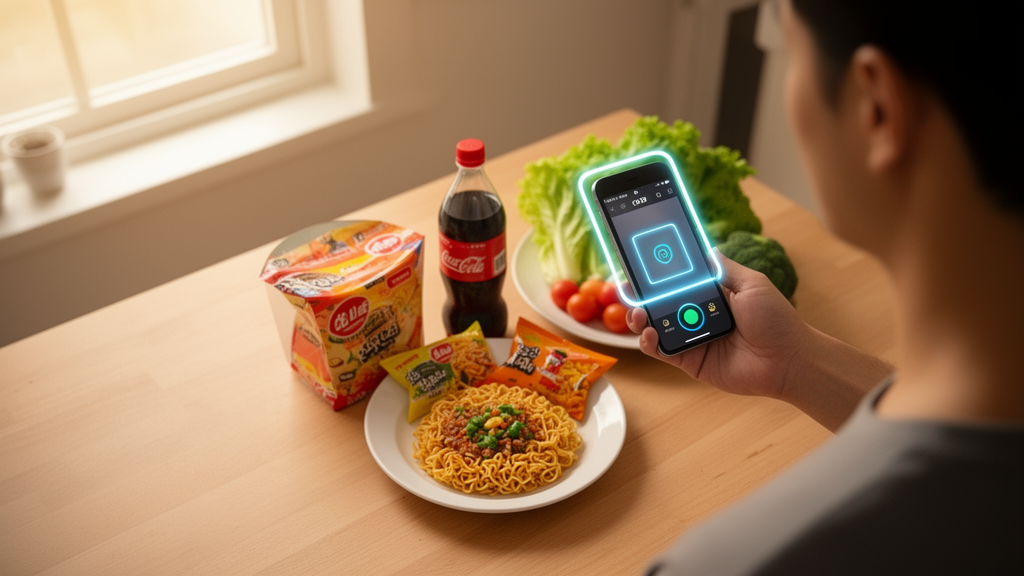
A plate of food photographed from above tells an artificial intelligence system far more than what it looks like. A newly published framework from researchers at The Education University of Hong Kong demonstrates that a multimodal large language model, connected to verified nutrition databases through an Internet of Things architecture, can identify individual food items from unconstrained meal images, retrieve their macronutrient and micronutrient profiles, classify their level of industrial processing using the NOVA taxonomy, and map the result onto a four-quadrant risk matrix that separates nutrient-dense whole foods from energy-dense ultra-processed products. The study, published in Frontiers in Nutrition, addresses a persistent blind spot in automated dietary assessment: the inability of existing tools to simultaneously evaluate what a meal contains nutritionally and how much industrial transformation it has undergone.
The researchers, Zhebang He, Steve W. Y. Mung, Peggy Pui Lai Or, and Chetwyn C. H. Chan, built their system around a four-phase cascaded pipeline that deliberately decouples visual perception from qualitative reasoning. In the first phase, a vision-language model segments the meal image into distinct food regions and generates open-vocabulary food-name predictions for each cropped patch. These raw descriptions are then aligned against the Center for Food Safety database through a predict-verify-align loop that employs named entity recognition and fuzzy matching to strip away non-essential culinary modifiers and map the output to standardized food entities. When exact matches fail, a fallback layer transforms the descriptive string into a structured food name that can still be processed downstream.
The second and third phases operate in parallel through dual-path retrieval-augmented generation architectures. Phase 2 retrieves quantitative nutrition labels per 100 grams of food mass from the Center for Food Safety repository, and when no direct entry exists, it queries external databases such as NHANES before falling back on LLM-based synthesis to generate a standardized nutrient vector. Phase 3 performs the same dual-path logic for NOVA classification, first querying the Open Food Facts database for explicit processing tiers and then, when no match is found, activating a text-based LLM that functions as an expert food-science auditor. This auditor decomposes ingredient structures and flags markers of industrial processing, including artificial texturizers, emulsifiers, high-fructose corn syrups, hydrogenated oils, and flavor enhancers, to assign a NOVA group from 1 through 4.
The fourth phase resolves the historical separation between nutrition tracking and processing assessment by routing both outputs into a two-dimensional decision matrix. One axis represents nutrient density, classified as high or low through a weighted scoring system that awards positive points for protein, dietary fiber, calcium, and iron while penalizing energy density, saturated fat, free sugars, and sodium. The other axis represents manufacturing severity, binarized as non-processed for NOVA Groups 1 and 2 or processed for Groups 3 and 4. The intersection produces four diagnostic quadrants: a green light for nutrient-dense whole foods, a yellow light for nutritionally sound items that carry industrial additive risk, a second yellow light for minimally processed foods with low nutrient density, and a red light for energy-dense, nutrient-poor ultra-processed formulations strongly associated with long-term metabolic health risks in epidemiological literature.
To validate the framework, the team constructed a novel benchmark called Nutrition-NOVA, which harmonizes quantitative profiles from the Center for Food Safety database with qualitative NOVA tiers from Open Food Facts. A systematic audit of the Open Food Facts repository, which comprises approximately 4.53 million commercial records, revealed that 75.0 percent of the dataset, roughly 3.39 million rows, lacked a NOVA classification entirely. This massive metadata deficit, attributed primarily to missing or unparseable ingredient information, mathematically justifies the need for the LLM fallback mechanisms embedded in the framework. After applying a NOVA-Strict pre-filtering protocol that retained only the 1.13 million nodes with validated processing tiers, the researchers embedded both datasets into a dense vector space using a pre-trained Sentence-Transformer model and established cross-database linkage through cosine similarity with a strict matching threshold of 0.75.
The choice of semantic vector matching over traditional lexical string matching proved critical. When comparing a raw whole-food entity such as fresh raw apple against an ultra-processed derivative like fresh raw apple candy, normalized Levenshtein similarity produced a misleadingly high score of 71.4 percent and Sørensen-Dice token overlap reached 85.7 percent, because both strings share three of four word tokens. Sentence-Transformer cosine similarity, in contrast, assigned the ultra-processed derivative a low vector similarity of 0.42, safely below the 0.75 filtering cutoff, while true whole-food category matches such as fresh raw apple against raw red delicious apple sustained a high alignment of 0.88. This approach prevented false-positive alignments across divergent processing tiers and guaranteed that only semantically and structurally equivalent entities sharing identical NOVA classifications were harmonized into the benchmark. The final dataset comprised 5,300 food cases paired with high-resolution meal images scraped under a CC-BY-4.0 license.
Experimental evaluation across 14 large language models and vision-language models revealed clear performance stratification. On the end-to-end visual benchmark, where models received raw meal plate images and were tasked with simultaneous dish identification, processing inference, and structured metric generation, GPT4.1 achieved the highest overall score with a Macro-F1 of 0.552, a mean absolute error of 0.600, an adjacent accuracy of 83.0 percent, and a quadratic weighted Kappa of 0.588. The Qwen-VL-Max baseline deployed in the platform achieved an adjacent accuracy of 77.7 percent across the full 5,300-sample dataset, with nearly identical results on a 100-sample subset, confirming statistical stability across evaluation scales. Among locally hosted open-weight models, Qwen3.6-27B achieved the strongest visual performance with a Macro-F1 of 0.318.
The decoupled text-only benchmark, which provided standardized food names directly to language models without visual input, revealed even stronger reasoning capabilities. GPT4.1 again led the benchmark with a Macro-F1 of 0.631, a mean absolute error of 0.500, an adjacent accuracy of 87.0 percent, and a quadratic weighted Kappa of 0.675. GPT5.4_mini followed closely with an adjacent accuracy of 80.0 percent. Among open-weight checkpoints evaluated across the complete dataset, Mistral-Small-3.2-24B-Instruct demonstrated the strongest alignment with a Macro-F1 of 0.497. Notably, structurally constrained API endpoints consistently outperformed unconstrained web-based interfaces, which frequently generated conversational responses that violated strict JSON schema requirements. ChatGPT’s web interface recorded a Macro-F1 of only 0.272 and a quadratic weighted Kappa of 0.044 in the text-only condition.
Adjacent accuracy emerged as the critical clinical safety metric. Rather than treating all misclassifications equally, this measure quantifies the percentage of predictions falling within one category of the true label, establishing the operational boundary within which automated recommendations remain clinically manageable. The high adjacent accuracy scores across top-performing models confirm that when errors occur, they are almost exclusively restricted to adjacent processing tiers, such as confusing a NOVA 1 minimally processed food with a NOVA 2 culinary ingredient, rather than producing extreme misclassifications that would compromise screening safety. The researchers note that under-triage errors, where the predicted NOVA level is lower than the actual level, present a potential false-negative hazard by under-reporting additive exposure, whereas over-triage errors act as a conservative over-warning that preserves user safety.
System latency profiling across deployment paradigms revealed distinct operational tradeoffs. The Qwen API backend achieved a total pipeline latency of 9.90 seconds with a standard deviation of 1.25 seconds, suitable for interactive meal scanning at the point of care. Phase 1 visual recognition consumed 5.85 seconds, Phase 2 nutrition retrieval executed in 1.24 seconds, and Phases 3 and 4 completed in 2.81 seconds. Local on-premise execution of the Gemma3-27B checkpoint on dual NVIDIA H20 GPUs recorded a total latency of 36.93 seconds, substantially slower but providing an isolated, zero-egress environment essential for privacy-sensitive hospital deployments. Token consumption averaged 1,690 input tokens and 1,961 output tokens per pipeline execution on the commercial API, while strict JSON schema enforcement restricted local output to just 343 tokens, dramatically reducing memory bandwidth utilization and accelerating decoding speed.
The framework’s modular architecture enables complete plug-and-play backend replaceability without architectural retraining. Healthcare institutions requiring maximum predictive precision can substitute higher-performing engines such as GPT4.1 directly into the vision and reasoning modules, while organizations prioritizing data privacy and compliance can deploy open-source checkpoints on local high-performance computing clusters without modifying prompt templates, database linkages, or clinical decision-matrix mapping logic. The researchers emphasize that the two-dimensional decision matrix functions as an automated dietary auditing and risk-screening utility designed for personal health monitoring and clinical decision support, not as a direct medical diagnostic device. Translating computational meal screening into individual clinical risk prognosis requires prospective validation trials, and future deployment will position the framework as an adjunct screening tool to assist dietitians and users in identifying ultra-processed food exposure rather than an autonomous diagnostic system. Future work will expand the underlying knowledge graph to incorporate broader global regional cuisines and specialized medical nutrition therapy protocols, replace symmetric evaluation metrics with asymmetric risk-weighted clinical loss functions that penalize under-triage over conservative over-warning, and integrate real-time mobile deployment into prospective clinical trials evaluating long-term dietary compliance and automated metabolic risk monitoring.
Subject of Research: An IoT-enabled multimodal large language model framework for automated food recognition, nutrient profiling, NOVA ultra-processed food classification, and dietary cancer risk screening
Article Title: IoT-enabled multimodal large language model-based framework for compositional food recognition, nutrient profiling, NOVA classification, and cancer risk mitigation
Article References: He, Z., Mung, S. W. Y., Or, P. P. L., & Chan, C. C. H. (2026). IoT-enabled multimodal large language model-based framework for compositional food recognition, nutrient profiling, NOVA classification, and cancer risk mitigation. Frontiers in Nutrition, 13, Article 1970182. https://doi.org/10.3389/fnut.2026.1970182
Image Credits: AI Generated
DOI: 10.3389/fnut.2026.1970182
Keywords: artificial intelligence, large language models, NOVA classification, ultra-processed foods, nutrition monitoring, dietary assessment, computer vision, Internet of Things, food recognition, cancer risk, digital health, retrieval-augmented generation
Cite Scienmag News
Daisy Hatcher. (October 26, 2026). AI System Spots Ultra-Processed Foods Hidden in Your Meals From a Single Photo. Scienmag. https://scienmag.com/ai-system-spots-ultra-processed-foods-hidden-in-your-meals-from-a-single-photo/
Daisy Hatcher. "AI System Spots Ultra-Processed Foods Hidden in Your Meals From a Single Photo." Scienmag, 26 October 2026, https://scienmag.com/ai-system-spots-ultra-processed-foods-hidden-in-your-meals-from-a-single-photo/. Accessed 26 October 2026.
Daisy Hatcher. "AI System Spots Ultra-Processed Foods Hidden in Your Meals From a Single Photo." Scienmag. October 26, 2026. https://scienmag.com/ai-system-spots-ultra-processed-foods-hidden-in-your-meals-from-a-single-photo/


