

Monday, October 26, 2026
Science
No Result
View All Result
  • Login
  • HOME
  • SCIENCE NEWS
  • CONTACT US
  • HOME
  • SCIENCE NEWS
  • CONTACT US
No Result
View All Result
Scienmag
No Result
View All Result
Home Science News Earth Science

Sudan’s returning rains are not refilling the soil beneath them

October 26, 2026
in Earth Science
Violet Maxwell
By Violet Maxwell Scienmag Editorial Profile - Natural Hazards
Reading Time: 3 mins read
0
Sudan’s returning rains are not refilling the soil beneath them

Sudan's returning rains are not refilling the soil beneath them

65
SHARES
587
VIEWS
Share on FacebookShare on Twitter
ADVERTISEMENT

More rain has been falling over parts of Sudan's drylands during the core growing season, yet the water is not necessarily reaching the roots of crops. A study published in Theoretical and Applied Climatology examined June-to-September rainfall, temperature, root-zone soil moisture, vegetation greenness and drought across ten dryland states between 1990 and 2023, and found that a partial rainfall recovery in some states coincided with widespread declines in soil moisture and rising nighttime temperatures elsewhere. North Darfur recorded a significant trend of 1.50 millimeters per year, which the authors calculate as a cumulative increase of 38.5 percent relative to its long-term mean June-September rainfall of 132.4 millimeters.

North Kordofan gained 2.23 millimeters per year, equivalent to 38.6 percent above its long-term mean of 196.3 millimeters. On paper, these are substantial recoveries for regions where rainfed agriculture depends critically on the summer wet season. But the multi-variable assessment showed that rainfall totals alone tell an incomplete story.

Root-zone soil moisture declined in seven states: Aj Jazirah, Blue Nile, Kassala, Sennar, South Darfur, South Kordofan and White Nile. At the same time, nighttime minimum temperatures rose in North Kordofan, Kassala, Aj Jazirah, White Nile and South Kordofan, with cumulative warming of 0.34 to 0.67 degrees Celsius over the 34-year record. The choice of drought index also changed the picture materially.

When the researchers compared two widely used indicators across 340 state-year records, the Standardized Precipitation Evapotranspiration Index, which accounts for atmospheric demand as well as rainfall supply, identified 12.5 percent more drought events than the rainfall-only Standardized Precipitation Index. In other words, a drought metric that ignores evapotranspiration can understate how often growing-season water stress appears in the record. Vegetation responses added a further layer of nuance.

Satellite-derived greenness, measured through the Normalized Difference Vegetation Index, showed significant trends in only three states: West Darfur, South Darfur and Aj Jazirah. North Kordofan, despite its strong rainfall recovery, showed neutral soil moisture and a non-significant vegetation response, meaning the additional rain did not translate into a measurable vegetation signal in that state during the study period. Taken together, the findings indicate that precipitation recovery was not by itself a reliable hydroclimatic indicator in the states and period analyzed.

A state can register significant rainfall gains while its soils show declining moisture, its nights warm and its vegetation fails to respond. The authors argue that drought early-warning systems would benefit from incorporating evapotranspiration-sensitive indices and root-zone monitoring rather than relying on precipitation alone. The study's scope carries clear limits.

It covers ten dryland states over 1990 to 2023, and the significant trends it reports apply to those states and that period; the analysis is observational, so it identifies associations among rainfall, temperature, soil moisture and vegetation rather than establishing causal mechanisms. Even so, its central message is a caution for dryland hydroclimatology: in a warming environment, more rain does not guarantee more available water, and monitoring systems that count only what falls from the sky may miss the stress unfolding in the soil.

Subject of Research: Trends in growing-season rainfall, evaporative demand, root-zone soil moisture, vegetation and drought across Sudan's dryland states from 1990 to 2023

Article Title: Partial rainfall recovery and evaporative-demands effects across Sudan’s drylands: a multi-variable JJAS assessment (1990–2023)

Article References: Rudwan, A., Lou, Y., Hussien, A., Gamreldin, E., Rashid, R., Datti, A. D., & Magara, G. (2026). Partial rainfall recovery and evaporative-demands effects across Sudan’s drylands: a multi-variable JJAS assessment (1990–2023). Theoretical and Applied Climatology, 157(11), Article 754. https://doi.org/10.1007/s00704-026-06688-9

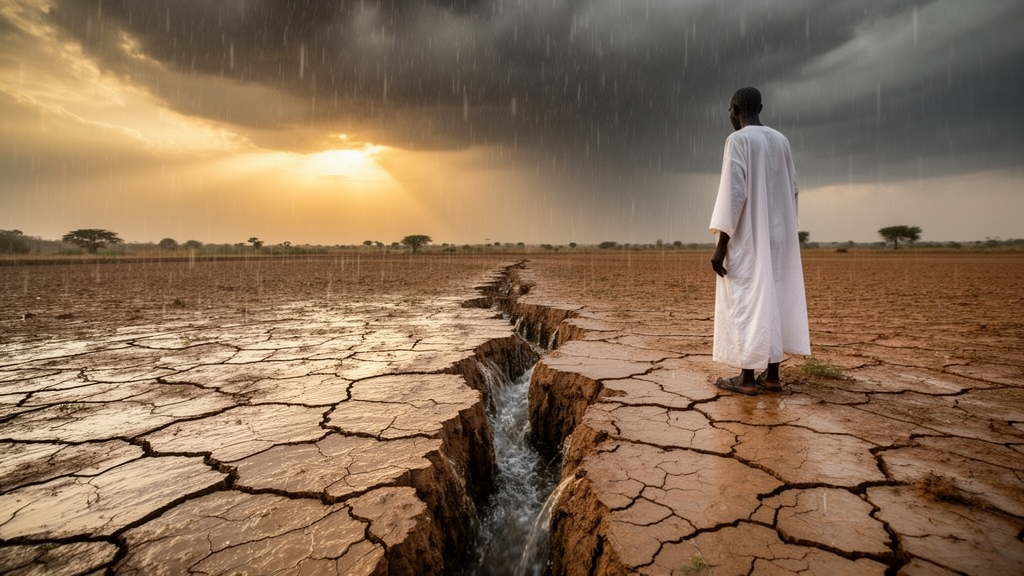
Image Credits: AI Generated

DOI: 10.1007/s00704-026-06688-9

Keywords: Sudan, drylands, rainfall recovery, root-zone soil moisture, evaporative demand, drought indices, SPEI, NDVI, JJAS rainfall, climate warming, rainfed agriculture, early-warning systems

Cite Scienmag News

Violet Maxwell. (October 26, 2026). Sudan’s returning rains are not refilling the soil beneath them. Scienmag. https://scienmag.com/sudans-returning-rains-are-not-refilling-the-soil-beneath-them/

Violet Maxwell. "Sudan’s returning rains are not refilling the soil beneath them." Scienmag, 26 October 2026, https://scienmag.com/sudans-returning-rains-are-not-refilling-the-soil-beneath-them/. Accessed 26 October 2026.

Violet Maxwell. "Sudan’s returning rains are not refilling the soil beneath them." Scienmag. October 26, 2026. https://scienmag.com/sudans-returning-rains-are-not-refilling-the-soil-beneath-them/


Tags: climate change effects on Sudan agricultureclimate study on Sudan's rainfall patternsclimate warmingdrought and vegetation health in Sudandrought indicesdryland crop resiliencedrylandsearly warning systemsevaporative demandimplications of changing rainfall for Sudanese farmersJJAS rainfallNDVInighttime temperature rise in Sudanrainfall and temperature variability in Sudanrainfall recoveryrainfall recovery in Sudanese drylandsrainfed agricultureroot-zone soil moistureroot-zone soil moisture trendssoil moisture decline in SudanSPEISudanSudan drought impactwater availability for rainfed agriculture
Share26Tweet16
Previous Post

New AI model sharpens subway passenger flow forecasts across three Chinese metros

Next Post

Multi-scale transformer network sharpens brain tumor segmentation on MRI scans

Related Posts

GOCI-II, Sentinel-2 and Sentinel-3 Compared on East China Sea Algal Blooms
Earth Science

GOCI-II, Sentinel-2 and Sentinel-3 Compared on East China Sea Algal Blooms

October 26, 2026
Citizen scientists map Poland’s mosses, but a dozen enthusiasts dominate the data
Earth Science

Citizen scientists map Poland’s mosses, but a dozen enthusiasts dominate the data

October 26, 2026
CatBoost Leads Chronologically Validated Air Quality Index Prediction Across Indian Cities
Earth Science

CatBoost Leads Chronologically Validated Air Quality Index Prediction Across Indian Cities

October 26, 2026
Rotating Poincaré Waves Reveal Where Tidal Models Feel Bottom Friction
Earth Science

Rotating Poincaré Waves Reveal Where Tidal Models Feel Bottom Friction

October 26, 2026
North Atlantic Oscillation Drives Winter Streamflow Across Moroccan Rivers
Earth Science

North Atlantic Oscillation Drives Winter Streamflow Across Moroccan Rivers

October 26, 2026
Mining Dam Disaster Pushed Aquatic Ecosystems Past Critical Ecological Thresholds
Earth Science

Mining Dam Disaster Pushed Aquatic Ecosystems Past Critical Ecological Thresholds

October 26, 2026
Next Post
Multi-scale transformer network sharpens brain tumor segmentation on MRI scans

Multi-scale transformer network sharpens brain tumor segmentation on MRI scans

  • Mothers who receive childcare support from maternal grandparents show more optimized

    Mothers who receive childcare support from maternal grandparents show more parental warmth, finds NTU Singapore study

    27656 shares
    Share 11059 Tweet 6912
  • University of Seville Breaks 120-Year-Old Mystery, Revises a Key Einstein Concept

    1061 shares
    Share 424 Tweet 265
  • Bee body mass, pathogens and local climate influence heat tolerance

    682 shares
    Share 273 Tweet 171
  • Researchers record first-ever images and data of a shark experiencing a boat strike

    546 shares
    Share 218 Tweet 137
  • Groundbreaking Clinical Trial Reveals Lubiprostone Enhances Kidney Function

    531 shares
    Share 212 Tweet 133
Science

Embark on a thrilling journey of discovery with Scienmag.com—your ultimate source for cutting-edge breakthroughs. Immerse yourself in a world where curiosity knows no limits and tomorrow’s possibilities become today’s reality!

RECENT NEWS

  • Telemedicine Lifestyle Program Linked to Weight Loss and Better Blood Sugar Control in Metabolic Syndrome
  • Standard Survival Model Fails for Ethiopian Colorectal Cancer Data
  • Hepatitis E Accounts for Small Share of Suspected Acute Hepatitis in Brazil
  • Step Counts Outperform Smartwatch Intensity Algorithms in Health Phenotyping Study

Categories

  • Agriculture
  • Anthropology
  • Archaeology
  • Athmospheric
  • Biology
  • Biotechnology
  • Blog
  • Bussines
  • Cancer
  • Chemistry
  • Climate
  • Earth Science
  • Editorial Policy
  • Marine
  • Mathematics
  • Medicine
  • Pediatry
  • Policy
  • Psychology & Psychiatry
  • Science Education
  • Science News
  • Social Science
  • Space
  • Technology and Engineering

Subscribe to Blog via Email

Enter your email address to subscribe to this blog and receive notifications of new posts by email.

Join 5,151 other subscribers

© 2025 Scienmag - Science Magazine

Welcome Back!

Login to your account below

Forgotten Password?

Retrieve your password

Please enter your username or email address to reset your password.

Log In
No Result
View All Result
  • HOME
  • SCIENCE NEWS
  • CONTACT US

© 2025 Scienmag - Science Magazine

Discover more from Science

Subscribe now to keep reading and get access to the full archive.

Continue reading