


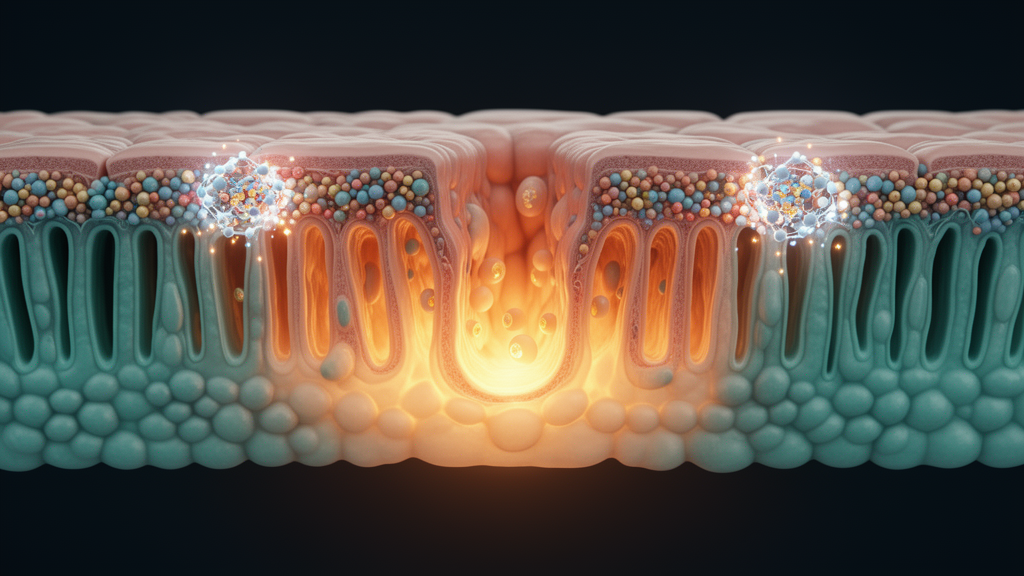
Runqi Wang, Zhengran Li, Jing Wei, Jiajia Wang, Xiyue Liu Tao, Danjie Zhang, Ruiyan Kong, Xuejing Ren, Hang Zhao and Zhouhua Li report an unprecedented function for the protein Auxilin in enteroendocrine cells, the hormone-producing cells of the intestinal lining. When Auxilin was depleted from all enteroendocrine cells, intestinal homeostasis broke down: intestinal stem cells proliferated excessively and generated aberrant progeny differentiation. The study, published as a research article, shows that differentiated cells actively restrain stem cell behavior through inter-cell signaling relays rather than acting as passive bystanders.
The mechanism centers on signaling molecules whose balance shifts when Auxilin is lost. In Auxilin-depleted enteroendocrine cells, levels of the secreted factor Slit dropped dramatically, while expression of the cytokine Upd3 rose significantly both in some Auxilin-depleted enteroendocrine cells and in neighboring wild-type enterocytes. Providing Slit ectopically effectively rescued the intestinal defects observed when Auxilin was knocked down, indicating that loss of this factor is a key driver of the stem cell overproliferation phenotype.
A second layer of the pathway involves EGFR signaling. In Auxilin-depleted enteroendocrine cells, EGFR signaling became ectopically activated because the EGFR protein accumulated abnormally. When the authors further inhibited EGFR signaling, the intestinal defects were completely suppressed, placing EGFR activation downstream of Auxilin loss in the cascade that unleashes stem cell proliferation.
The study also resolved how activated EGFR feeds back onto Slit: EGFR signaling suppresses Slit transcription through the transcription factor Pointed, which binds to regulatory regions of the Slit gene. This establishes a coherent signaling relay in which Auxilin normally keeps EGFR activity in check, allowing Slit expression to persist and hold intestinal stem cells at an appropriate proliferation rate. When the relay breaks, EGFR accumulates, Pointed silences Slit, and stem cells escape control.
Beyond defining tissue homeostasis, the authors note that the same inter-cell communications are relevant to tumorigenesis, since uncontrolled stem cell proliferation is a hallmark of tumor formation. The work uncovers a mechanism by which differentiated cells properly control stem cell proliferation through inter-cell signaling relays during tissue maintenance.
Subject of Research: How Auxilin in enteroendocrine cells restrains intestinal stem cell proliferation through Slit, Upd3 and EGFR signaling relays
Article Title: Auxilin in enteroendocrine cells controls intestinal homeostasis through inter-cell signaling relays
Article References: Wang, R., Li, Z., Wei, J., Wang, J., Tao, X. L., Zhang, D., Kong, R., Ren, X., Zhao, H., & Li, Z. (2026). Auxilin in enteroendocrine cells controls intestinal homeostasis through inter-cell signaling relays. PLOS Genetics, 22(10), e1012353. https://doi.org/10.1371/journal.pgen.1012353
Image Credits: AI Generated
DOI: 10.1371/journal.pgen.1012353
Keywords: Auxilin, enteroendocrine cells, intestinal stem cells, Slit, EGFR signaling, Upd3, Pointed, tissue homeostasis, cell-cell communication, tumorigenesis, enteroendocrine, cells
Cite Scienmag News
Drew Townsend. (October 26, 2026). Auxilin in Enteroendocrine Cells Keeps Intestinal Stem Cell Proliferation in Check. Scienmag. https://scienmag.com/auxilin-in-enteroendocrine-cells-keeps-intestinal-stem-cell-proliferation-in-check/
Drew Townsend. "Auxilin in Enteroendocrine Cells Keeps Intestinal Stem Cell Proliferation in Check." Scienmag, 26 October 2026, https://scienmag.com/auxilin-in-enteroendocrine-cells-keeps-intestinal-stem-cell-proliferation-in-check/. Accessed 26 October 2026.
Drew Townsend. "Auxilin in Enteroendocrine Cells Keeps Intestinal Stem Cell Proliferation in Check." Scienmag. October 26, 2026. https://scienmag.com/auxilin-in-enteroendocrine-cells-keeps-intestinal-stem-cell-proliferation-in-check/


