


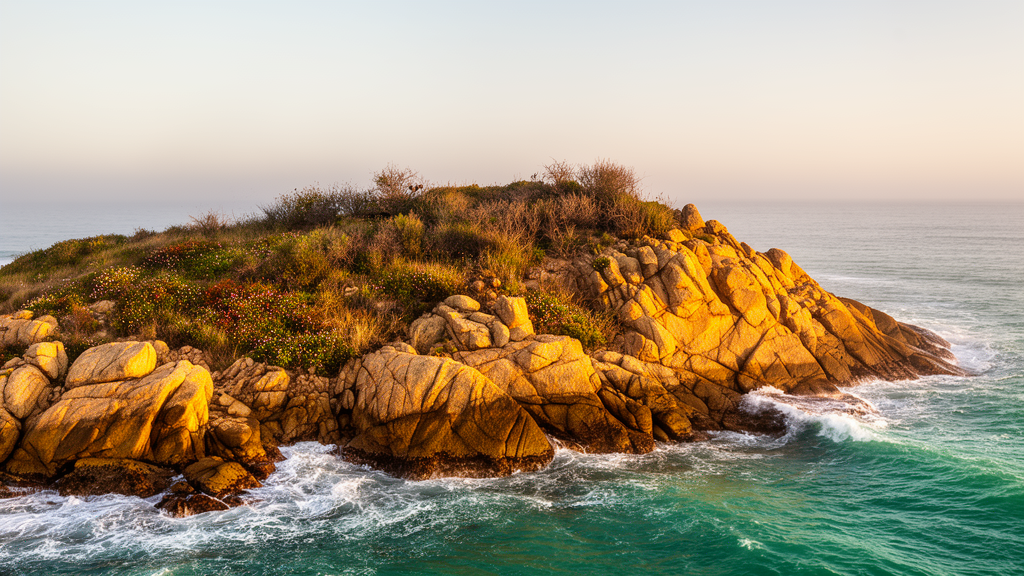
A nine-year botanical survey of Punta Ballena, a rocky point on Uruguay’s southern coast, has documented 427 species of vascular plants packed into roughly 20 hectares of remaining natural habitat, a flora that corresponds to about 15% of the entire known plant diversity of Uruguay. The inventory, compiled from herbarium records and systematic fieldwork carried out every year from 2013 to 2021, also identified seven distinct vegetation types, 64 endemic taxa, 33 species considered priority for conservation in the country, and six species threatened according to IUCN criteria. At the same time, the researchers confirmed that 14% of the taxa historically documented at the site have not been registered in recent years, and that five species are now considered locally extinct, a loss they attribute largely to decades of tourist and urban development.
Punta Ballena lies in the Maldonado Department, about 12 kilometres west of Punta del Este, the country’s most important seaside resort. The rocky point is the coastal southern tip of the Sierra de la Ballena, a shear zone roughly 4 kilometres wide that marks the tectonic boundary between two geological terrains, the Terreno Nico Pérez to the west and the Cuchilla Dionisio to the east. The rocks are intensely deformed metamorphic materials of granitic composition, including granite mylonites, quartz mylonites, philonites and mylonitic porphyry. Because quartz mylonite and mylonitic porphyry resist erosion, they form the prominent outcrop ridges that characterise the site, reaching 50 metres in height only 200 metres from the coastline. The point extends into the outer estuary zone of the Río de la Plata, where the climate is humid subtropical, with a mean annual temperature of about 17 °C and mean annual precipitation of roughly 1,146 millimetres.
The site is far from pristine. Transformation began in 1896, when the merchant sailor Antonio Lussich bought the area and converted extensive dunes and hills into an artificial forest, part of which survives today as an arboretum. Over the last 70 years, tourist-urbanistic development accelerated, initially led by the architect Bonet, and has continued with strong backing from the departmental government. Today an urbanised area and a natural area of about 20 hectares coexist on the point. The natural zone hosts fishing, paragliding, abseiling, hiking and cave visits, and is prized for whale and bird watching, particularly when southern right whales visit the coast. The famous Casapueblo museum and hotel, built by the painter Carlos Páez Vilaró, alone receives between 800 and 1,500 visitors per day in the high season, and the rocky point as a whole receives many more visitors than the museum itself.
To build the species list, the team revised specimens held in three national herbaria, MVFA, MVJB and MVM, and conducted systematic field surveys across the remaining natural areas between buildings, with more exhaustive sampling on the extreme point of the headland. Fieldwork took place regularly during spring each year from 2013 to 2021, and in the last three years also during summer and autumn to capture species that flower at those times. Sterile live collections were cultivated until flowering when identification required it, and species not documented in national herbaria were collected and deposited at MVJB. Nomenclature followed the Flora del Cono Sur database and the International Plant Names Index, with updated treatments for particular genera where recent taxonomic studies exist. Each species was classified by type of record, vegetation type, life form, geographic origin, conservation status and endemism.
The resulting flora is dominated by herbs, which account for 76% of the species, with evergreen herbs, grasses and graminoids, and therophytes each representing around a fifth of the flora, followed by seasonal herbs that persist through subterranean or basal resistant structures at nearly 16%. Suffrutices made up 9.6% of species, shrubs 4.2% and cacti 3.5%, while ferns and lycophytes, vines, trees and arborescent monocots each contributed less than 2%. Asteraceae and Poaceae were the richest families with 82 species each, followed by Fabaceae with 26, Cactaceae and Cyperaceae with 14 each, Iridaceae and Solanaceae with 12 each, and Amaryllidaceae and Rubiaceae with 11 each. The authors note that these dominant families coincide with those of highest richness for Uruguay as a whole and dominate the Río de la Plata grasslands ecoregion.
Five main native vegetation types were mapped within the natural area. Rupicolous herblands, growing over and between rocks where soil is less than 10 centimetres deep, are the most extensive, covering nine hectares and harbouring 35% of the flora. Mesophilic herblands occupy long slopes above 20 metres in elevation on soils around 50 centimetres deep, covering 5.3 hectares and holding 34% of the species. Halophilic grasslands, exposed to temporary flooding from the Río de la Plata on the extreme point, cover less than 0.3 hectares and support about 3% of the flora. Hydrophilic herblands, found only on the western slope in depressions with the deepest soils, more than 80 centimetres, hold roughly 7% of the species, while humid rocky shelter communities on tide-exposed rocks cover less than 0.1 hectares. Two additional types, native forest patches and vegetation of disturbed areas, occur along the sides of the access road.
The conservation value of the site is striking. In total, 74 taxa, 17% of the site’s flora, are endemic, threatened or priority species for conservation. According to IUCN criteria, the irid Cypella osteniana is endangered, and five species are vulnerable: the asclepiad Oxypetalum marchesii and four cacti, Parodia concinna, P. ottonis, P. scopa and P. sellowii. Of the 64 endemic taxa, 48 are regional endemics whose distribution falls within the southern Paranaense Province or Subregion, 13 are restricted to Uruguay, and two are local endemics found only at Punta Ballena: the aster Senecio ostenii var. balaenicus and the cactus Parodia tabularis, the latter showing a reduction in its population each year. The regional endemics reflect a mixture of grassland species with subtropical elements of Atlantic or Paranaense affinity, including several Bipinnula orchids, Mimosa species and globose cacti.
The historical comparison reveals a sobering pattern. Of the taxa documented at the site, 14% had not been registered in recent years; applying a precautionary principle, the authors kept them on the list, since some may persist in diminished populations. However, five species were confirmed as locally extinct: Oxypetalum nigricans, Gyptis commersonii, Gyptis tanacetifolia, Agalinis digitalis and Parodia mammulosa. For all of these, their typical environments were reduced or lost, and in the habitats that remain they were not found despite intense searching. The authors consider this loss a likely direct consequence of the urban development of recent decades. Continuous surveys also revealed severely diminished populations in other species, including the cacti Frailea pygmaea and Gymnocalycium hyptiacanthum and the legume Lathyrus subulatus, and a decrease in the abundance of all Cactaceae species, probably as a consequence of illegal collection by visitors.
Exotic species represent 13% of the flora, and 11 of them are considered invasive alien species for Uruguay. Carpobrotus edulis is of particular concern because it is locally spreading through the rupicolous communities of the rocky point, while Cynodon dactylon forms a dense mat in parts of the mesophilic herbland, especially near parking lots. Pittosporum undulatum grows mainly along the access road and Ulex europaeus is locally restricted to one sector. The authors argue that these invasions threaten the diverse native flora and note earlier recommendations that rapid control actions be carried out in coastal departments, both to reduce impacts on coastal ecosystems and to mitigate economic losses in a locality that depends on tourism.
The study’s authors conclude that the natural area of the rocky point qualifies as a plant hotspot, supporting an exceptionally high flora on a reduced surface together with numerous endemic, priority and threatened species, and that its loss or reduction would seriously endanger these species. They recommend that undeveloped private spaces be left unmodified, that vehicular traffic and irregular parking in vegetated areas be regulated, that grass cutting along the access road be avoided or minimised, that boardwalks with interpretive signage be installed, and that measures be taken to stop the illegal extraction of cacti and other plants. They also call for regulation of the plant species used in gardens and green roofs, since several commonly planted species are exotic invasives. The inventory, they hope, lays the foundation for conservation plans and for defining future actions and responsibilities for this emblematic stretch of the Uruguayan coast.
Subject of Research: Floristic inventory and conservation assessment of the vascular plants of the Punta Ballena coastal rocky point, Uruguay
Article Title: Vascular plants of Punta Ballena: dataset for conservation of an endangered hotspot from Uruguay
Article References: Mai, P., Zabaleta, M., Cappuccio, L., Pollero, A., & Marchesi, E. (2022). Vascular plants of Punta Ballena: dataset for conservation of an endangered hotspot from Uruguay. Neotropical Biology and Conservation, 17(2), 163-195. https://doi.org/10.3897/neotropical.17.e84893
Image Credits: AI Generated
DOI: 10.3897/neotropical.17.e84893
Keywords: Punta Ballena, Uruguay, vascular plants, floristic inventory, endemism, coastal rocky points, plant conservation, invasive alien species, Cactaceae, urban development, biodiversity hotspot, IUCN threat status
Cite Scienmag News
Margaret Porter. (October 26, 2026). Uruguay’s Punta Ballena rocky point hosts 427 plant species, but 14% have vanished. Scienmag. https://scienmag.com/uruguays-punta-ballena-rocky-point-hosts-427-plant-species-but-14-have-vanished/
Margaret Porter. "Uruguay’s Punta Ballena rocky point hosts 427 plant species, but 14% have vanished." Scienmag, 26 October 2026, https://scienmag.com/uruguays-punta-ballena-rocky-point-hosts-427-plant-species-but-14-have-vanished/. Accessed 26 October 2026.
Margaret Porter. "Uruguay’s Punta Ballena rocky point hosts 427 plant species, but 14% have vanished." Scienmag. October 26, 2026. https://scienmag.com/uruguays-punta-ballena-rocky-point-hosts-427-plant-species-but-14-have-vanished/


