


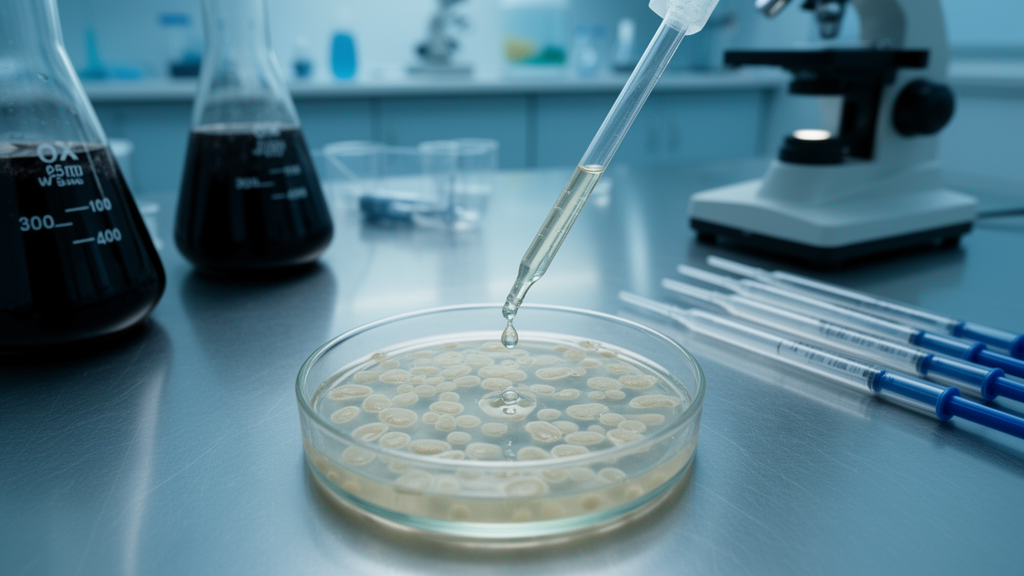
A compound isolated from a marine bacterium has shown rapid and highly selective activity against Naegleria fowleri, the free-living amoeba responsible for primary amoebic meningoencephalitis (PAM), one of the deadliest infections known to medicine. The study, led by researchers at the University of California San Diego and published in the journal Marine Drugs, reports that the compound, rutamycin B, killed multiple clinical strains of the amoeba at low concentrations and reached its full effect within four hours — considerably faster than amphotericin B, the current gold-standard drug, which requires roughly sixteen hours to achieve comparable potency.
PAM is an almost uniformly fatal disease, with a fatality rate exceeding 97 percent. The infection causes the rapid deterioration of brain tissue, and patients often have only a few days in which treatment can hope to alter the outcome. Existing therapies, including amphotericin B, are limited by slow action and significant toxicity, which is precisely the therapeutic window the UC San Diego team set out to address.
“Current treatments for PAM often act too slowly or carry heavy toxicity,” said Anjan Debnath, PhD, associate professor at the UC San Diego Skaggs School of Pharmacy and Pharmaceutical Sciences and co-director of the university’s Center for Discovery and Innovation in Parasitic Diseases. “By identifying a compound that is both faster and more selective, we are moving closer to a treatment that can stop the infection before it causes irreversible damage, which could fundamentally change the prognosis for people who contract this parasite.”
The laboratory findings point to several advantages of rutamycin B. In addition to its faster onset of action, the compound was 200 to 300 times more lethal to the amoeba than to human cells, a selectivity margin that is critical for any candidate intended to treat an infection of the central nervous system. Mechanistically, rutamycin B works by shutting down an enzyme the parasite relies on to produce energy, effectively starving the organism. The team also tested the compound in combination with the existing standard treatment and found that the same antiamoebic effect could be achieved with as little as 3 to 10 percent of the original dose of rutamycin B, suggesting that combination therapy could reduce the amount of drug needed and potentially limit toxicity.
The compound’s origin underscores a broader theme in drug discovery: the ocean as an underexplored reservoir of bioactive chemistry. Rutamycin B was isolated from a marine bacterium by researchers at UC San Diego’s Scripps Institution of Oceanography. “The ocean contains a diverse library of chemicals, and we’ve only just scratched its surface,” said William Fenical, PhD, Distinguished Professor emeritus at Scripps. “These results are a powerful reminder that the solutions to some of our most challenging medical problems may be hiding in unexpected places.”
Beyond its immediate potency, the researchers believe the structural properties of rutamycin B make it a promising candidate for further pharmacological optimization. Because N. fowleri infects the brain, any effective therapy must reach the central nervous system, and the team is planning future studies to evaluate whether the compound can cross the blood-brain barrier and to test its efficacy in live disease models. These are essential steps: the current results come from laboratory experiments against clinical amoeba strains, and potency in a dish does not guarantee that a drug will penetrate brain tissue or clear an established infection in a patient.
The study was led by Debnath, Fenical, and Hayley Fong, PhD, who carried out the project as part of her doctoral research at UC San Diego. The work was funded in part by grants from the National Institutes of Health (R21EY034294 and R21AI171538), and an international patent application related to the findings was filed on March 12, 2026. The researchers caution that considerably more research will be needed before the approach could reach the clinic, but for a disease that has historically left almost no survivors, a faster-acting and more selective compound represents a meaningful step toward a viable treatment strategy.
Subject of Research: A marine bacterium-derived compound, rutamycin B, as a potential faster-acting therapy for primary amoebic meningoencephalitis caused by Naegleria fowleri
Article Title: Research Alert: Marine molecule may help combat “brain-eating” amoeba
Article References: Research Alert: Marine molecule may help combat “brain-eating” amoeba. Original publication (Bibliographic details unavailable.)
Image Credits: AI Generated
DOI: Not provided
Keywords: Naegleria fowleri, primary amoebic meningoencephalitis, rutamycin B, marine natural products, drug discovery, amphotericin B, blood-brain barrier, antiparasitic agents, Scripps Institution of Oceanography, Marine Drugs, Research, Alert
Cite Scienmag News
Cassandra Pierce. (October 26, 2026). Marine bacterium compound shows rapid potency against brain-eating amoeba. Scienmag. https://scienmag.com/marine-bacterium-compound-shows-rapid-potency-against-brain-eating-amoeba/
Cassandra Pierce. "Marine bacterium compound shows rapid potency against brain-eating amoeba." Scienmag, 26 October 2026, https://scienmag.com/marine-bacterium-compound-shows-rapid-potency-against-brain-eating-amoeba/. Accessed 26 October 2026.
Cassandra Pierce. "Marine bacterium compound shows rapid potency against brain-eating amoeba." Scienmag. October 26, 2026. https://scienmag.com/marine-bacterium-compound-shows-rapid-potency-against-brain-eating-amoeba/


