


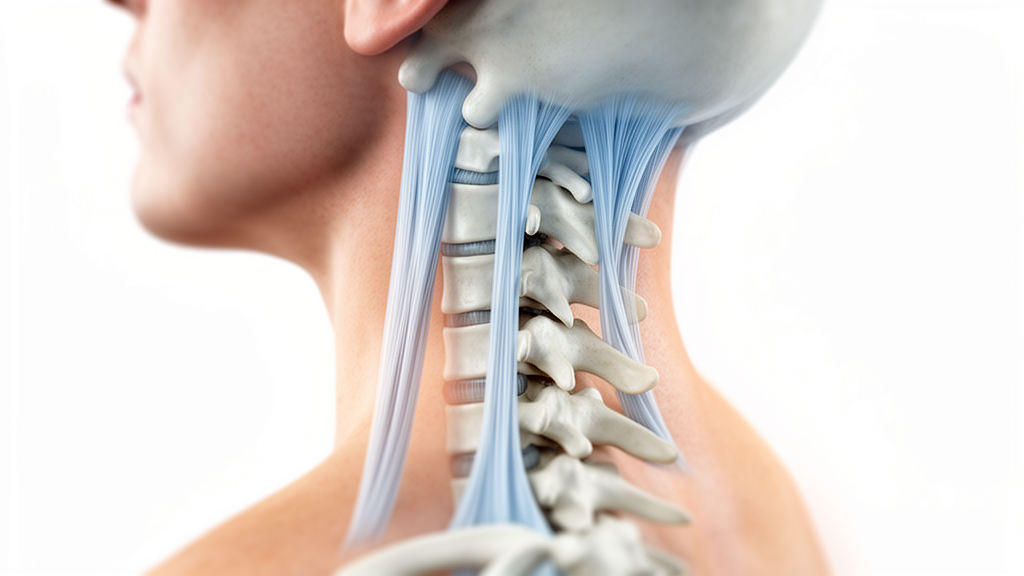
A new narrative review published in Frontiers in Neuroscience argues that instability of the upper cervical spine, long treated as a niche orthopedic concern, may be an under-recognized contributor to the dizziness, fainting, and fatigue that plague many patients with hypermobile Ehlers-Danlos syndrome. The analysis, conducted by physicians at Franklin Cardiovascular Associates in New Jersey, synthesized 43 studies published through August 2026 and found consistent evidence linking hypermobility disorders to both autonomic dysfunction and instability at the craniocervical junction, the point where the skull meets the top of the spine.
The autonomic nervous system governs involuntary processes across every organ system, from heart rate and blood pressure to digestion and thermoregulation. When it malfunctions, patients can experience orthostatic intolerance, palpitations, gastrointestinal dysmotility, cognitive dysfunction, and profound fatigue. Postural orthostatic tachycardia syndrome, or POTS, is the most commonly diagnosed form, but the review emphasizes that autonomic manifestations in hypermobile patients extend well beyond POTS and often involve multiple organ systems simultaneously.
The evidence connecting hypermobile Ehlers-Danlos syndrome to dysautonomia was the strongest strand in the review. In one cohort of 102 patients with the condition, 48 percent met diagnostic criteria for POTS and 25.5 percent presented with orthostatic intolerance, alongside abnormal baroreflex findings. A study of 91 POTS patients found the relationship ran in both directions: 31 percent met criteria for hypermobile Ehlers-Danlos syndrome and another 24 percent showed generalized joint hypermobility. Larger observational cohorts, including one of 270 patients in which more than 90 percent reported autonomic symptoms with reduced cerebral blood flow frequently identified on testing, reinforced the pattern.
Hypermobile Ehlers-Danlos syndrome is characterized by generalized joint hypermobility arising from connective tissue and ligamentous laxity, hypothesized to result from improper collagen formation. That same laxity, the review’s authors note, may destabilize the upper cervical spine. Craniocervical instability refers to abnormal motion where the skull articulates with the atlas, while atlantoaxial instability involves excessive movement at the C1-C2 joint between the first two vertebrae. Surgical and observational cohorts documented clinically significant instability requiring fusion in subsets of these patients, including a 347-patient series screened for craniocervical instability secondary to Ehlers-Danlos and related connective tissue disorders.
The direct link between cervical instability and autonomic dysfunction rests on thinner evidence, but the clinical overlap was consistent. Among 86 patients with connective tissue disorders and cerebral venous outflow disorders, POTS was present in 55.8 percent, dysautonomia in 45.3 percent, and craniocervical instability in 37.2 percent. In a study of 20 patients with connective tissue disorders and atlantoaxial instability, all reported lightheadedness and 15 experienced refractory syncope or presyncope. Smaller case series described orthostatic intolerance, dizziness, and brain fog appearing after hyperextension injuries that destabilized the craniocervical junction.
Most provocative are the surgical outcomes. After C1-C2 fusion in the 20-patient atlantoaxial cohort, patients showed statistically significant improvements in lightheadedness, presyncope, and syncope, with p-values of 0.003, 0.006, and 0.03 respectively. A retrospective study of 53 patients undergoing craniocervical fusion documented significant improvements in syncope, orthostatic grading scores, dizziness, nausea, vertigo, and fatigue. Additional case series reported improvement in cardiovascular, gastrointestinal, and neurologic symptoms following halo-vest traction or stabilization, with one series of 67 patients finding 67.2 percent reported significant symptomatic improvement after decompression or stabilization.
The authors caution, however, that symptomatic improvement after surgery does not establish causation. These studies were predominantly retrospective, relied heavily on patient-reported outcomes rather than objective autonomic testing, and are vulnerable to selection and reporting bias, particularly in surgical cohorts where patients who improve are more likely to be reported. Craniocervical fusion is also an invasive and irreversible procedure with potential postoperative complications, and the review stresses that surgical stabilization should be reserved for patients who fail conservative therapy and have severe or progressive neurologic symptoms combined with radiographic evidence of instability.
Several biologically plausible mechanisms could explain how a wobbly upper spine might disturb the autonomic nervous system. Excessive motion at the craniocervical junction may compress or irritate adjacent neurovascular structures, including the vagus nerve, which carries parasympathetic fibers to the heart and gut. Imaging and ultrasound studies reported associations between cervical instability, reduced vagus nerve cross-sectional area, and narrowing of the internal jugular veins, which drain blood from the brain. In one observational study of 203 patients, C1-C2 instability was found in 86.2 percent, internal jugular vein narrowing in 99.5 percent, and reduced vagus nerve cross-sectional area in 95.6 percent. Compressed jugular veins could alter cerebral venous outflow, while distortion of the cervicomedullary junction, where the brainstem transitions into the spinal cord, could impair the autonomic control centers housed there. Impaired cerebral perfusion offers a further candidate pathway.
The review is candid about the diagnostic chaos that complicates the field. Definitions of craniocervical and atlantoaxial instability varied across studies, with differences in imaging modalities, radiographic measurements, and thresholds used to define instability. Some experts argue that upright MRI or flexion-extension CT scans are the best diagnostic tools, and commonly reported measurements include the clivo-axial angle, the Harris measurement, Grabb-Mapstone-Oakes measurements, and angular displacement of C1-C2. Autonomic dysfunction was similarly inconsistently defined, with some studies using head-up tilt testing and objective cardiovascular measures while others relied on symptom questionnaires. Even the Beighton score, the standard measure of joint hypermobility, is not by itself diagnostic of hypermobile Ehlers-Danlos syndrome, which remains a clinical diagnosis without a routine genetic test.
The authors conclude that the current evidence justifies further investigation of craniocervical and atlantoaxial instability as a potential contributor to dysautonomia but is insufficient to declare a causal relationship. They call for prospective cohort studies using standardized diagnostic criteria for both instability and autonomic dysfunction, with objective autonomic testing performed before and after any stabilization procedure, and direct measurement of vagus nerve morphology, jugular vein patency, and cerebral perfusion. Until such studies are done, the proposed mechanisms should be treated as hypothesis-generating rather than established pathways, and the findings should not be interpreted as evidence supporting any specific treatment over another. For patients with hypermobility, severe headaches, neck pain, and stubborn orthostatic symptoms, however, the review suggests that structural pathology at the top of the spine deserves a closer look than it has traditionally received.
Subject of Research: The association between craniocervical and atlantoaxial instability and autonomic dysfunction in hypermobile Ehlers-Danlos syndrome
Article Title: Evaluating the role of craniocervical and atlantoaxial instability in autonomic dysfunction: a narrative review
Article References: Vilotti, L., DePace, N., Colombo, J., & Benn, A. (2026). Evaluating the role of craniocervical and atlantoaxial instability in autonomic dysfunction: a narrative review. Frontiers in Neuroscience, 20, Article 1967117. https://doi.org/10.3389/fnins.2026.1967117
Image Credits: AI Generated
DOI: 10.3389/fnins.2026.1967117
Keywords: craniocervical instability, atlantoaxial instability, hypermobile Ehlers-Danlos syndrome, dysautonomia, POTS, autonomic nervous system, vagus nerve, internal jugular vein, connective tissue disorders, craniocervical fusion, orthostatic intolerance, narrative review
Cite Scienmag News
Ophelia Keating. (October 26, 2026). Loose Ligaments in the Neck May Help Explain Dizziness and Dysautonomia in Ehlers-Danlos Patients. Scienmag. https://scienmag.com/loose-ligaments-in-the-neck-may-help-explain-dizziness-and-dysautonomia-in-ehlers-danlos-patients/
Ophelia Keating. "Loose Ligaments in the Neck May Help Explain Dizziness and Dysautonomia in Ehlers-Danlos Patients." Scienmag, 26 October 2026, https://scienmag.com/loose-ligaments-in-the-neck-may-help-explain-dizziness-and-dysautonomia-in-ehlers-danlos-patients/. Accessed 26 October 2026.
Ophelia Keating. "Loose Ligaments in the Neck May Help Explain Dizziness and Dysautonomia in Ehlers-Danlos Patients." Scienmag. October 26, 2026. https://scienmag.com/loose-ligaments-in-the-neck-may-help-explain-dizziness-and-dysautonomia-in-ehlers-danlos-patients/


