


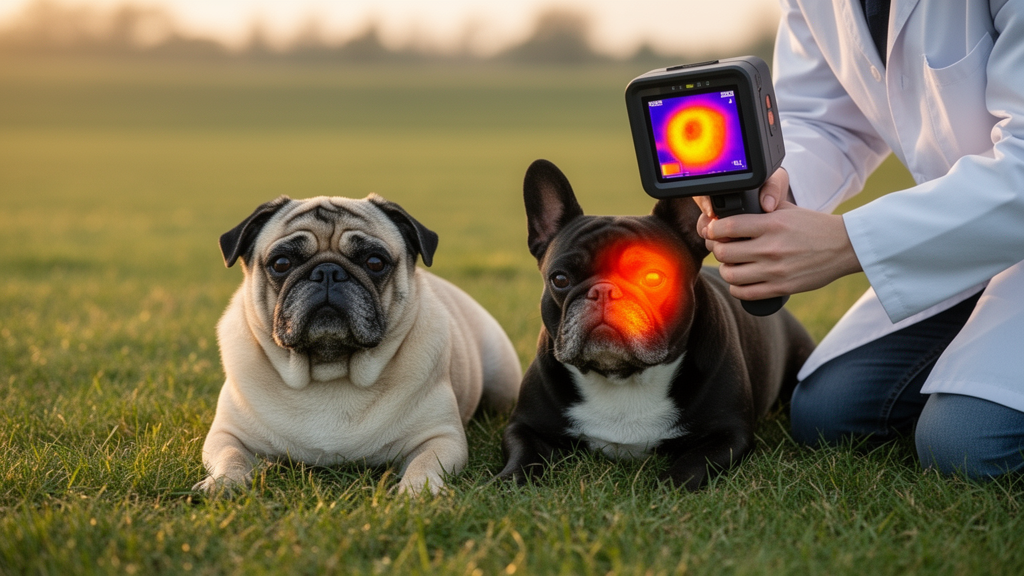
Flat-faced dogs run hotter than their longer-muzzled relatives when they exercise, and their skin stays hot for longer after the walk is over. That is the central finding of a study in which 80 pet dogs in Mexico City were walked through two standardized exercise tests while an infrared camera tracked the temperature of their faces and limbs. The researchers, led by Daniel Mota-Rojas of the Universidad Autónoma Metropolitana, report in Frontiers in Veterinary Science that brachycephalic dogs showed facial surface temperature increases of up to 2.6 degrees Celsius during moderate exertion, with a statistical significance of p less than 0.0001, and that these dogs recovered their baseline surface temperatures more slowly than dolichocephalic or mesocephalic dogs during a 10-minute rest period. The work, with data collected between January 2024 and December 2025, offers a non-invasive window into how skull shape shapes thermoregulation under real-world conditions.
The team recruited purebred and mixed-breed companion dogs from 10 veterinary clinics in eastern Mexico City, all aged between one and six years and free of apparent disease or mobility impairment on general clinical examination. Each animal was classified by cephalic biotype using the Total Cephalic Index, calculated from radiographic skull measurements: cranial width across the zygomatic arches divided against cranial length from the external occipital protuberance to the interincisive suture. Dogs scoring below 55 percent were classed as dolichocephalic, those between 55 and 80 percent as mesocephalic, and those above 80 percent as brachycephalic. That yielded 20 dolichocephalic dogs, including Dachshunds, Chihuahuas and Xoloitzcuintli; 20 mesocephalic dogs, including Labrador Retrievers, Beagles and Old English Sheepdogs; and 40 brachycephalic dogs dominated by Pugs, with Shih Tzus, English and French Bulldogs and a Boston Terrier also represented.
The brachycephalic group was then subdivided by the severity of Brachycephalic Obstructive Airway Syndrome, or BOAS, using a functional grading protocol in which dogs trotted for three minutes at six to eight kilometers per hour under a trained evaluator. Grade 0 dogs showed no clinical signs, Grade 1 displayed audible respiratory stertor without exercise intolerance, Grade 2 showed clinically relevant signs potentially requiring medical management or corrective surgery, and Grade 3 included severe cases with pronounced signs. Ten dogs fell into the mildest category, 18 into Grade 2, and 12 into Grade 3. Owners of dogs with clinically significant signs were informed of potential complications and advised to seek prompt surgical correction, and all procedures were approved by the university’s doctoral committee under protocol CBS.205.22 with signed owner consent.
Each dog then completed two moderate exercise tests on the same day, in a covered corridor with natural ventilation at an altitude of 2,240 meters, where morning temperatures averaged 16.75 degrees Celsius and relative humidity averaged 61 percent. The first was a six-minute walk test along a 40-meter corridor at a self-selected leash pace, a tool long used clinically to separate healthy dogs from those with mild to moderate pulmonary disease. The second was a continuous 1,000-meter walk, a distance already adopted in some brachycephalic breeding programs as a selection criterion. Thermal images were captured at four time points: baseline, immediately after the six-minute test, immediately after the 1,000-meter walk, and again after 10 minutes of recovery. A FLIR E80 radiometric camera with a thermal sensitivity below 0.045 degrees Celsius and emissivity standardized at 0.98 recorded seven facial thermal windows, including the lacrimal caruncle, upper and lower eyelids, upper and lower lips, the masseter and the nostril region, alongside five appendicular windows covering the forelimbs, hindlimbs, and the gracilis, biceps femoris and gastrocnemius muscles.
The performance data told a nuanced story. In the six-minute walk test, the three biotypes covered mean distances of 462, 451.5 and 526.22 meters for dolichocephalic, mesocephalic and brachycephalic dogs respectively, differences that did not reach statistical significance. Significant differences among biotypes emerged only in the distance covered during the 1,000-meter walk test, where the Kruskal-Wallis test returned p equal to 0.0028. Within the brachycephalic subdivisions, Grade 3 dogs covered 699.1 meters compared with 932.77 meters for Grade 2 dogs, a difference significant at p equal to 0.0389, while Grade 1 dogs fell intermediate at 876 meters without reaching significance. The authors suggest the two tests are complementary: the shorter test probes initial exercise performance, while the longer continuous walk exposes the thermal and microcirculatory strain that builds as airway obstruction compounds over distance.
The thermographic results were more striking. At baseline, dolichocephalic and mesocephalic dogs showed mean facial temperatures between 34.4 and 34.5 degrees Celsius, while brachycephalic dogs started hotter, with the mildest BOAS group averaging 36.39 degrees Celsius. By the end of the 1,000-meter walk, that group had climbed to 36.90 degrees Celsius, significantly above the other biotypes. The nostril region showed the greatest thermal variation of any facial window: Grade 3 dogs reached 37.00 degrees Celsius after the long walk, compared with 31.20 degrees Celsius in dolichocephalic dogs. Brachycephalic dogs across all BOAS grades showed significant post-exercise increases in the eyelid and lip regions, reaching values between 36.2 and 36.9 degrees Celsius, and these elevations persisted into the recovery period, particularly in the most severely affected animals.
The muscular and limb windows revealed a different pattern. Grade 2 brachycephalic dogs recorded post-exercise temperatures of 35 degrees Celsius, plus or minus 0.5 degrees, in their muscular thermal windows, and the gracilis muscle of Grade 2 dogs peaked at 35.05 degrees Celsius after the long walk, significantly higher than in the other biotypes. In contrast, dolichocephalic and mesocephalic dogs showed modest increases of only 1 to 1.5 degrees Celsius across all three muscular regions during exercise, and returned to baseline values by the recovery measurement. Notably, Grade 3 brachycephalic dogs had the lowest baseline temperatures in the forelimb and hindlimb windows, around 29 degrees Celsius, which the authors interpret as a possible sign that severe airway obstruction diverts blood flow away from peripheral tissues during exertion, consistent with the peripheral hypoxia and carbon dioxide retention seen in the most affected animals.
Correlation analysis reinforced the picture. Across all biotypes, elapsed time showed highly significant positive correlations with minimum, maximum and mean temperatures in every thermal window, with coefficients ranging from 0.644 to 0.884, and the facial and appendicular regions intercorrelated strongly, at coefficients above 0.95 in several groups. Body weight also correlated highly with thermal variables, at coefficients between 0.86 and 0.96, but age, distance traveled and body condition score showed no significant associations with the thermal windows. The authors caution that these correlations describe associations within this cohort rather than causal mechanisms, and that appendicular readings can be influenced by hair density and coat type, which the study did not systematically evaluate.
The physiological explanation the authors favor centers on ventilatory efficiency. Computational fluid dynamics studies of brachycephalic airways have shown increased resistance and intranasal pressures that compromise evaporative heat dissipation and promote superficial thermal accumulation on the face. In normocephalic dogs, cardiac output can rise by 74 to 200 percent during exercise, with carotid blood flow increasing by up to 500 percent at ambient temperatures between 25 and 35 degrees Celsius, directing heat toward evaporative surfaces such as the nose, mouth and tongue. Brachycephalic anatomy blunts that route, the authors argue, forcing greater reliance on cutaneous heat dissipation, which the infrared camera registers as hotter facial skin and slower cooling. The team also points to the lacrimal caruncle, a highly vascularized, hairless patch of tissue, as a particularly reliable site for detecting sympathetic activation during stress.
The study has clear limits that the authors acknowledge. Environmental conditions were not standardized, a deliberate choice meant to test clinical applicability under variable temperature and humidity, but one that may have influenced thermal responses. The high altitude of Mexico City may affect oxygen availability and physiological demand, so the findings may not extrapolate directly to populations at lower elevations. Coat type was not assessed, and the brachycephalic sample skewed heavily toward Pugs, with limited participation from English and French Bulldog owners. The researchers position infrared thermography as a complementary tool for assessing thermoregulatory responses, not as an isolated measure of core temperature or physiological impairment, and suggest it could work alongside the BOAS functional grading system and plethysmography in multimodal assessments of exercise tolerance. For flat-faced dogs, the message is that their faces run measurably hotter under load, and that a simple thermal camera can see it.
Subject of Research: Infrared thermographic assessment of exercise-induced thermal responses in dogs of different skull biotypes and brachycephalic obstructive airway syndrome severity
Article Title: Thermal response to moderate exercise in dogs of different biotypes and brachycephalic obstructive airway syndrome severity assessed using infrared thermography
Article References: Reyes-Sotelo, B., Martínez-Burnes, J., Hernández-Avalos, I., Olmos-Hernández, A., Mora-Medina, P., Villanueva-García, D., Torres-Bernal, F., Casas-Alvarado, A., & Mota-Rojas, D. (2026). Thermal response to moderate exercise in dogs of different biotypes and brachycephalic obstructive airway syndrome severity assessed using infrared thermography. Frontiers in Veterinary Science, 13, Article 1975908. https://doi.org/10.3389/fvets.2026.1975908
Image Credits: AI Generated
DOI: 10.3389/fvets.2026.1975908
Keywords: dogs, brachycephalic, BOAS, infrared thermography, exercise, thermoregulation, heat dissipation, veterinary science, animal welfare, skull biotypes, exercise tolerance, flat-faced breeds
Cite Scienmag News
William Thompson. (October 26, 2026). Infrared Cameras Reveal How Flat-Faced Dogs Struggle to Shed Heat During Exercise. Scienmag. https://scienmag.com/infrared-cameras-reveal-how-flat-faced-dogs-struggle-to-shed-heat-during-exercise/
William Thompson. "Infrared Cameras Reveal How Flat-Faced Dogs Struggle to Shed Heat During Exercise." Scienmag, 26 October 2026, https://scienmag.com/infrared-cameras-reveal-how-flat-faced-dogs-struggle-to-shed-heat-during-exercise/. Accessed 26 October 2026.
William Thompson. "Infrared Cameras Reveal How Flat-Faced Dogs Struggle to Shed Heat During Exercise." Scienmag. October 26, 2026. https://scienmag.com/infrared-cameras-reveal-how-flat-faced-dogs-struggle-to-shed-heat-during-exercise/


