


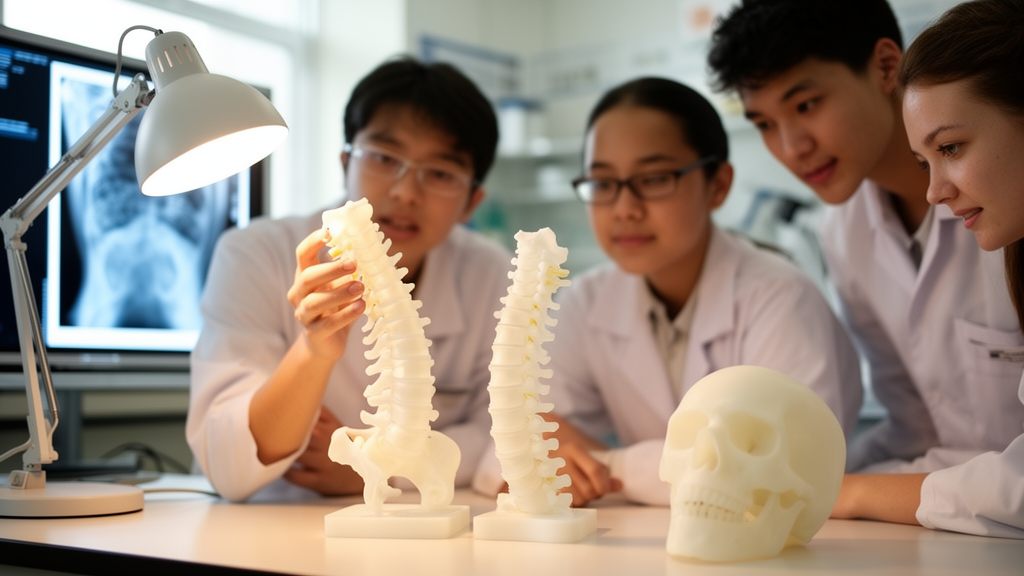
Radiography students appear broadly enthusiastic about three-dimensional printed models as educational tools, according to a survey study published in BMC Medical Education. When researchers presented two 3D-printed models to radiography students and then asked how they perceived 3D printing as a learning technology, 86 of 108 participants — 79.6 percent — strongly agreed with the use of 3D-printed models for radiography education. Only a limited number of students expressed negative perceptions across the survey statements.
The findings describe student attitudes rather than measured learning gains, and the authors conclude that students demonstrated positive perceptions of integrating 3D-printed models as educational tools in radiography. The study was designed as a perception assessment rather than a test of educational effectiveness. Two 3D-printed models were designed, fabricated, and subsequently presented to students as tangible examples of how 3D printing could be applied in radiography education.
After seeing the models, students completed a 12-item questionnaire probing their broader views of 3D-printed models as learning tools. Importantly, the questionnaire did not evaluate the design or educational effectiveness of the specific models presented. The first section of the survey assessed students' general knowledge of 3D-printed models and their preferences concerning the organs and imaging modalities where these models might be useful.
The second section focused on students' perceptions of 3D-printed models as learning tools, their educational applications, and their perceived benefits for learning. One hundred and eight radiography students participated, 73 of them female and 35 male. A gap in prior exposure emerged from the first section: most participants, 73 students or 67.6 percent, reported limited attendance at workshops on the use of 3D-printed models in radiography.
Despite that limited formal training, enthusiasm for the technology was high. When asked which imaging modalities they would most like to see paired with 3D-printed models in their education, 61 students, or 56.5 percent, chose magnetic resonance imaging, while 30 students, or 27.8 percent, preferred computed tomography. The survey data report these preferences without probing the reasons behind them.
The perception items in the second section proved statistically reliable. Cronbach's alpha, calculated for the eight Likert-type items, was 0.891 with a standard error of 0.043 and a 95 percent confidence interval of 0.807 to 0.974, indicating good internal consistency. In general, students strongly agreed with the use of 3D-printed models for radiography education, and negative responses were rare across the statements.
The researchers then compared responses across academic-year groups using Kruskal-Wallis tests, applying Holm correction for multiple comparisons with statistical significance set at a Holm-adjusted p value below 0.05. The tests found no statistically significant evidence of differences in responses among academic-year groups after Holm correction, meaning responses did not differ measurably by academic year in this cohort. The survey captured self-reported perceptions from a single cohort of 108 students, and the questionnaire was explicitly not an evaluation of how well the two presented models taught anatomy or imaging interpretation.
Whether 3D-printed models improve radiography students' actual learning outcomes remains a question for future effectiveness studies, which the present data do not address. What the results do establish is that students, most of whom reported limited prior workshop experience with 3D printing, nonetheless strongly endorsed the technology's integration into radiography education, with MRI and CT identified as the modalities where they most wanted physical models applied. The absence of statistically significant year-group differences indicates that the measured perceptions were consistent across the academic-year groups included in the survey.
Subject of Research: Exploring radiography students’ perceptions of 3D-printed models as learning tools
Article Title: Exploring radiography students’ perceptions of 3D-printed models as learning tools
Article References: Abdulaal, O. M. (2026). Exploring radiography students’ perceptions of 3D-printed models as learning tools. BMC Medical Education. https://doi.org/10.1186/s12909-026-10299-3
Image Credits: AI Generated
DOI: 10.1186/s12909-026-10299-3
Keywords: Exploring, radiography, students, perceptions, D-printed, models, learning, tools, scientific research
Cite Scienmag News
Courtney Benton. (October 26, 2026). Radiography Students Give 3D-Printed Models High Marks as Learning Tools. Scienmag. https://scienmag.com/radiography-students-give-3d-printed-models-high-marks-as-learning-tools/
Courtney Benton. "Radiography Students Give 3D-Printed Models High Marks as Learning Tools." Scienmag, 26 October 2026, https://scienmag.com/radiography-students-give-3d-printed-models-high-marks-as-learning-tools/. Accessed 26 October 2026.
Courtney Benton. "Radiography Students Give 3D-Printed Models High Marks as Learning Tools." Scienmag. October 26, 2026. https://scienmag.com/radiography-students-give-3d-printed-models-high-marks-as-learning-tools/


