


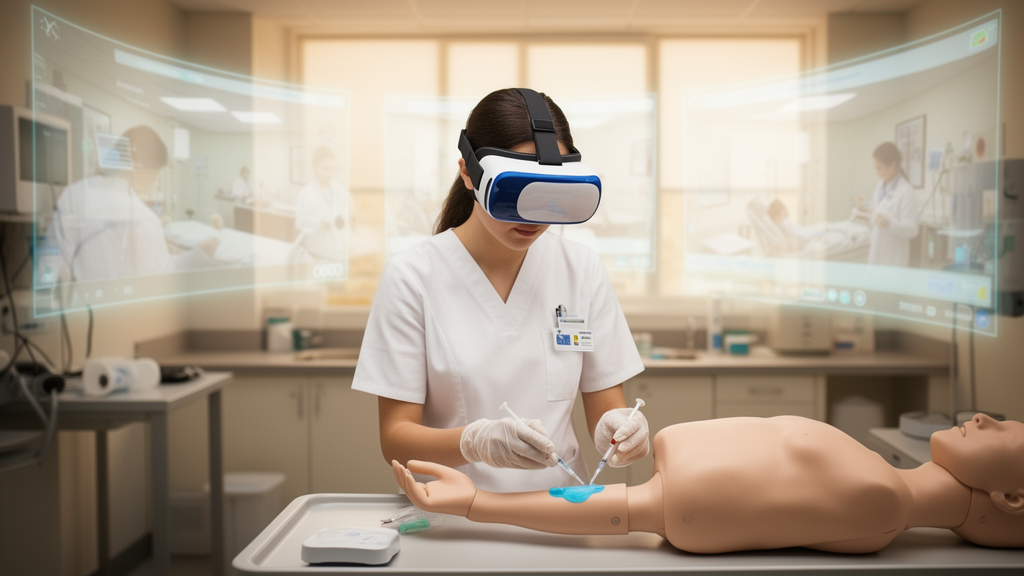
Nursing students who watched a standardized 360-degree immersive virtual reality video of a deltoid intramuscular injection significantly improved their procedural skills and maintained that improvement two months later, according to a pre-experimental study published in BMC Medical Education. The single-group pretest–posttest study, led by Serpil Çelik Durmuş and colleagues, involved 89 nursing students whose performance was scored on a 20-item Intramuscular Injection Skills Checklist at baseline and again after a two-month delay. Total skill scores rose from a mean of 1.16 ± 0.24 on the checklist's 0-to-2 scale at pre-test to 1.72 ± 0.19 at the two-month retention test, a difference the authors report as statistically significant using Wilcoxon signed-rank tests, with p < 0.001.
Satisfaction with the VR format was strikingly high, with 97.8 percent of participants reporting they were satisfied with the learning experience. The intervention itself was deliberately simple: rather than a fully interactive simulation, participants observed a standardized 360-degree video that placed them inside a virtual observation environment of the injection procedure. This format, the authors note, addresses a persistent challenge in nursing education — maintaining continuity of hands-on skill training during global and regional crises that disrupt access to clinical settings and simulation laboratories.
Evidence on 360-degree immersive VR for high-stakes procedures such as deltoid intramuscular injections has remained limited, and the study was designed to evaluate both skill acquisition and safety compliance in this specific context. One of the study's most notable observations concerned safety behavior rather than raw skill scores alone. Students showed high baseline compliance on specific safety steps, including glove-wearing and needle withdrawal, and that compliance was successfully sustained at the two-month retention test.
The authors describe this as providing vital pedagogical insight into clinical risk prevention within the limitations of their evaluation framework. The participant group had a mean age of 22.67 years and was 85.4 percent female. A single trained and calibrated evaluator scored all performances, which the authors explicitly identify as a limitation, alongside the pre-experimental design.
Because there was no control group, the study cannot isolate the VR experience from other learning effects such as repeated testing, natural skill consolidation, or concurrent coursework. The authors are careful to frame their conclusions accordingly: the findings support 360-degree immersive VR as an effective and standardized platform for the continuity of safe clinical skill acquisition within the limits of a single-rater, single-group design, not as proof of superiority over conventional instruction. They position the approach as a scalable solution for both nursing curricula and disaster-resilient professional development, a use case that gained urgency as educators sought digital substitutes for in-person clinical training.
Looking forward, the research team calls for multi-center randomized controlled trials and for hybrid simulations that combine VR with haptic feedback to optimize long-term clinical competencies across the nursing workforce. For now, the study offers measured evidence that a video-based immersive observation format can produce skill gains that persist over at least two months in a cohort of nursing students — an encouraging signal for educators weighing immersive media against the logistical constraints of traditional skills laboratories, and one that future controlled studies will need to test against alternative teaching methods before firmer claims can be made.
Subject of Research: The effect of a 360-degree immersive VR video environment on nursing students' deltoid intramuscular injection skill acquisition and two-month competency retention
Article Title: The impact of a 360-degree immersive VR video observation environment on deltoid IM injection skill acquisition and 2-month competency maintenance: a single-group pretest–posttest study
Article References: Durmuş, S. Ç., Erdem, Y., & Ağca, R. K. (2026). The impact of a 360-degree immersive VR video observation environment on deltoid IM injection skill acquisition and 2-month competency maintenance: a single-group pretest–posttest study. BMC Medical Education. https://doi.org/10.1186/s12909-026-10135-8
Image Credits: AI Generated
DOI: 10.1186/s12909-026-10135-8
Keywords: virtual reality, nursing education, intramuscular injection, skill retention, clinical simulation, 360-degree video, deltoid injection, pretest-posttest, nursing students, medical education, impact, degree
Cite Scienmag News
Courtney Benton. (October 26, 2026). 360-Degree VR Video Helps Nursing Students Retain Injection Skills for Two Months. Scienmag. https://scienmag.com/360-degree-vr-video-helps-nursing-students-retain-injection-skills-for-two-months/
Courtney Benton. "360-Degree VR Video Helps Nursing Students Retain Injection Skills for Two Months." Scienmag, 26 October 2026, https://scienmag.com/360-degree-vr-video-helps-nursing-students-retain-injection-skills-for-two-months/. Accessed 26 October 2026.
Courtney Benton. "360-Degree VR Video Helps Nursing Students Retain Injection Skills for Two Months." Scienmag. October 26, 2026. https://scienmag.com/360-degree-vr-video-helps-nursing-students-retain-injection-skills-for-two-months/


