


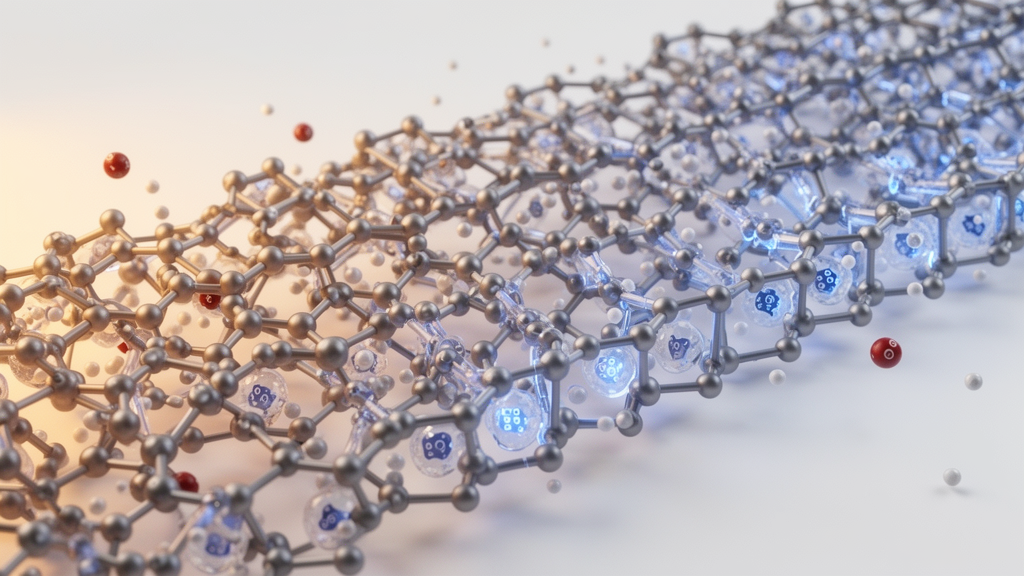
A peer-reviewed review concludes that viologen-linked covalent organic frameworks combine permanent positive charge, reversible redox activity and extended π-conjugated structures in a single, tunable porous material. The authors say this combination offers a platform for controlling charge distribution, electron transfer, ion transport and interactions with guest molecules, with potential applications in energy conversion, catalysis, sensing, adsorption and optoelectronics. The review synthesizes design strategies, structural features and reported material performance rather than presenting a new experimental demonstration.
Viologen-based covalent organic frameworks, or Vio-COFs, differ from conventional neutral COFs because their molecular linkers carry positive charge and can undergo reversible changes in oxidation state. The review describes the relevant viologen transformations as V²⁺/V•⁺/V⁰ and identifies them as a basis for dynamic electron storage and charge transfer. Their cationic nature also supports anion exchange, ionic conduction and electrostatic interactions with guest molecules. Alongside these ionic and redox functions, the extended π-conjugated network can facilitate charge transport and electronic communication, while tunable pores provide molecular diffusion pathways and expose active sites.
Several engineering strategies are described for developing Vio-COFs with these properties. Molecular redesign of viologen linkers can optimize electronic structures and redox behavior, while framework modulation is used to improve crystallinity, porosity and access to active sites. Other approaches incorporate catalytic centers, regulate charge-transfer pathways to facilitate charge transport and photocatalysis, and apply post-synthetic modification to introduce responsive and catalytic functionality. The review connects Vio-COF performance to several material features: permanent cationic frameworks that facilitate selective adsorption and ion transport, reversible redox centers that support dynamic electron transfer and catalytic transformations, conjugated networks that aid charge transport, and adjustable pore structures that promote molecular diffusion and active-site exposure.
The synthesis and stability of these materials remain major obstacles to wider implementation. The review identifies limited availability of viologen-based monomers, electrostatic repulsion during framework formation, and trade-offs between charge and porosity. Practical development also requires scalable synthesis, improved long-term structural and redox stability, precise regulation of charge distribution, and better electrical conductivity. A comprehensive understanding of structure–property–performance relationships is needed so that pore architecture, linker chemistry and redox behavior can be linked reliably to material function. The authors therefore recommend sustainable synthesis, advanced experimental characterization combined with theoretical simulations to elucidate charge-transfer mechanisms, and application-driven development of multifunctional Vio-COFs.
Overall, the review presents viologen-linked covalent organic frameworks as a charged and redox-active design platform that integrates ionic behavior, reversible electron-transfer centers and ordered porous architecture. Its analysis indicates multiple potential uses across energy conversion, catalysis, sensing, adsorption and optoelectronics, but it does not establish performance in a specific device or commercial setting. The immediate research priorities are to overcome synthesis, stability, conductivity and charge-distribution challenges while clarifying how molecular and structural features govern real-world function.
Subject of Research: Review of the design, properties, applications and development challenges of viologen-linked covalent organic frameworks
Article Title: Viologen-linked covalent organic frameworks: A charged and redox-active platform for functional materials
Article References: Viologen-linked covalent organic frameworks: A charged and redox-active platform for functional materials. Original publication (Bibliographic details unavailable.)
Image Credits: AI Generated
DOI: Not provided
Keywords: viologen, covalent organic frameworks, redox-active materials, porous materials, charge transport, ion transport, catalysis, energy conversion, optoelectronics, materials chemistry, Viologen-linked, covalent
Cite Scienmag News
Bethany Barker. (October 26, 2026). Review maps design potential and challenges of viologen-linked frameworks. Scienmag. https://scienmag.com/review-maps-design-potential-and-challenges-of-viologen-linked-frameworks/
Bethany Barker. "Review maps design potential and challenges of viologen-linked frameworks." Scienmag, 26 October 2026, https://scienmag.com/review-maps-design-potential-and-challenges-of-viologen-linked-frameworks/. Accessed 26 October 2026.
Bethany Barker. "Review maps design potential and challenges of viologen-linked frameworks." Scienmag. October 26, 2026. https://scienmag.com/review-maps-design-potential-and-challenges-of-viologen-linked-frameworks/


