


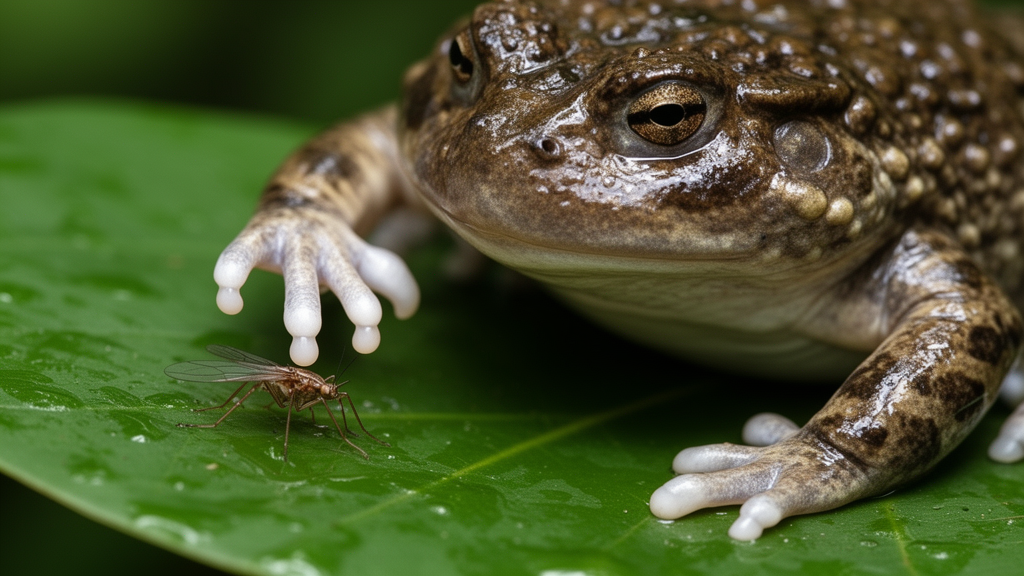
Surinam toads can detect approaching prey with fingertip lobules whose touch thresholds fall within the range measured for human fingertips, according to a study by University of California, Los Angeles, biologists. The flat Amazon frogs spread their forelimbs in murky water and detect disturbances created by swimming animals, then open their jaws rapidly enough to draw prey into their tongueless mouths. High-speed observations showed that the toads could capture fish before physical contact, even in darkness, indicating that they were sensing movement in the surrounding water rather than relying on vision. The research combined anatomical imaging, calibrated mechanical stimulation, nerve recordings, behavioral observations and analysis of neural organization to characterize this unusual sensory system.
The study focused on Pipa pipa, a species also known as the Surinam toad or star-fingered toad, which lives in the murky waters of the Amazon basin. Its minute eyes and poor vision make visual hunting difficult. Instead, the animals extend their arms in front of and just to the sides of their mouths, keeping their fingers spread wide, and wait for a fish or other moving animal to approach. They can then snap open their jaws and create enough suction to pull prey into their mouths, swallowing it whole in a few hundredths of a second. Although 19th-century naturalists had noted the peculiar anatomy at the ends of the toads’ fingers, the function of these structures had never been satisfactorily explained. The new findings identify them as highly specialized touch organs that allow the frogs to sample their immediate surroundings when vision provides little useful information.
Each finger ends not in a claw or conventional pad but in a small cluster of soft lobes. The investigators used a scanning electron microscope to examine the finger surfaces and identified a total of 128 miniature lobes, called lobules, per frog. The skin covering each lobule contained nearly four times the density of dome-shaped bumps, known as papillae, found elsewhere on the fingers. Papillae also occur on the human tongue and are known to increase touch sensitivity. Their unusual concentration suggested that the lobules might provide more precise mechanical sensing than the surrounding skin. The researchers therefore tested whether this visible anatomical specialization corresponded to greater sensitivity in the nerves associated with different regions of the hand.
To measure tactile sensitivity, the scientists touched the frogs’ hands with calibrated filaments that applied forces of known magnitude. The responses became progressively stronger toward the ends of the fingers, reaching their highest sensitivity at the lobules. At those locations, touch thresholds fell into the same range as those recorded for human fingertips. The researchers then examined the electrophysiology of nerves in the arms and found dense clusters of touch-receptive nerve fibers on the fingertip lobules. Although the lobules occupied only 8% of the total forelimb skin surface, they contained 60% of the touch-sensitive nerves serving the arm. The measurements and recordings show that the lobules were not simply unusual folds in the skin: they combined specialized surface anatomy with an exceptionally dense sensory supply.
The team next used high-speed video to observe the toads hunting and consuming prey. When a fish or other moving animal came within about half a centimeter of the outstretched fingers, the frog could accurately and efficiently suck it up before it touched the toad’s skin. Captures also succeeded in the dark. Because the prey had not made physical contact and the frogs could not see it under those conditions, the observations support the conclusion that the animals detected water movement produced by the approaching animal. The fingers act as an active prey-detection system, translating small movements in the surrounding fluid into sensory signals that indicate the presence and proximity of potential food. This behavior resolves a central feature of the toad’s hunting strategy: it can locate prey at extremely close range without waiting for direct touch.
The finger lobules are also magnified within the nervous system. Researchers found that a disproportionately large region of the optic tectum was devoted to processing touch information from the fingertips. The optic tectum is a midbrain region found in most vertebrates; unlike mammals, frogs do not have a cortex. To assess the degree of enlargement, the investigators estimated how much neural space the fingertips should occupy if representation were proportional to their small share of the body’s surface area. The actual region devoted to fingertip touch was far larger than that expectation. In this respect, the toad concentrates sensory processing around a tiny body surface much as mammals devote enlarged cortical regions to sensitive structures such as primate fingertips and the platypus bill. The result is therefore an example of neural magnification that does not depend on the mammalian organization of the cortex.
The researchers describe the toad’s fingertip system as a tactile fovea, a specialized, high-resolution sensory region that allows an animal to extract fine detail from a limited part of its environment. The Surinam toad’s lobules are analogous to the tentacle-like appendages on the face of the star-nosed mole, although the species use different anatomy and different brain structures. The central similarity is organizational rather than superficial: a small patch of the body receives disproportionately sensitive skin, abundant touch-receptive innervation and enlarged neural representation. That arrangement lets the toad resolve information at very short range, where the presence of a moving fish can be represented by slight changes in the water. The findings establish the lobules as mechanoreceptive organs rather than merely descriptive curiosities of the species’ unusual fingers.
The methods in the peer-reviewed study, published in the Journal of Comparative Physiology A, connect physical structure, neural activity and hunting behavior. Anatomical imaging revealed the lobules and their dense papillae; calibrated stimulation quantified how readily sensory neurons responded to touch; electrophysiological recordings mapped the concentration of touch-sensitive nerves; and high-speed observations showed how the system was used during real prey encounters. Analysis of the optic tectum then demonstrated that fingertip signals were represented at a scale disproportionate to the fingers’ physical size. Together, these results support a role in locating prey before capture rather than merely detecting an object after it has arrived. The experiments do not identify every stage of the neural pathway or establish how broadly the same organizational pattern occurs across vertebrates, but they provide converging anatomical, physiological and behavioral evidence for tactile prey detection in this species.
Finding the same broad organizational strategy in frogs and mammals is especially notable because the lineages diverged more than 350 million years ago and the relevant systems occur in different parts of the brain. The toad result suggests that magnifying the neural representation of a finely sensitive body surface may be an ancient vertebrate solution rather than a mammalian specialization. Corresponding author Duncan Leitch said the shared sensory-processing properties indicate that such systems are probably more widespread than previously appreciated. He suggested that birds and other animals might also possess specialized sensing systems if their sensory structures were examined closely, although the study itself provides direct evidence only for Surinam toads. The species offers a striking example of evolution solving a common sensory problem with a profoundly different body plan: a hidden network concentrated in 128 fingertip lobules, wired to an enlarged region of the midbrain and used to read the movement of prey through dark, turbid water.
Subject of Research: Tactile prey detection and neural specialization in Surinam toads
Article Title: The frog that reads the water with its fingertips
Article References: The frog that reads the water with its fingertips. Original publication (Bibliographic details unavailable.)
Image Credits: AI Generated
DOI: Not provided
Keywords: Surinam toads, Pipa pipa, tactile sensing, fingertip lobules, prey detection, mechanoreception, neural magnification, optic tectum, tactile fovea, Amazon basin, frog, reads
Cite Scienmag News
Drew Townsend. (October 26, 2026). Study Links Surinam Toad Fingertips to Tactile Prey Detection. Scienmag. https://scienmag.com/study-links-surinam-toad-fingertips-to-tactile-prey-detection/
Drew Townsend. "Study Links Surinam Toad Fingertips to Tactile Prey Detection." Scienmag, 26 October 2026, https://scienmag.com/study-links-surinam-toad-fingertips-to-tactile-prey-detection/. Accessed 26 October 2026.
Drew Townsend. "Study Links Surinam Toad Fingertips to Tactile Prey Detection." Scienmag. October 26, 2026. https://scienmag.com/study-links-surinam-toad-fingertips-to-tactile-prey-detection/


