


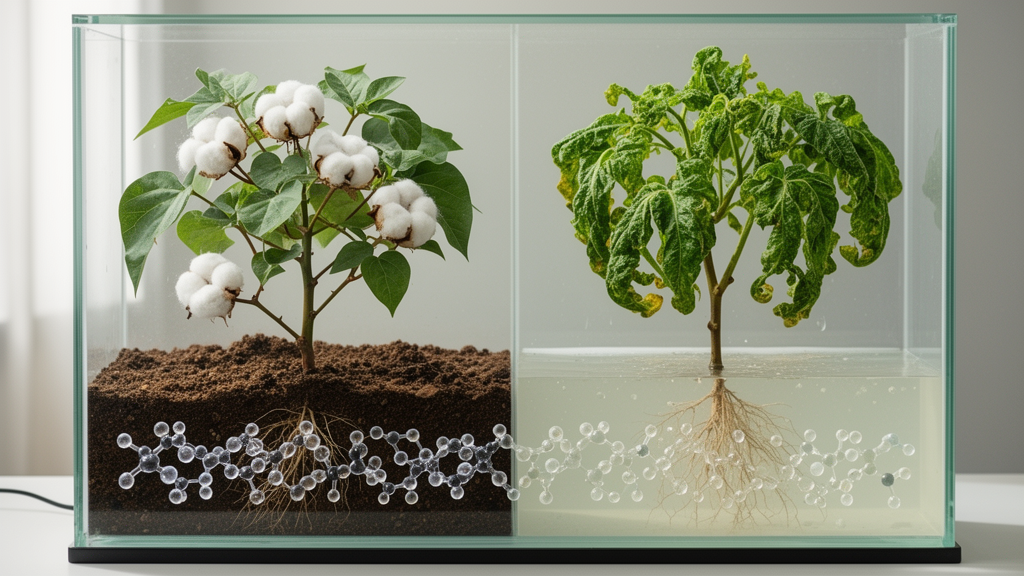
A genome-wide study of upland cotton identified six stay-green, or SGR, genes whose expression was associated with responses to salt and polyethylene glycol (PEG)-simulated drought stress. The research, published in BMC Plant Biology , combined evolutionary comparisons, transcriptome profiling, quantitative real-time PCR (qRT-PCR) and weighted gene co-expression network analysis to characterize the gene family in Gossypium hirsutum . The findings point to a conserved set of genes that may serve as candidates for future functional studies of abiotic stress resistance, although the research does not demonstrate improved crop performance.
The researchers identified six GhSGR genes and found them unevenly distributed across six chromosomes in the cotton genome’s At and Dt subgenomes. Phylogenetic analysis separated the genes into SGR and SGR-like subgroups. Comparisons also revealed conserved gene structures, protein domains and syntenic relationships across cotton species.
Together, these results indicated that the GhSGR family is highly conserved through evolution. The study characterized the family at the sequence, structural and chromosomal levels; it did not directly test whether any individual gene causes greater resistance to drought or salinity. Transcriptome profiling provided the principal expression-based evidence connecting GhSGR genes with the tested stresses.
Most of the six genes were induced following salt treatment or PEG-simulated drought stress. qRT-PCR then confirmed distinct, dynamic expression patterns for GhSGR1 and GhSGR3 under the stress treatments. These observations show that the genes respond at the transcriptional level to the experimental conditions. They do not, on their own, establish which physiological traits would change if the genes were modified, or whether the observed responses would translate into better tolerance in field-grown cotton.
Co-expression analysis placed the GhSGR genes alongside stress-related transporters and transcription factors, suggesting that they may participate in broader gene-regulatory and transport networks associated with plant stress responses. The authors identify the GhSGR genes as candidates for further functional dissection and for molecular breeding of stress resistance. Overall, the study provides a conserved evolutionary framework and expression evidence pointing to the SGR family as a subject for further investigation in cotton.
Subject of Research: Evolutionary conservation and stress-induced expression of SGR genes in upland cotton
Article Title: Molecular characterization of SGR genes related to abiotic stress resistance in cotton
Article References: Wei, F., Wang, L., Du, L., Yao, J., Wu, W., Deng, Y., Zhang, Q., Li, J., & Chen, P. (2026). Molecular characterization of SGR genes related to abiotic stress resistance in cotton. BMC Plant Biology. https://doi.org/10.1186/s12870-026-09856-1
Image Credits: AI Generated
DOI: 10.1186/s12870-026-09856-1
Keywords: cotton, stay-green genes, abiotic stress, drought response, salt stress, gene family evolution, transcriptome profiling, qRT-PCR, co-expression networks, molecular breeding, Molecular, characterization
Cite Scienmag News
Juliet Wilcox. (October 26, 2026). Cotton SGR genes show conserved evolution and salt-drought responses. Scienmag. https://scienmag.com/cotton-sgr-genes-show-conserved-evolution-and-salt-drought-responses/
Juliet Wilcox. "Cotton SGR genes show conserved evolution and salt-drought responses." Scienmag, 26 October 2026, https://scienmag.com/cotton-sgr-genes-show-conserved-evolution-and-salt-drought-responses/. Accessed 26 October 2026.
Juliet Wilcox. "Cotton SGR genes show conserved evolution and salt-drought responses." Scienmag. October 26, 2026. https://scienmag.com/cotton-sgr-genes-show-conserved-evolution-and-salt-drought-responses/


