

Monday, October 26, 2026
Science
No Result
View All Result
  • Login
  • HOME
  • SCIENCE NEWS
  • CONTACT US
  • HOME
  • SCIENCE NEWS
  • CONTACT US
No Result
View All Result
Scienmag
No Result
View All Result
Home Science News Agriculture

Stacking deep learning reaches 97.2% accuracy for olive disease images

October 26, 2026
in Agriculture
Blake Davidson
By Blake Davidson Scienmag Editorial Profile - Data Science
Reading Time: 2 mins read
0
Stacking deep learning reaches 97.2% accuracy for olive disease images

Stacking deep learning reaches 97.2% accuracy for olive disease images

65
SHARES
587
VIEWS
Share on FacebookShare on Twitter
ADVERTISEMENT

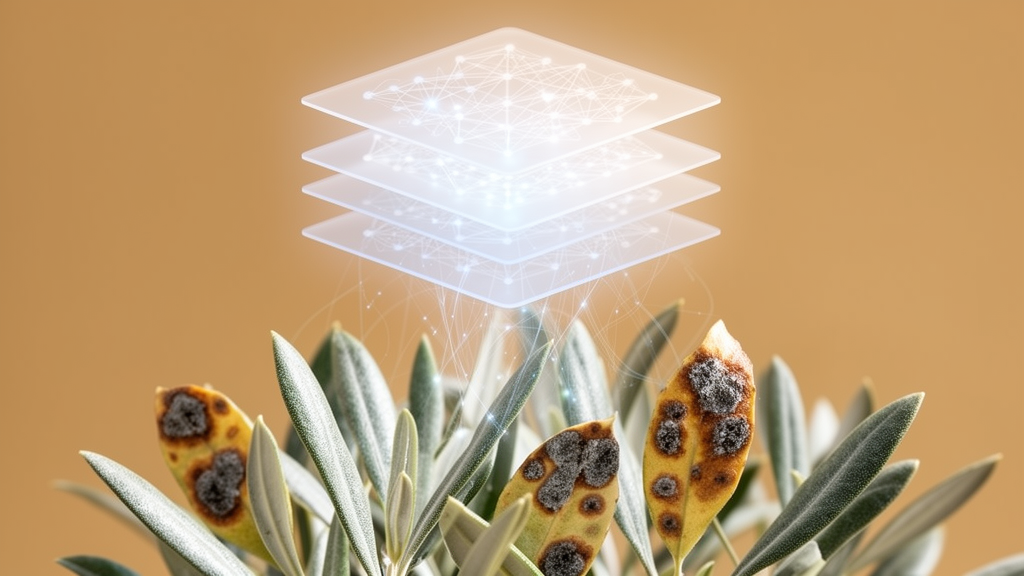
A stacking ensemble combining EfficientNet, ResNet and MobileNet classified olive leaf images with 97.21% accuracy in accepted research published in BMC Plant Biology. The system was tested on a publicly available dataset of 3,400 images representing three classes: healthy leaves, Aculus olearius and Olive Peacock Spot. On the hold-out test set, the ensemble also achieved a macro-averaged F1-score of 0.9720, a macro-averaged ROC-AUC of 0.9946 and a Cohen’s Kappa score of 0.9578.

The study compared four strategies for combining the predictions of the three transfer-learning models: weighted soft voting, unweighted soft voting, hard voting and stacking. Stacking delivered the best overall performance among the approaches evaluated. Model development and evaluation involved stratified five-fold cross-validation, while the final ensemble predictions were assessed on a separate hold-out test set after each base model had been trained and fine-tuned using the training data. The reported figures therefore describe an ensemble built from EfficientNet, ResNet and MobileNet rather than the performance of any one architecture in isolation.

Image preprocessing was intended to reduce environmental noise and improve the learning of disease-related features. The researchers separated leaves from their backgrounds through leaf–background segmentation and used rotation-based data augmentation to expand the range of examples seen during training. During cross-validation, augmentation was applied exclusively to the training folds rather than the validation folds, with the stated aims of increasing training diversity and reducing the effect of class imbalance. The supplied evidence does not provide class-specific sample counts, training-set performance or uncertainty intervals, so the aggregate results cannot establish that performance was uniform across all three image classes.

The research framework also incorporated Grad-CAM visualization, named in the study title alongside the ensemble method. The supplied findings do not report separate performance measures for these visualizations, meaning that the reported accuracy, F1-score, ROC-AUC and Kappa cannot be attributed to Grad-CAM alone. Instead, the clearest supported result is that the stacking ensemble combined the three base architectures effectively on the hold-out evaluation. The authors also caution that independent validation under diverse field conditions remains necessary before the approach can be considered for practical application, leaving its performance outside the public image dataset unresolved.

Subject of Research: Evaluation of ensemble deep learning methods for classifying olive leaf diseases from images

Article Title: Ensemble deep learning with Grad-CAM visualization for olive leaf disease classification

Article References: Coşkun, C., & Türk, Ö. (2026). Ensemble deep learning with Grad-CAM visualization for olive leaf disease classification. BMC Plant Biology. https://doi.org/10.1186/s12870-026-09881-0

Image Credits: AI Generated

DOI: 10.1186/s12870-026-09881-0

Keywords: olive leaf diseases, deep learning, ensemble learning, image classification, transfer learning, Grad-CAM, EfficientNet, ResNet, MobileNet, plant pathology, Ensemble, deep

Cite Scienmag News

Blake Davidson. (October 26, 2026). Stacking deep learning reaches 97.2% accuracy for olive disease images. Scienmag. https://scienmag.com/stacking-deep-learning-reaches-97-2-accuracy-for-olive-disease-images/

Blake Davidson. "Stacking deep learning reaches 97.2% accuracy for olive disease images." Scienmag, 26 October 2026, https://scienmag.com/stacking-deep-learning-reaches-97-2-accuracy-for-olive-disease-images/. Accessed 26 October 2026.

Blake Davidson. "Stacking deep learning reaches 97.2% accuracy for olive disease images." Scienmag. October 26, 2026. https://scienmag.com/stacking-deep-learning-reaches-97-2-accuracy-for-olive-disease-images/


Tags: data augmentation in plant disease diagnosisDeepdeep learningEfficientNetEfficientNet ResNet MobileNetensembleensemble learningfive-fold cross-validation in deep learningGrad-CAMimage classificationleaf-background segmentation techniquesmacro-averaged F1-score ROC-AUC Cohen’s KappaMobileNetmulti-model ensemble performancenoise reduction in image preprocessingolive disease image classificationolive leaf diseasesolive leaf health monitoringplant disease detection accuracyplant pathologyResNetstacking ensemble deep learningtransfer learningtransfer learning models comparison
Share26Tweet16
Previous Post

Scoping review links international health education partnerships to varied outcomes

Next Post

Review maps planned behaviour research in household waste management

Related Posts

Hairy-root perilla yields more shikonin and comparable luteolin
Agriculture

Hairy-root perilla yields more shikonin and comparable luteolin

October 26, 2026
Time-course transcriptomics reveals MeJA-responsive genes in ginseng roots
Agriculture

Time-course transcriptomics reveals MeJA-responsive genes in ginseng roots

October 26, 2026
Metallic nanoparticles and magnetic pellets optimize purslane in green walls
Agriculture

Metallic nanoparticles and magnetic pellets optimize purslane in green walls

October 26, 2026
Melatonin helps Tartary buckwheat tolerate cadmium stress in controlled experiments
Agriculture

Melatonin helps Tartary buckwheat tolerate cadmium stress in controlled experiments

October 26, 2026
Validated reference genes support RT-qPCR in Cuphea hookeriana
Agriculture

Validated reference genes support RT-qPCR in Cuphea hookeriana

October 26, 2026
G25 tops ornamental cayenne lines in agronomic and consumer evaluation
Agriculture

G25 tops ornamental cayenne lines in agronomic and consumer evaluation

October 26, 2026
Next Post
Review maps planned behaviour research in household waste management

Review maps planned behaviour research in household waste management

  • Mothers who receive childcare support from maternal grandparents show more optimized

    Mothers who receive childcare support from maternal grandparents show more parental warmth, finds NTU Singapore study

    27656 shares
    Share 11059 Tweet 6912
  • University of Seville Breaks 120-Year-Old Mystery, Revises a Key Einstein Concept

    1061 shares
    Share 424 Tweet 265
  • Bee body mass, pathogens and local climate influence heat tolerance

    682 shares
    Share 273 Tweet 171
  • Researchers record first-ever images and data of a shark experiencing a boat strike

    546 shares
    Share 218 Tweet 137
  • Groundbreaking Clinical Trial Reveals Lubiprostone Enhances Kidney Function

    531 shares
    Share 212 Tweet 133
Science

Embark on a thrilling journey of discovery with Scienmag.com—your ultimate source for cutting-edge breakthroughs. Immerse yourself in a world where curiosity knows no limits and tomorrow’s possibilities become today’s reality!

RECENT NEWS

  • Researchers Create First Three-Dimensional Carbon Allotrope
  • Review maps planned behaviour research in household waste management
  • Stacking deep learning reaches 97.2% accuracy for olive disease images
  • Scoping review links international health education partnerships to varied outcomes

Categories

  • Agriculture
  • Anthropology
  • Archaeology
  • Athmospheric
  • Biology
  • Biotechnology
  • Blog
  • Bussines
  • Cancer
  • Chemistry
  • Climate
  • Earth Science
  • Editorial Policy
  • Marine
  • Mathematics
  • Medicine
  • Pediatry
  • Policy
  • Psychology & Psychiatry
  • Science Education
  • Science News
  • Social Science
  • Space
  • Technology and Engineering

Subscribe to Blog via Email

Enter your email address to subscribe to this blog and receive notifications of new posts by email.

Join 5,151 other subscribers

© 2025 Scienmag - Science Magazine

Welcome Back!

Login to your account below

Forgotten Password?

Retrieve your password

Please enter your username or email address to reset your password.

Log In
No Result
View All Result
  • HOME
  • SCIENCE NEWS
  • CONTACT US

© 2025 Scienmag - Science Magazine

Discover more from Science

Subscribe now to keep reading and get access to the full archive.

Continue reading