

Monday, October 26, 2026
Science
No Result
View All Result
  • Login
  • HOME
  • SCIENCE NEWS
  • CONTACT US
  • HOME
  • SCIENCE NEWS
  • CONTACT US
No Result
View All Result
Scienmag
No Result
View All Result
Home Science News Biology

Peer-reviewed Arabidopsis study links RAB5 and ROP7 to pollen development

October 26, 2026
in Biology
Drew Townsend
By Drew Townsend Scienmag Editorial Profile - Cell Biology
Reading Time: 2 mins read
0
Peer-reviewed Arabidopsis study links RAB5 and ROP7 to pollen development

Peer-reviewed Arabidopsis study links RAB5 and ROP7 to pollen development

65
SHARES
587
VIEWS
Share on FacebookShare on Twitter
ADVERTISEMENT

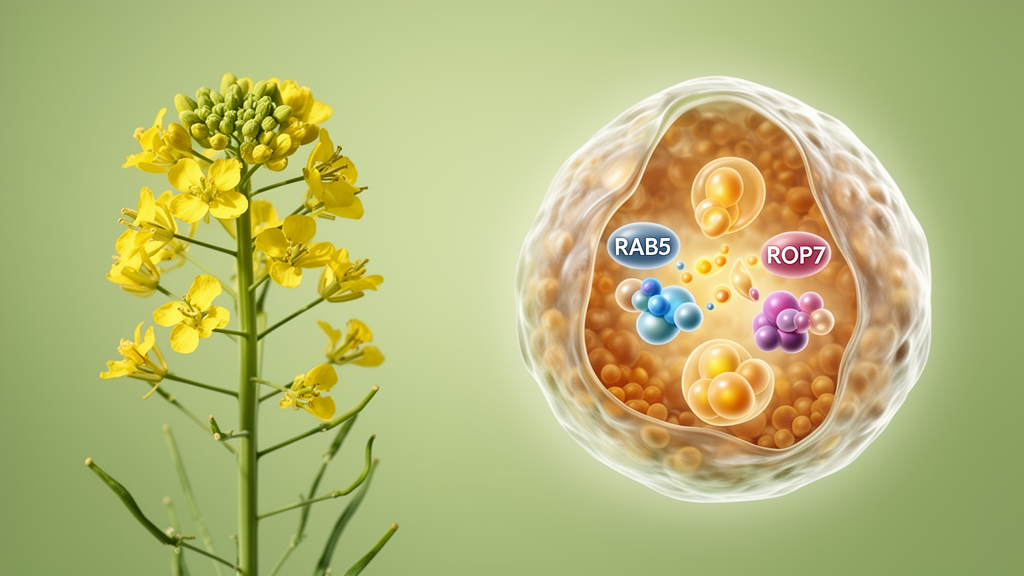
A protein called REAP1 acts as a molecular bridge between two distinct small-GTPase pathways in the model plant Arabidopsis thaliana, according to a peer-reviewed study in Nature Plants . The researchers found that REAP1 links RAB5 proteins involved in intracellular membrane trafficking with ROP7, a plant-specific Rho-family GTPase involved in processes such as cell morphogenesis. Their experiments identified a previously unknown RAB5–REAP1–ROP7 pathway whose coordinated activity contributes to normal pollen development.

Small GTPases function as molecular switches within cellular signaling networks, where they help regulate activities including intracellular transport and cell morphogenesis. Communication between different families of small GTPases is established in animal cells, but whether and how such crosstalk occurs in plants had remained largely unknown. A team led by Emi Ito and Takashi Ueda at the National Institute for Basic Biology investigated the question in Arabidopsis , with collaborators at Ochanomizu University, Kyoto Prefectural University, Saitama University, Nagoya University and RIKEN.

The study focused on molecular interactions, protein localization, genetic manipulation and pollen development in the model plant, rather than on reproduction in other plant species or on human biology. Plants have distinct repertoires of small GTPases, including ARA6, a plant-unique member of the RAB5 family, and ROPs, a plant-specific group within the Rho family. RAB5 proteins participate in intracellular membrane trafficking, while ROP proteins regulate processes including cell morphogenesis.

The researchers identified REAP1, also known as SWAP70, as a component capable of interacting with both pathways. REAP1 bound to ARA6 and to canonical RAB5 proteins that are widely conserved among eukaryotic cells. It also localized to endosomes, intracellular compartments that serve as hubs for membrane trafficking.

This localization depended on interactions with both RAB5 and specific membrane lipids. Additional experiments showed that REAP1 binds to ROP7, providing the molecular connection between the two GTPase systems. Overexpression of RAB5 promoted the recruitment of ROP7 to endosomes, whereas ROP7 recruitment did not occur in cells lacking REAP1.

These observations support a model in which REAP1 connects RAB5-dependent membrane-trafficking machinery with ROP7 signaling at endosomes. The pathway had a measurable role in plant reproduction. When RAB5 and ROP7 functions were reduced simultaneously, defects occurred during the transition from the unicellular to the bicellular stage of pollen development.

Plants in this condition produced an increased number of pollen grains that failed to mature normally. This combined disruption links communication between the two pathways through REAP1 with proper pollen development. The findings identify a specific molecular bridge and show that crosstalk between distinct small-GTPase systems contributes to a reproductive outcome in Arabidopsis , offering a mechanistic account of how membrane-trafficking and cell-morphogenesis signals may be coordinated during pollen maturation.

Subject of Research: REAP1-mediated crosstalk between RAB5 and ROP7 in Arabidopsis pollen development

Article Title: A molecular bridge connects two small GTPase pathways in plants

Article References: A molecular bridge connects two small GTPase pathways in plants. Original publication (Bibliographic details unavailable.)

Image Credits: AI Generated

DOI: Not provided

Keywords: Arabidopsis, REAP1, RAB5, ROP7, small GTPases, endosomes, pollen development, plant reproduction, cell signaling, membrane trafficking, molecular, bridge

Cite Scienmag News

Drew Townsend. (October 26, 2026). Peer-reviewed Arabidopsis study links RAB5 and ROP7 to pollen development. Scienmag. https://scienmag.com/peer-reviewed-arabidopsis-study-links-rab5-and-rop7-to-pollen-development/

Drew Townsend. "Peer-reviewed Arabidopsis study links RAB5 and ROP7 to pollen development." Scienmag, 26 October 2026, https://scienmag.com/peer-reviewed-arabidopsis-study-links-rab5-and-rop7-to-pollen-development/. Accessed 26 October 2026.

Drew Townsend. "Peer-reviewed Arabidopsis study links RAB5 and ROP7 to pollen development." Scienmag. October 26, 2026. https://scienmag.com/peer-reviewed-arabidopsis-study-links-rab5-and-rop7-to-pollen-development/


Tags: ArabidopsisArabidopsis thalianaBRIDGEcell signalingendosomesgenetic regulation of pollen formationintracellular membrane trafficking in plantsmembrane traffickingmolecularmolecular signaling in plantsplant cell biologyplant cell morphogenesisplant reproductionplant-specific GTPasespollen developmentprotein interaction networks in ArabidopsisRAB5RAB5 and ROP7 crosstalkREAP1REAP1 protein functionROP7small GTPase pathwayssmall GTPases
Share26Tweet16
Previous Post

Indonesian biology students’ needs analysis informs physiology materials, not efficacy

Next Post

Aeration timing separates soil neutralization from strength gains

Related Posts

Bacterial fatty acid activates metabolic receptor and improves liver markers in mice
Biology

Bacterial fatty acid activates metabolic receptor and improves liver markers in mice

October 26, 2026
Aging DNA alarm links cellular stress to persistent brain inflammation
Biology

Aging DNA alarm links cellular stress to persistent brain inflammation

October 26, 2026
PGK1 kinase activity disables a host chaperone to restrict multiple viruses
Biology

PGK1 kinase activity disables a host chaperone to restrict multiple viruses

October 26, 2026
Captive Rüppell’s vultures display extensive, graded vocal repertoires
Biology

Captive Rüppell’s vultures display extensive, graded vocal repertoires

October 26, 2026
Digital-twin model identifies two candidate drugs for delaying preterm labor
Biology

Digital-twin model identifies two candidate drugs for delaying preterm labor

October 26, 2026
Selective antifungal outperformed amphotericin B in mice without kidney injury
Biology

Selective antifungal outperformed amphotericin B in mice without kidney injury

October 26, 2026
Next Post
Aeration timing separates soil neutralization from strength gains

Aeration timing separates soil neutralization from strength gains

  • Mothers who receive childcare support from maternal grandparents show more optimized

    Mothers who receive childcare support from maternal grandparents show more parental warmth, finds NTU Singapore study

    27656 shares
    Share 11059 Tweet 6912
  • University of Seville Breaks 120-Year-Old Mystery, Revises a Key Einstein Concept

    1061 shares
    Share 424 Tweet 265
  • Bee body mass, pathogens and local climate influence heat tolerance

    682 shares
    Share 273 Tweet 171
  • Researchers record first-ever images and data of a shark experiencing a boat strike

    546 shares
    Share 218 Tweet 137
  • Groundbreaking Clinical Trial Reveals Lubiprostone Enhances Kidney Function

    531 shares
    Share 212 Tweet 133
Science

Embark on a thrilling journey of discovery with Scienmag.com—your ultimate source for cutting-edge breakthroughs. Immerse yourself in a world where curiosity knows no limits and tomorrow’s possibilities become today’s reality!

RECENT NEWS

  • Dental students welcome AI but remain wary of diagnosis, privacy and trust
  • Aeration timing separates soil neutralization from strength gains
  • Peer-reviewed Arabidopsis study links RAB5 and ROP7 to pollen development
  • Indonesian biology students’ needs analysis informs physiology materials, not efficacy

Categories

  • Agriculture
  • Anthropology
  • Archaeology
  • Athmospheric
  • Biology
  • Biotechnology
  • Blog
  • Bussines
  • Cancer
  • Chemistry
  • Climate
  • Earth Science
  • Editorial Policy
  • Marine
  • Mathematics
  • Medicine
  • Pediatry
  • Policy
  • Psychology & Psychiatry
  • Science Education
  • Science News
  • Social Science
  • Space
  • Technology and Engineering

Subscribe to Blog via Email

Enter your email address to subscribe to this blog and receive notifications of new posts by email.

Join 5,151 other subscribers

© 2025 Scienmag - Science Magazine

Welcome Back!

Login to your account below

Forgotten Password?

Retrieve your password

Please enter your username or email address to reset your password.

Log In
No Result
View All Result
  • HOME
  • SCIENCE NEWS
  • CONTACT US

© 2025 Scienmag - Science Magazine

Discover more from Science

Subscribe now to keep reading and get access to the full archive.

Continue reading