


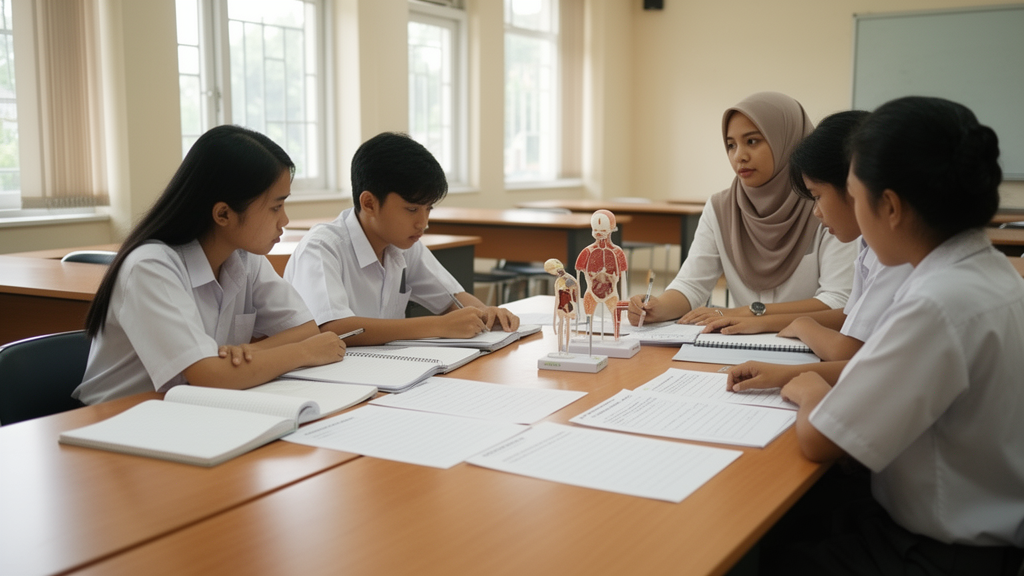
A multi-institutional needs analysis involving 77 undergraduate biology education students and five lecturers in South Sulawesi, Indonesia, identified requirements for project-based physiology teaching materials. Students reported substantial experience with project tasks and nearly all considered project activities supportive of independent learning, but their responses also indicated a need for stronger support in planning, reviewing feedback, controlling procrastination and reflecting on learning. The study examined instructional and resource needs; it did not test whether newly developed materials improved learning outcomes.
Researchers conducted the study during the Analysis phase of the ADDIE instructional-design model, using a mixed-methods approach. They surveyed students at three universities and collected qualitative information through three face-to-face interviews and two asynchronous written responses from lecturers. The questionnaire included a 23-item section measuring self-regulated learning, for which the reported internal consistency was good, with a Cronbach’s alpha of 0.839.
This phase was intended to establish an empirical basis for the later design of project-based learning, or PjBL, materials for human physiology. The student results showed that project-based approaches were familiar but not the most frequently selected form of learning. Lectures and discussions were selected by 64 of the 77 students, or 83.1%, while PjBL was selected by 24 students, or 31.2%.
Thirty students, representing 39.0%, reported frequent involvement in project tasks, and 27, or 35.1%, reported very frequent involvement. In addition, 76 students, or 98.7%, perceived project activities as supporting independent learning. These findings describe reported experience and perceptions rather than a measured learning benefit, and the analysis did not establish that one teaching format produced better performance than another.
PowerPoint was the most widely used learning resource, reported by 73 students, or 94.8%. Forty-five students, or 58.4%, also reported needing printed books or modules, and students identified needs for other structured resources. The self-regulated learning responses revealed reported strengths in self-efficacy, resource selection and project participation.
More support was needed for planning, feedback review, procrastination control and reflection. Lecturers described physiology as conceptually demanding because of abstract mechanisms, technical terminology and the need to visualize bodily processes, adding important information about the kinds of learning support that future materials may need to address. Sustainability competence was positioned as a theoretically informed direction for the subsequent Design phase.
The supplied results do not establish that integrating sustainability thinking improves knowledge, engagement, retention or performance, nor do they show that project-based materials outperform lectures and discussions. It provides a starting point for subsequent development and evaluation, not evidence that a completed intervention is already effective.
Subject of Research: Needs analysis for project-based human physiology teaching materials in Indonesian biology education
Article Title: Needs analysis for developing sustainability mindset-integrated project-based learning teaching materials in human physiology for biology education students
Article References: Hambali, H., Bancong, H., & Sukmawati, S. (2026). Needs analysis for developing sustainability mindset-integrated project-based learning teaching materials in human physiology for biology education students. Discover Sustainability. https://doi.org/10.1007/s43621-026-04751-z
Image Credits: AI Generated
DOI: 10.1007/s43621-026-04751-z
Keywords: needs analysis, human physiology, biology education, project-based learning, self-regulated learning, sustainability competence, instructional design, student resources, lecturer feedback, Indonesia, Needs, analysis
Cite Scienmag News
Violet Maxwell. (October 26, 2026). Indonesian biology students’ needs analysis informs physiology materials, not efficacy. Scienmag. https://scienmag.com/indonesian-biology-students-needs-analysis-informs-physiology-materials-not-efficacy/
Violet Maxwell. "Indonesian biology students’ needs analysis informs physiology materials, not efficacy." Scienmag, 26 October 2026, https://scienmag.com/indonesian-biology-students-needs-analysis-informs-physiology-materials-not-efficacy/. Accessed 26 October 2026.
Violet Maxwell. "Indonesian biology students’ needs analysis informs physiology materials, not efficacy." Scienmag. October 26, 2026. https://scienmag.com/indonesian-biology-students-needs-analysis-informs-physiology-materials-not-efficacy/


