

Monday, October 26, 2026
Science
No Result
View All Result
  • Login
  • HOME
  • SCIENCE NEWS
  • CONTACT US
  • HOME
  • SCIENCE NEWS
  • CONTACT US
No Result
View All Result
Scienmag
No Result
View All Result
Home Science News Chemistry

Varna canal measurements reveal hazardous short-period water oscillations

October 26, 2026
in Chemistry
Bethany Barker
By Bethany Barker Scienmag Editorial Profile - Catalysis
Reading Time: 3 mins read
0
Varna canal measurements reveal hazardous short-period water oscillations

Varna canal measurements reveal hazardous short-period water oscillations

65
SHARES
587
VIEWS
Share on FacebookShare on Twitter
ADVERTISEMENT

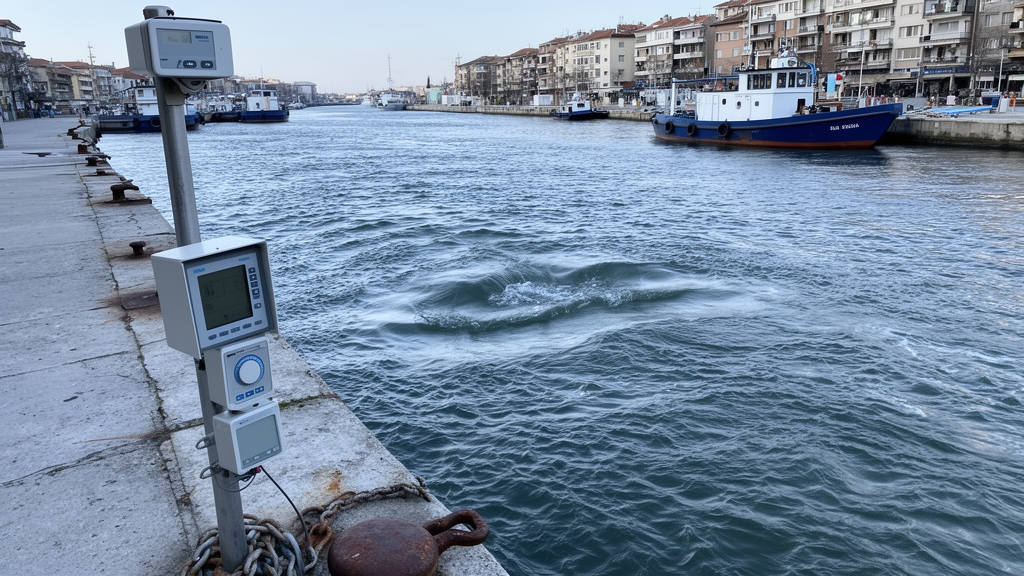
Estonian researchers have measured strong, potentially hazardous oscillations in the 2.4-kilometer-long, 300-meter-wide canal connecting Lake Varna with the Black Sea, including pronounced periods of 37 and 19 minutes. The observations and mathematical modeling indicate that resonance within the canal–lake system can amplify water movement under certain atmospheric conditions. During one exceptional episode, changes in current velocity and water level each reached 0.8 meters per second and 0.8 meters, respectively, over a 10-minute period. The researchers say fluctuations of that magnitude can make navigation highly dangerous, disrupt port operations and complicate coastal management.

The field study involved Maarja Kruusmaa, an academician and professor at Tallinn University of Technology, and researcher Laura Piho, who worked with the Port of Varna. Jüri Elken, professor emeritus of oceanography, joined the team in interpreting the unusual water movements. Investigators used Hydromast measuring stations developed at Tallinn University of Technology’s Center for Biorobotics. Three stations recorded the speed and direction of water movement and water levels at one-minute intervals. This high-temporal-resolution record allowed the researchers to capture rapid changes that could otherwise have gone undetected and to examine the canal’s sub-hourly dynamics.

Two exceptionally strong events were recorded during the monitoring period. In the first, water oscillations began abruptly and lasted for a couple of cycles. The researchers attributed it to a meteorological tsunami, which can occur when a weather front moves over shallow coastal waters at a speed associated with resonance. The second significant event occurred more than five hours after a storm, when offshore winds reached 20 meters per second. Over 10 minutes, the largest changes in current velocity reached 0.8 meters per second, while water levels changed by as much as 0.8 meters. In addition to these extremes, the canal also experienced normal moderate water movement.

Elken, Piho and Kruusmaa emphasized that the scientific paper primarily demonstrates how high-temporal-resolution measurements combined with mathematical modeling can identify and predict hazardous oscillations, rather than presenting a completed coastal forecasting system. The authors also propose specific steps for developing coastal monitoring and forecasting capabilities. The findings indicate potential applications in vessel navigation, forecasting strong currents and providing rapid warnings about changing conditions. More broadly, the researchers say strong currents and resonant sea-level fluctuations lasting less than an hour warrant study in other marine bays and in channels connecting those bays with upstream lakes and rivers, where comparable flow dynamics may occur.

The results provide information that could support port management, navigational safety and environmental impact assessment. The study’s scope was centered on the Varna harbor canal and the characteristics of its observed current and sea-level events; it does not establish that every canal will display the same behavior. The peer-reviewed article, “High current speed events in a harbor channel driven by resonant sub-hourly sea level dynamics: an example from Varna, Black Sea,” was authored by Jüri Elken, Laura Piho and Maarja Kruusmaa and published in Ocean Science on 17 August 2026.

Subject of Research: Hazardous short-period current and water-level oscillations in the Varna harbor canal

Article Title: Estonian scientists discover dangerous water oscillations between Lake Varna and Black Sea

Article References: Estonian scientists discover dangerous water oscillations between Lake Varna and Black Sea. Original publication (Bibliographic details unavailable.)

Image Credits: AI Generated

DOI: Not provided

Keywords: Varna Canal, Lake Varna, Black Sea, resonance, coastal currents, water levels, meteorological tsunami, port safety, Hydromast, coastal monitoring, Estonian, scientists

Cite Scienmag News

Bethany Barker. (October 26, 2026). Varna canal measurements reveal hazardous short-period water oscillations. Scienmag. https://scienmag.com/varna-canal-measurements-reveal-hazardous-short-period-water-oscillations/

Bethany Barker. "Varna canal measurements reveal hazardous short-period water oscillations." Scienmag, 26 October 2026, https://scienmag.com/varna-canal-measurements-reveal-hazardous-short-period-water-oscillations/. Accessed 26 October 2026.

Bethany Barker. "Varna canal measurements reveal hazardous short-period water oscillations." Scienmag. October 26, 2026. https://scienmag.com/varna-canal-measurements-reveal-hazardous-short-period-water-oscillations/


Tags: atmospheric conditions influencing water resonanceBlack SeaBlack Sea canal water oscillationscoastal currentscoastal management challenges due to water fluctuationscoastal monitoringEstonianhazardous short-term water level fluctuationshigh-frequency water movement measurementsHydromasthydromast measurement stations for real-time water dataimpact of water oscillations on navigation safetyLake Varnameteorological tsunamioceanographic research on canal-lake water interactionsport operation disruptions caused by water oscillationsport safetyrapid water velocity changes in Varna canalresonanceresonance effects in canal-lake systemsscientistssub-hourly dynamics of water bodiesVarna Canalwater levels
Share26Tweet16
Previous Post

Zeolite pores enable ligand-free olefin carbonylation

Next Post

Pooled healthy-person urine reveals urinary N-glycan diversity by reversed-phase LC/MS/MS

Related Posts

Zeolite pores enable ligand-free olefin carbonylation
Chemistry

Zeolite pores enable ligand-free olefin carbonylation

October 26, 2026
Liquid membranes bend 100 times more easily than lipid membranes
Chemistry

Liquid membranes bend 100 times more easily than lipid membranes

October 26, 2026
Stanford team observes first real-time quantum jump in sound
Chemistry

Stanford team observes first real-time quantum jump in sound

October 26, 2026
Layered magnetic crystal converts microwaves into optical signals
Chemistry

Layered magnetic crystal converts microwaves into optical signals

October 26, 2026
Sandia-Led AI Project Targets Uncertainty in Turbulent Flow Models
Chemistry

Sandia-Led AI Project Targets Uncertainty in Turbulent Flow Models

October 26, 2026
Quasi-BIC design improves quantum-well photodetection for machine vision
Chemistry

Quasi-BIC design improves quantum-well photodetection for machine vision

October 26, 2026
Next Post
Pooled healthy-person urine reveals urinary N-glycan diversity by reversed-phase LC/MS/MS

Pooled healthy-person urine reveals urinary N-glycan diversity by reversed-phase LC/MS/MS

  • Mothers who receive childcare support from maternal grandparents show more optimized

    Mothers who receive childcare support from maternal grandparents show more parental warmth, finds NTU Singapore study

    27656 shares
    Share 11059 Tweet 6912
  • University of Seville Breaks 120-Year-Old Mystery, Revises a Key Einstein Concept

    1061 shares
    Share 424 Tweet 265
  • Bee body mass, pathogens and local climate influence heat tolerance

    682 shares
    Share 273 Tweet 171
  • Researchers record first-ever images and data of a shark experiencing a boat strike

    546 shares
    Share 218 Tweet 137
  • Groundbreaking Clinical Trial Reveals Lubiprostone Enhances Kidney Function

    531 shares
    Share 212 Tweet 133
Science

Embark on a thrilling journey of discovery with Scienmag.com—your ultimate source for cutting-edge breakthroughs. Immerse yourself in a world where curiosity knows no limits and tomorrow’s possibilities become today’s reality!

RECENT NEWS

  • Autoimmune disease linked to greater dengue severity in Colombian cohort
  • Survey links drought vulnerability, coping and livelihoods in Borena
  • AI, Green Resources and Semiconductor Markets Form a Tightly Linked Financial Network
  • Aboriginal early years workers identify priorities for infant nutrition and active play

Categories

  • Agriculture
  • Anthropology
  • Archaeology
  • Athmospheric
  • Biology
  • Biotechnology
  • Blog
  • Bussines
  • Cancer
  • Chemistry
  • Climate
  • Earth Science
  • Editorial Policy
  • Marine
  • Mathematics
  • Medicine
  • Pediatry
  • Policy
  • Psychology & Psychiatry
  • Science Education
  • Science News
  • Social Science
  • Space
  • Technology and Engineering

Subscribe to Blog via Email

Enter your email address to subscribe to this blog and receive notifications of new posts by email.

Join 5,151 other subscribers

© 2025 Scienmag - Science Magazine

Welcome Back!

Login to your account below

Forgotten Password?

Retrieve your password

Please enter your username or email address to reset your password.

Log In
No Result
View All Result
  • HOME
  • SCIENCE NEWS
  • CONTACT US

© 2025 Scienmag - Science Magazine

Discover more from Science

Subscribe now to keep reading and get access to the full archive.

Continue reading