


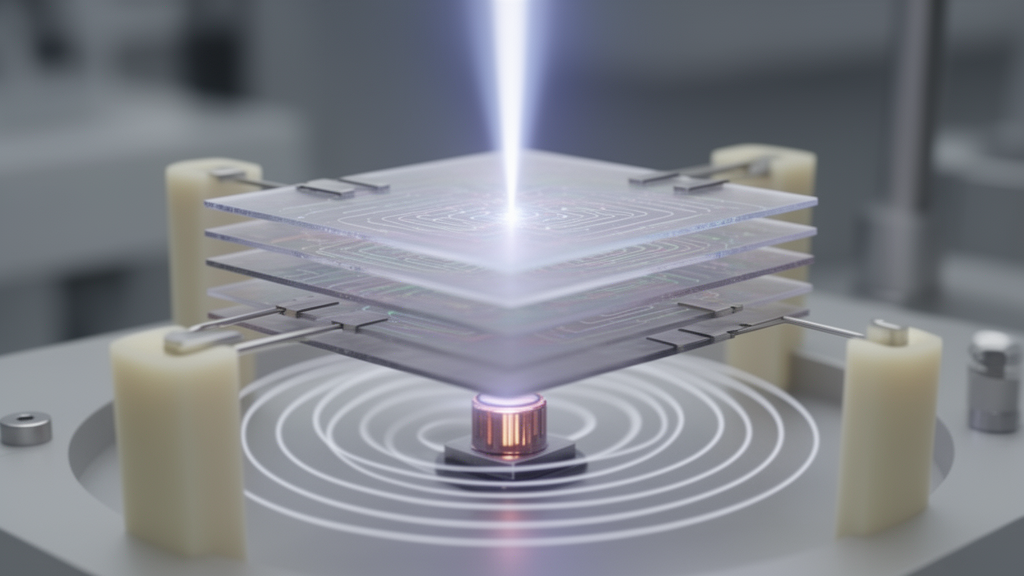
Physicists at the City College of New York have demonstrated a way to transfer microwave signals onto light using magnetic waves inside a layered magnetic semiconductor. In the peer-reviewed experimental study, published in Nature Materials, the team used chromium sulfide bromide, or CrSBr, to produce a coherent optical signal that tracked a microwave input. The result establishes a materials platform for interfaces that could one day link microwave-based quantum computers through optical networks, although the experiment did not transfer individual quantum states.
The proposed application addresses a difference between the technologies used to process and transmit quantum information. Many leading quantum processors operate using microwave signals, while light is better suited to carrying information over long distances through optical fiber. A transducer is needed to convert a signal from one frequency range to another while preserving the information it carries.
Such conversion is routine in telecommunications, but a useful quantum interface must operate with high efficiency while adding very little noise. The present work demonstrates the conversion mechanism and identifies efficiency, noise control and stronger light–matter interactions as requirements for transferring individual quantum states in the longer term. CrSBr contains atomic magnetic moments that move collectively when driven by microwaves.
These collective excitations are called magnons. They shift the energies of excitons, which are bound pairs of electrons and holes that interact strongly with light. As a result, laser light reflected from the crystal acquires a coherent optical signal corresponding to the microwave drive.
The effect takes advantage of the strong interaction between light and matter near exciton resonances, allowing the magnetic dynamics within the crystal to imprint the microwave signal onto the reflected light. The researchers measured conversion across a microwave frequency window of approximately 300 megahertz, and the operating frequency could be tuned with an applied magnetic field. A notable feature of the experiment is that the researchers observed the effect in a bulk crystal without adding either an optical or a microwave resonator to boost the interaction.
It does not, however, make the setup a complete quantum-network transducer: the study did not demonstrate the transfer of individual quantum states, and it did not establish the efficiency and added-noise performance required for that application. The paper identifies several possible routes toward stronger interactions and higher efficiency, including thinner magnetic flakes, microwave resonators and high-quality optical cavities. Engineering exciton–polaritons—hybrid states of light and matter—is another proposed direction for managing optical loss.
The layered structure of CrSBr may provide useful flexibility for future device design and integration. According to Pratap Chandra Adak, a postdoctoral researcher in Vinod Menon’s group who led the study, CrSBr’s magnetic and optical properties can be retained when the material is thinned to a few layers. Thinner flakes could strengthen the relevant interactions and support more compact devices.
The broader opportunity identified by the team is to combine strong optical interactions and microwave-frequency magnetism in a single material, then use families of layered magnetic materials to engineer new opto-magnonic devices. The CCNY-led collaboration included researchers from the CUNY Advanced Science Research Center, Columbia University, the University of Chemistry and Technology Prague, the University of Chicago and RPTU Kaiserslautern-Landau in Germany. The study, “Microwave-to-optical transduction using magnon–exciton coupling,” was published in Nature Materials on 14 September 2026.
Subject of Research: Experimental microwave-to-optical transduction using magnon–exciton coupling in the layered magnetic semiconductor CrSBr
Article Title: A new bridge for quantum networks: CCNY physicists convert microwaves to light using 2D magnets
Article References: A new bridge for quantum networks: CCNY physicists convert microwaves to light using 2D magnets. Original publication (Bibliographic details unavailable.)
Image Credits: AI Generated
DOI: Not provided
Keywords: quantum networks, microwave-to-optical transduction, CrSBr, magnons, excitons, layered magnets, opto-magnonics, quantum processors, coherent optical signals, Nature Materials, bridge, quantum
Cite Scienmag News
Bethany Barker. (October 26, 2026). Layered magnetic crystal converts microwaves into optical signals. Scienmag. https://scienmag.com/layered-magnetic-crystal-converts-microwaves-into-optical-signals/
Bethany Barker. "Layered magnetic crystal converts microwaves into optical signals." Scienmag, 26 October 2026, https://scienmag.com/layered-magnetic-crystal-converts-microwaves-into-optical-signals/. Accessed 26 October 2026.
Bethany Barker. "Layered magnetic crystal converts microwaves into optical signals." Scienmag. October 26, 2026. https://scienmag.com/layered-magnetic-crystal-converts-microwaves-into-optical-signals/


