


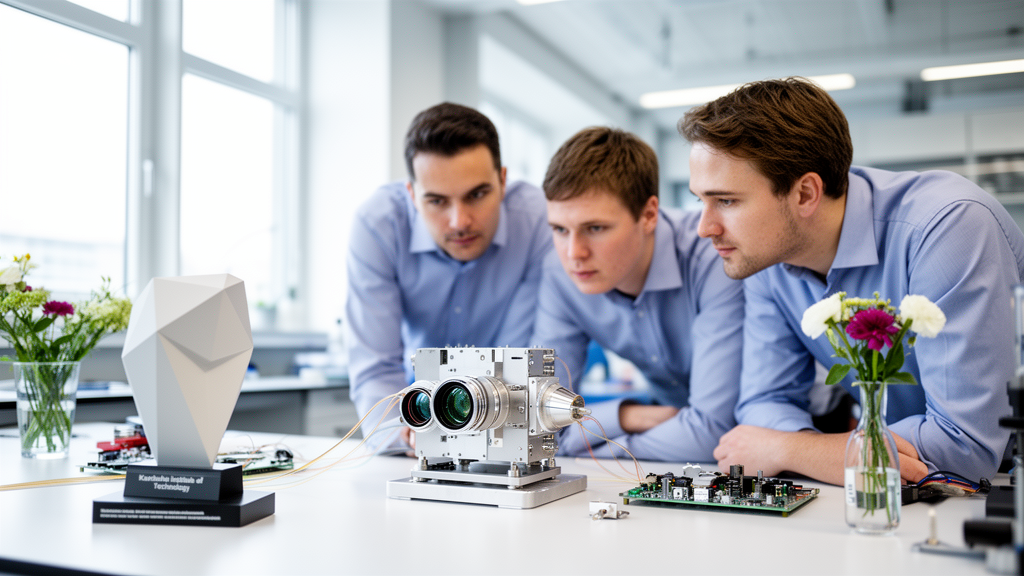
Researchers at the Karlsruhe Institute of Technology (KIT) and two KIT spin-offs have reached the final stage of the Deutscher Zukunftspreis, Germany’s Future Prize. The nominated teams are led by Christian Koos, Philipp Dietrich and Matthias Lauermann, whose work addresses automated optical connections and wafer-level testing for densely integrated photonic chips. Their technologies are intended to improve the manufacture of optical systems used in data networks, data centers and artificial-intelligence applications.
Koos’s team at KIT’s Institute of Photonics and Quantum Electronics and Institute of Microstructure Technology has developed a laser-assisted printing process for creating tiny optical connections between microchips and optical fibers. A specialized laser is used to form three-dimensional connecting structures in the gap between components that have initially been positioned only roughly. The approach is intended to tolerate small placement errors that can arise during assembly, including shifts on the micrometer scale caused by adhesive curing, while digital compensation can correct unavoidable inaccuracies. The researchers say the resulting process can be automated to produce large numbers of connections in confined spaces.
The same printing technology can also produce precisely formed microlenses on optical fibers or chip edges. As photonic components become smaller and more numerous, the difficult manufacturing challenge is no longer simply producing the chips in bulk but connecting them optically with high precision. Traditional assembly has required components to be positioned extremely accurately, making the process costly and potentially vulnerable to small mechanical displacements. Printing the optical connection directly into the gap offers a way to accommodate components that are not perfectly aligned and reduce reliance on costly manual assembly.
Reliability is another manufacturing problem addressed by the nominated work, because a single defective chip can make a complex photonic system unusable. Conventional methods had not provided efficient testing of optical chips during production, according to KIT. The researchers use their printing process to fabricate specialized measurement probes capable of testing photonic chips at the wafer level. Defective components can consequently be identified and discarded early in manufacturing, which the researchers say makes the production of more complex photonic systems economically feasible.
Industrial implementation is being pursued by the KIT spin-offs Vanguard Automation GmbH and Keystone Photonics GmbH. Matthias Lauermann’s team at Vanguard Automation has developed industrial machinery and process solutions for multi-chip systems based on integrated optics. Under Philipp Dietrich’s leadership, Keystone Photonics develops and manufactures the measurement probes used to test chips. KIT reports that the probes have become an important manufacturing step for optoelectronic transmitters and receivers, while the broader technology is being transferred toward economical production of optical systems for digital infrastructure. A jury nominates candidates for the Deutscher Zukunftspreis, which is awarded by Germany’s Federal President and recognizes technological, engineering and natural-science innovations that lead to market-ready products; candidates cannot apply directly.
Subject of Research: Automated optical connections and wafer-level testing for photonic microchip manufacturing
Article Title: Karlsruhe researchers nominated for Deutscher Zukunftspreis
Article References: Karlsruhe researchers nominated for Deutscher Zukunftspreis. Original publication (Bibliographic details unavailable.)
Image Credits: AI Generated
DOI: Not provided
Keywords: photonics, photonic microchips, 3D printing, optical interconnects, wafer-level testing, data transmission, manufacturing automation, KIT, technology transfer, Deutscher Zukunftspreis, Karlsruhe, researchers
Cite Scienmag News
Katie Riggs. (October 26, 2026). KIT Photonics Teams Named Finalists for Germany’s Future Prize. Scienmag. https://scienmag.com/kit-photonics-teams-named-finalists-for-germanys-future-prize/
Katie Riggs. "KIT Photonics Teams Named Finalists for Germany’s Future Prize." Scienmag, 26 October 2026, https://scienmag.com/kit-photonics-teams-named-finalists-for-germanys-future-prize/. Accessed 26 October 2026.
Katie Riggs. "KIT Photonics Teams Named Finalists for Germany’s Future Prize." Scienmag. October 26, 2026. https://scienmag.com/kit-photonics-teams-named-finalists-for-germanys-future-prize/


