

Monday, October 26, 2026
Science
No Result
View All Result
  • Login
  • HOME
  • SCIENCE NEWS
  • CONTACT US
  • HOME
  • SCIENCE NEWS
  • CONTACT US
No Result
View All Result
Scienmag
No Result
View All Result
Home Science News Technology and Engineering

Thicker walls and more openings raise bending loads in PLA specimens

October 26, 2026
in Technology and Engineering
Denise Maddox
By Denise Maddox Scienmag Editorial Profile - Mechanical Engineering
Reading Time: 2 mins read
0
Thicker walls and more openings raise bending loads in PLA specimens

Thicker walls and more openings raise bending loads in PLA specimens

65
SHARES
587
VIEWS
Share on FacebookShare on Twitter
ADVERTISEMENT

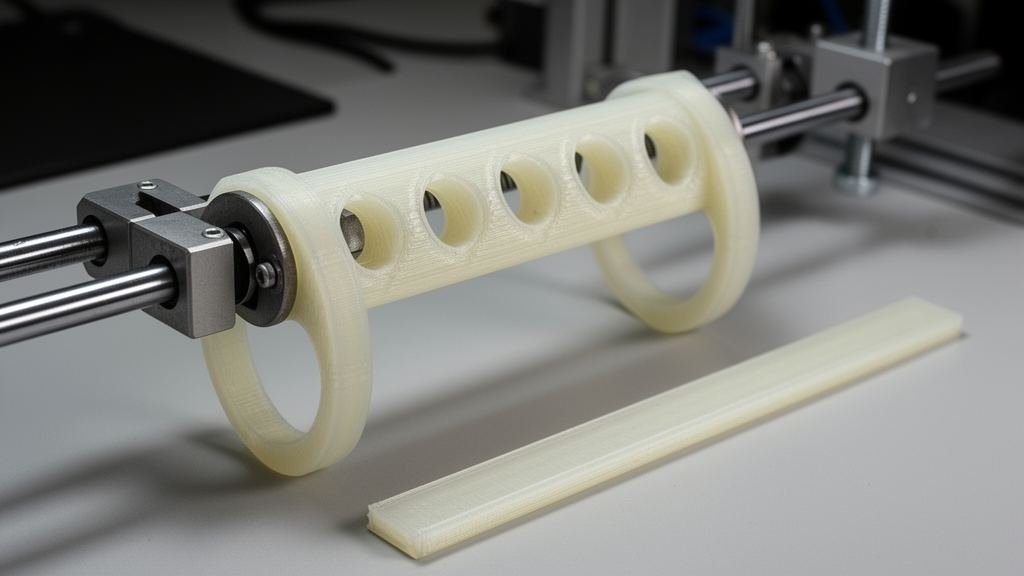
Increasing wall thickness or the number of openings markedly improved the peak bending-load capacity of polylactic acid (PLA) specimens produced by fused deposition modeling, according to an experimental and finite-element study. In the designs examined, raising wall thickness from 2 to 4 millimetres at a constant number of openings increased peak load capacity by as much as 170%. Increasing the opening count from one to three at a constant wall thickness produced a peak-load increase of 118%.

To investigate how geometry affected flexural performance, the researchers manufactured test specimens from PLA filament using fused deposition modeling, abbreviated FDM. The specimens included five wall thicknesses—2, 2.6, 2.7, 3.8 and 4 millimetres—and were evaluated in configurations with one, two or three openings. Bending tests measured the loads and deflections associated with each specimen’s structural response. Within the tested range, the largest reported gains in peak-load capacity occurred when wall thickness increased while the number of openings remained fixed.

The study combined physical experiments with finite-element modelling in ABAQUS. The computational analysis was used to examine failure mechanisms in the different specimen geometries. Its predicted deflection and force values were consistent with the experimental findings, providing a numerical account of the structures’ behaviour under bending loads. This agreement does not mean that every possible FDM component will respond identically: the results are tied to the specimen designs, PLA material and test conditions included in the investigation.

Thermogravimetric analysis examined the thermal behaviour of the PLA. The analysis showed no mass loss up to approximately 250–280 °C, while higher temperatures produced mass loss associated with thermal combustion of the polymer chains. Scanning electron microscopy revealed secondary-phase particles dispersed throughout the matrix rather than a completely homogeneous polymer structure. These observations characterize the tested material, but the reported thermal range and microscopic features were not shown to be universal across all PLA filaments or printed parts.

Together, the experiments and simulations identify wall thickness and opening count as influential design variables for the flexural performance of the investigated FDM-produced PLA specimens. Thicker walls and additional openings were each associated with higher peak bending-load capacity, while the finite-element results broadly matched the measured behaviour. The research therefore offers quantified evidence for two ways of altering geometry in this test program, without establishing whether the same percentage gains will occur in components of other shapes, under different loading conditions, or with different PLA formulations.

Subject of Research: Effects of wall thickness and opening count on the flexural performance of FDM-produced PLA specimens

Article Title: Effect of wall thickness and openings on the flexural properties of PLA produced by additive manufacturing

Article References: Karalar, M., Türe, M. O., Motameni, A., Korkut, F., & Evis, Z. (2026). Effect of wall thickness and openings on the flexural properties of PLA produced by additive manufacturing. Scientific Reports. https://doi.org/10.1038/s41598-026-67674-9

Image Credits: AI Generated

DOI: 10.1038/s41598-026-67674-9

Keywords: PLA, additive manufacturing, FDM, flexural performance, bending loads, wall thickness, openings, finite-element analysis, ABAQUS, polymer mechanics, Effect, wall

Cite Scienmag News

Denise Maddox. (October 26, 2026). Thicker walls and more openings raise bending loads in PLA specimens. Scienmag. https://scienmag.com/thicker-walls-and-more-openings-raise-bending-loads-in-pla-specimens/

Denise Maddox. "Thicker walls and more openings raise bending loads in PLA specimens." Scienmag, 26 October 2026, https://scienmag.com/thicker-walls-and-more-openings-raise-bending-loads-in-pla-specimens/. Accessed 26 October 2026.

Denise Maddox. "Thicker walls and more openings raise bending loads in PLA specimens." Scienmag. October 26, 2026. https://scienmag.com/thicker-walls-and-more-openings-raise-bending-loads-in-pla-specimens/


Tags: ABAQUSadditive manufacturingand bending load in 3Dbending loadsEffecteffects of wall thickness on 3D printed PLAexperimental study of PLA wall thickness and opening variationsFDMfinite element analysisfinite element analysis of PLA flexural performanceflexural performanceimpact of geometry on bending resistance in 3D printed polymersinfluence of openings on FDM printed structuresnumerical modeling of failure mechanisms in PLA specimensopeningsoptimization of FDM part design for improved load capacityPLAPLA specimen bending load enhancementpolymer mechanicsrelationship between wall thicknessstructural strength of fused deposition modeling partswallwall thickness
Share26Tweet16
Previous Post

Semantic Labels Guide Terrain-Specific Humanoid Behavior in Simulation

Next Post

Attention-enhanced YOLOv8s advances photovoltaic defect detection

Related Posts

Attention-enhanced YOLOv8s advances photovoltaic defect detection
Technology and Engineering

Attention-enhanced YOLOv8s advances photovoltaic defect detection

October 26, 2026
Semantic Labels Guide Terrain-Specific Humanoid Behavior in Simulation
Technology and Engineering

Semantic Labels Guide Terrain-Specific Humanoid Behavior in Simulation

October 26, 2026
Finite-element study maps stresses around 4-mm ultra-short dental implants
Technology and Engineering

Finite-element study maps stresses around 4-mm ultra-short dental implants

October 26, 2026
Kinematic Model Tests Ductile-Hinge Layouts for Curved Bridge Launching
Technology and Engineering

Kinematic Model Tests Ductile-Hinge Layouts for Curved Bridge Launching

October 26, 2026
Higher Platelet-to-White Blood Cell Ratio Linked to Survival in HFpEF
Technology and Engineering

Higher Platelet-to-White Blood Cell Ratio Linked to Survival in HFpEF

October 26, 2026
Injection model caused faster, more severe joint degeneration in rats
Technology and Engineering

Injection model caused faster, more severe joint degeneration in rats

October 26, 2026
Next Post
Attention-enhanced YOLOv8s advances photovoltaic defect detection

Attention-enhanced YOLOv8s advances photovoltaic defect detection

  • Mothers who receive childcare support from maternal grandparents show more optimized

    Mothers who receive childcare support from maternal grandparents show more parental warmth, finds NTU Singapore study

    27656 shares
    Share 11059 Tweet 6912
  • University of Seville Breaks 120-Year-Old Mystery, Revises a Key Einstein Concept

    1061 shares
    Share 424 Tweet 265
  • Bee body mass, pathogens and local climate influence heat tolerance

    682 shares
    Share 273 Tweet 171
  • Researchers record first-ever images and data of a shark experiencing a boat strike

    546 shares
    Share 218 Tweet 137
  • Groundbreaking Clinical Trial Reveals Lubiprostone Enhances Kidney Function

    531 shares
    Share 212 Tweet 133
Science

Embark on a thrilling journey of discovery with Scienmag.com—your ultimate source for cutting-edge breakthroughs. Immerse yourself in a world where curiosity knows no limits and tomorrow’s possibilities become today’s reality!

RECENT NEWS

  • Traceability Linked to Modest Smallholder Price Gains and Export Readiness
  • Attention-enhanced YOLOv8s advances photovoltaic defect detection
  • Thicker walls and more openings raise bending loads in PLA specimens
  • Semantic Labels Guide Terrain-Specific Humanoid Behavior in Simulation

Categories

  • Agriculture
  • Anthropology
  • Archaeology
  • Athmospheric
  • Biology
  • Biotechnology
  • Blog
  • Bussines
  • Cancer
  • Chemistry
  • Climate
  • Earth Science
  • Editorial Policy
  • Marine
  • Mathematics
  • Medicine
  • Pediatry
  • Policy
  • Psychology & Psychiatry
  • Science Education
  • Science News
  • Social Science
  • Space
  • Technology and Engineering

Subscribe to Blog via Email

Enter your email address to subscribe to this blog and receive notifications of new posts by email.

Join 5,151 other subscribers

© 2025 Scienmag - Science Magazine

Welcome Back!

Login to your account below

Forgotten Password?

Retrieve your password

Please enter your username or email address to reset your password.

Log In
No Result
View All Result
  • HOME
  • SCIENCE NEWS
  • CONTACT US

© 2025 Scienmag - Science Magazine

Discover more from Science

Subscribe now to keep reading and get access to the full archive.

Continue reading