

Monday, October 26, 2026
Science
No Result
View All Result
  • Login
  • HOME
  • SCIENCE NEWS
  • CONTACT US
  • HOME
  • SCIENCE NEWS
  • CONTACT US
No Result
View All Result
Scienmag
No Result
View All Result
Home Science News Medicine

Central obesity prevalence differs across Australian remoteness areas

October 26, 2026
in Medicine
Daisy Hatcher
By Daisy Hatcher Scienmag Editorial Profile - Food Safety and Toxicology
Reading Time: 3 mins read
0
Central obesity prevalence differs across Australian remoteness areas

Central obesity prevalence differs across Australian remoteness areas

65
SHARES
587
VIEWS
Share on FacebookShare on Twitter
ADVERTISEMENT

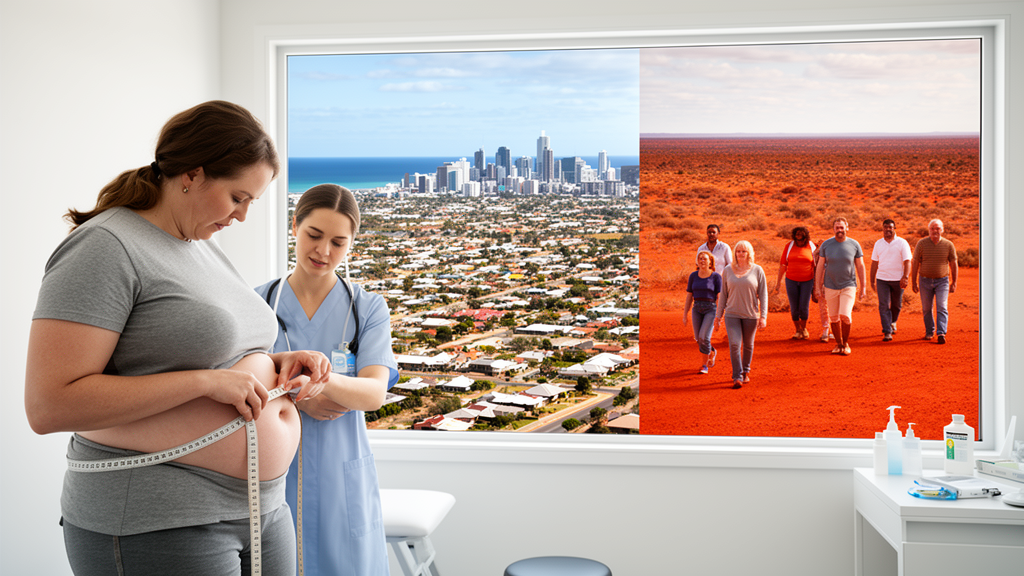
Central obesity was more prevalent among adults in Australia’s Outer Regional and Remote areas than in other remoteness categories, according to a population-based analysis of the 2017–18 Australian National Health Survey. The study estimated that 46.2% of adults in Outer Regional and Remote areas met the central-obesity threshold, compared with 38.8% across Australia as a whole. Central obesity was defined as a waist circumference of at least 102 cm for males and at least 88 cm for females.

The findings concern differences among geographic categories rather than an increase over time, and the observational study did not establish that remoteness caused the differences. Researchers analysed a weighted sample of 18,655 adults aged 18 years or older from the national survey. They used Bayesian multivariable logistic regression to estimate associations between central obesity and a range of sociodemographic, lifestyle and psychosocial characteristics, reporting odds ratios with 95% credible intervals.

In Inner Regional areas, several factors were associated with higher adjusted odds of central obesity. Adults who had not completed Year 12 had 27% higher odds than the relevant reference group (odds ratio 1.27; 95% credible interval 1.09–1.50), while those living in the most socioeconomically disadvantaged areas had 71% higher odds (odds ratio 1.71; 95% credible interval 1.26–2.34). These estimates identify population-level associations and do not demonstrate direct causal effects.

Physical inactivity and depression were also associated with higher odds in Inner Regional areas. Physically inactive adults had more than twice the odds of central obesity (odds ratio 2.15; 95% credible interval 1.73–2.69), and adults with depression had 96% higher odds (odds ratio 1.96; 95% credible interval 1.49–2.60). Socioeconomic disadvantage was associated with higher odds in both Inner Regional and Outer Regional and Remote areas, although the magnitude differed between the models.

Daily consumption of sugary drinks was another correlate identified in Outer Regional and Remote areas. Adults who consumed them daily had 38% higher odds of central obesity than the relevant reference group (odds ratio 1.38; 95% credible interval 1.08–1.77). In that same category, residents of the most socioeconomically disadvantaged areas had 54% higher odds than those in the reference group (odds ratio 1.54; 95% credible interval 1.13–2.13).

Because the analysis drew on survey observations and adjusted multivariable models, it cannot determine whether physical inactivity, disadvantage, sugary drink consumption or other measured factors produced the higher odds. The analysis also identified a subgroup that a BMI-only assessment could miss. Among adults in Outer Regional and Remote areas whose body mass index was classified as normal, 6.7% still met the study’s waist-circumference threshold for central obesity—approximately one in 15.

This finding supports the authors’ concern that assessing obesity only by BMI may overlook some adults with central obesity in regional and remote communities. The study is cross-sectional, so it cannot show how central obesity developed or changed over time, and it did not test whether any policy or intervention would improve cardiometabolic outcomes. Its scope was limited to adults represented in the 2017–18 national survey and to the sociodemographic, lifestyle and psychosocial factors included in the analysis.

Subject of Research: Population-based study of central obesity and associated factors among regional and remote Australian adults

Article Title: Central obesity in regional and remote Australian adults: a population-based Bayesian study

Article References: Aychiluhm, S. B., Ahmed, K. Y., Ross, A. G., Thapa, S., Astawesegn, F. H., Isaac, V., Berhe, F. T., Nezenega, Z. S., Leshargie, C. T., Kassa, Z. Y., Huda, M. M., Mahmood, S., Mondal, U. K., Anyasodor, A. E., Mengist, T. Y., Demissie, B. W., & Bore, M. G. (2026). Central obesity in regional and remote Australian adults: a population-based Bayesian study. BMC Public Health. https://doi.org/10.1186/s12889-026-29863-z

Image Credits: AI Generated

DOI: 10.1186/s12889-026-29863-z

Keywords: central obesity, Australia, waist circumference, remoteness, Bayesian regression, socioeconomic disadvantage, physical inactivity, depression, sugary drinks, body mass index, Central, obesity

Cite Scienmag News

Daisy Hatcher. (October 26, 2026). Central obesity prevalence differs across Australian remoteness areas. Scienmag. https://scienmag.com/central-obesity-prevalence-differs-across-australian-remoteness-areas/

Daisy Hatcher. "Central obesity prevalence differs across Australian remoteness areas." Scienmag, 26 October 2026, https://scienmag.com/central-obesity-prevalence-differs-across-australian-remoteness-areas/. Accessed 26 October 2026.

Daisy Hatcher. "Central obesity prevalence differs across Australian remoteness areas." Scienmag. October 26, 2026. https://scienmag.com/central-obesity-prevalence-differs-across-australian-remoteness-areas/


Tags: AustraliaBayesian analysis of obesity dataBayesian regressionbody mass indexCentralcentral obesitycentral obesity prevalence AustraliaDepressiondifferences in obesity across remoteness areasgeographic health disparities Australiahealth outcomes in Outer Regional and Remote Australiaimpact of socioeconomic status on obesitylifestyle factors influencing obesity in remote areasobesityobesity disparities and remotenessobesity risk factors in Australian adultsphysical inactivitypopulation-based health survey Australiaremotenesssociodemographic determinants of central obesitysocioeconomic disadvantagesugary drinkswaist circumferencewaist circumference thresholds for obesity
Share26Tweet16
Previous Post

Survey finds mixed patient-centred orientations among South African optometry students

Next Post

Specialized deep learning improves UAV-based solar fault detection

Related Posts

Australian survey finds broad acceptability of lifestyle medicine for brain health
Medicine

Australian survey finds broad acceptability of lifestyle medicine for brain health

October 26, 2026
Free Healthy Food Access May Reduce Food Insecurity, Not Significantly Improve HbA1c
Medicine

Free Healthy Food Access May Reduce Food Insecurity, Not Significantly Improve HbA1c

October 26, 2026
Indian district survey maps low birth weight, temperature and health
Medicine

Indian district survey maps low birth weight, temperature and health

October 26, 2026
Iranian child-development providers report referral, funding and coordination barriers
Medicine

Iranian child-development providers report referral, funding and coordination barriers

October 26, 2026
Cross-sectional study links Swiss bus driver burnout to demanding working conditions
Medicine

Cross-sectional study links Swiss bus driver burnout to demanding working conditions

October 26, 2026
Health literacy linked to metabolic syndrome prevalence in Korean adults
Medicine

Health literacy linked to metabolic syndrome prevalence in Korean adults

October 26, 2026
Next Post
Specialized deep learning improves UAV-based solar fault detection

Specialized deep learning improves UAV-based solar fault detection

  • Mothers who receive childcare support from maternal grandparents show more optimized

    Mothers who receive childcare support from maternal grandparents show more parental warmth, finds NTU Singapore study

    27656 shares
    Share 11059 Tweet 6912
  • University of Seville Breaks 120-Year-Old Mystery, Revises a Key Einstein Concept

    1061 shares
    Share 424 Tweet 265
  • Bee body mass, pathogens and local climate influence heat tolerance

    682 shares
    Share 273 Tweet 171
  • Researchers record first-ever images and data of a shark experiencing a boat strike

    546 shares
    Share 218 Tweet 137
  • Groundbreaking Clinical Trial Reveals Lubiprostone Enhances Kidney Function

    531 shares
    Share 212 Tweet 133
Science

Embark on a thrilling journey of discovery with Scienmag.com—your ultimate source for cutting-edge breakthroughs. Immerse yourself in a world where curiosity knows no limits and tomorrow’s possibilities become today’s reality!

RECENT NEWS

  • Australian survey finds broad acceptability of lifestyle medicine for brain health
  • Virtual patient scores rose after emergency internship in 86-intern single-group study
  • Survey links Ethiopian small firms’ performance to innovation capability
  • Free Healthy Food Access May Reduce Food Insecurity, Not Significantly Improve HbA1c

Categories

  • Agriculture
  • Anthropology
  • Archaeology
  • Athmospheric
  • Biology
  • Biotechnology
  • Blog
  • Bussines
  • Cancer
  • Chemistry
  • Climate
  • Earth Science
  • Editorial Policy
  • Marine
  • Mathematics
  • Medicine
  • Pediatry
  • Policy
  • Psychology & Psychiatry
  • Science Education
  • Science News
  • Social Science
  • Space
  • Technology and Engineering

Subscribe to Blog via Email

Enter your email address to subscribe to this blog and receive notifications of new posts by email.

Join 5,151 other subscribers

© 2025 Scienmag - Science Magazine

Welcome Back!

Login to your account below

Forgotten Password?

Retrieve your password

Please enter your username or email address to reset your password.

Log In
No Result
View All Result
  • HOME
  • SCIENCE NEWS
  • CONTACT US

© 2025 Scienmag - Science Magazine

Discover more from Science

Subscribe now to keep reading and get access to the full archive.

Continue reading