


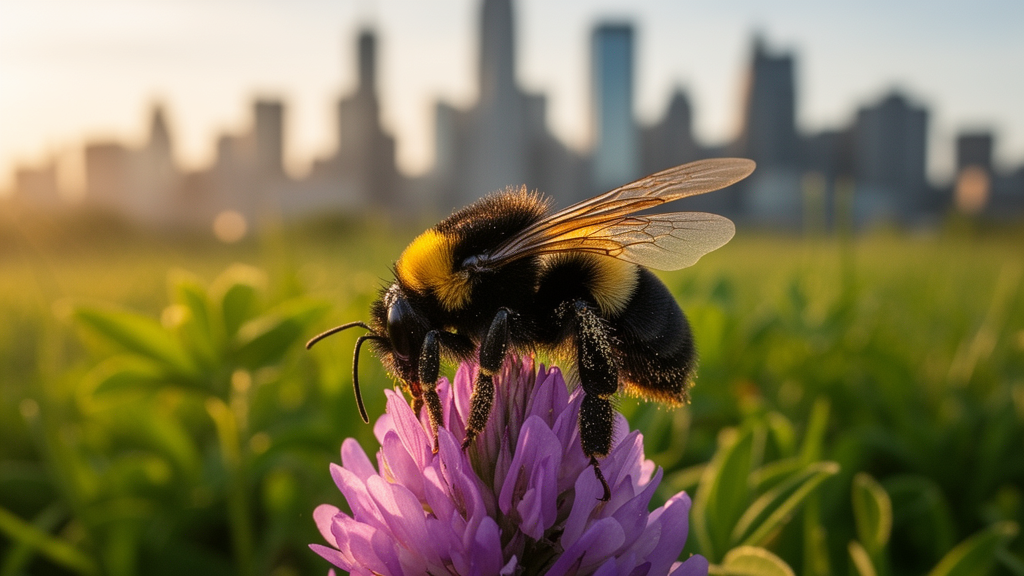
Cities do not just reshape landscapes; they can also reshape genomes in repeatable ways. A whole-genome study published in Genome Biology on 26 October 2026 analysed 524 individual bumble bees from three widespread species, each sampled across nine independent urban–rural pairs in Central Europe. The research, led by Panagiotis Theodorou and Robert J. Paxton, set out to test a long-standing question in urban evolutionary biology: whether responses to city life are largely idiosyncratic, varying unpredictably from one population to the next, or whether similar selective pressures operating in different cities repeatedly generate predictable genomic outcomes.
The answer, according to the study, is that both patterns occur, but at different levels of biological organisation. When the researchers examined overall genetic diversity, the response to urbanisation was species-specific. Two of the three bumble bee species showed no detectable differences in genetic diversity between urban and rural populations, while one species exhibited reduced diversity in cities. The authors interpret this variation as consistent with species-specific ecological traits and habitat requirements, meaning that the demographic consequences of urban living are not uniform across closely related species.
Population structure told a similar story of connectivity. Across all three species, the team found only weak genetic differentiation between urban and rural samples, together with evidence of high gene flow. In other words, bees move among habitats often enough that city and countryside populations are not isolated from one another. This ongoing gene flow might be expected to erase any local adaptation, yet the genomic data revealed the opposite: consistent and replicated divergence associated with urban environments, detectable despite the mixing of individuals.
Two complementary analyses underpinned this finding. Genome–environment association analyses identified parallel allele-frequency shifts at the same loci across independent cities for each species, indicating that the same genetic variants rise in frequency in urban settings again and again. Separately, selective sweep scans uncovered repeated signals of positive selection in urban populations, suggesting that natural selection, rather than drift alone, has driven these patterns in multiple cities independently.
The architecture of this urban-associated divergence was strikingly polygenic. Rather than a handful of large-effect mutations, adaptation to cities appears distributed across many genomic sites, and it occurred predominantly in non-coding regions of the genome with potential regulatory roles. This points to changes in gene regulation as an important component of evolutionary responses to urban environments, a conclusion the authors highlight as a broader lesson of the work.
Although the specific genes showing urban-associated divergence were largely species-specific, functional enrichment analyses revealed strong convergence across species. The affected genes were over-represented in pathways related to physiological stress responses, neurocognitive and behavioural processes, metabolism and immunity. The study reports these enrichment results rather than assigning causes to individual urban pressures, so the functional categories should be read as convergent targets of selection, not as evidence for which specific city conditions drove the changes.
Taken together, the findings suggest that urban environments can impose recurrent selective pressures strong enough to generate predictable, parallel genomic responses across independent cities and even across species, despite ongoing gene flow that would otherwise homogenise populations. For bumble bees, the results imply that urban adaptation is a real and replicated evolutionary process rather than a collection of one-off events.
The study also frames polygenic, potentially regulatory adaptation as a key mechanism by which organisms respond to pervasive environmental change. By combining whole-genome data from multiple species and multiple independent urban–rural comparisons, the work demonstrates that similar selective pressures in different cities can repeatedly generate similar genomic outcomes, a result the authors present as evidence that evolution in urban environments can be predictable rather than idiosyncratic.
Subject of Research: Parallel genomic divergence and polygenic adaptation to urbanisation in three Central European bumble bee species
Article Title: Urbanisation drives parallel genomic divergence across cities and bumble bee species
Article References: Theodorou, P., & Paxton, R. J. (2026). Urbanisation drives parallel genomic divergence across cities and bumble bee species. Genome Biology, 27(1), Article 326. https://doi.org/10.1186/s13059-026-04322-5
Image Credits: AI Generated
DOI: 10.1186/s13059-026-04322-5
Keywords: urbanisation, bumble bees, genomics, parallel evolution, selective sweeps, gene flow, polygenic adaptation, genome-environment association, Central Europe, non-coding regulation, drives, parallel
Cite Scienmag News
Juliet Wilcox. (October 26, 2026). Cities Push Bumble Bees Toward Parallel Genomic Change. Scienmag. https://scienmag.com/cities-push-bumble-bees-toward-parallel-genomic-change/
Juliet Wilcox. "Cities Push Bumble Bees Toward Parallel Genomic Change." Scienmag, 26 October 2026, https://scienmag.com/cities-push-bumble-bees-toward-parallel-genomic-change/. Accessed 26 October 2026.
Juliet Wilcox. "Cities Push Bumble Bees Toward Parallel Genomic Change." Scienmag. October 26, 2026. https://scienmag.com/cities-push-bumble-bees-toward-parallel-genomic-change/


