


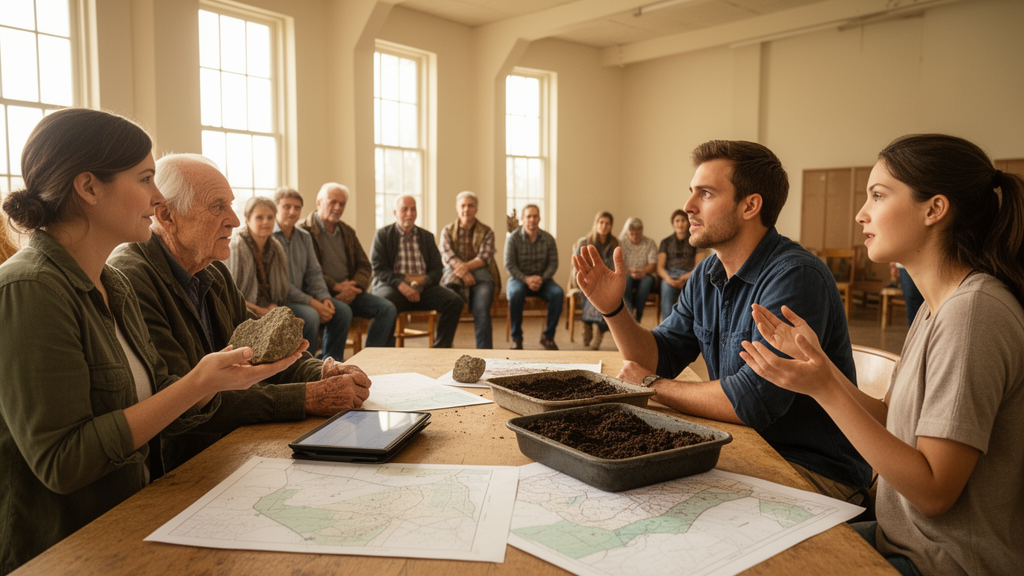
An editorial published in Frontiers in Earth Science on 26 October 2026 argues that producing robust geoscience evidence does not guarantee that knowledge will reach its intended audience, be understood, trusted, or considered relevant. The editorial, written by Katia Jasbinschek Pinheiro of CNRS and Université Grenoble Alpes, Tanvi Arora of CSIR-National Geophysical Research Institute in Hyderabad, Alison Lisa Bird of Natural Resources Canada, Hannah Frances Rogers of the University of Leeds, Shivangi Sharan of Imperial College London, and Barbara Leichter of GeoSphere Austria, introduces a Research Topic on bridging geoscience and society. The authors contend that between scientific research and societal action lies a complex communication environment in which information may be misinterpreted. Clear and inclusive communication, they write, is therefore essential for supporting public understanding, equitable decision-making, and effective action on natural hazards and environmental change.
The editorial identifies a central weakness in traditional outreach: the bridge between scientific institutions and society has frequently been treated as a one-way transfer of knowledge from experts to a presumed-to-be uninformed public. Meaningful engagement, the authors argue, requires dialogue, reciprocity, and the sharing of knowledge that communities already possess. Efforts to connect geoscience with society therefore demand more than making scientific results publicly available. They require understanding how different audiences encounter evidence, how they assess its credibility and relevance, and how it may influence their behaviours. The manuscripts gathered in the Research Topic span natural-hazard awareness, education, public engagement, interdisciplinary collaboration, and knowledge co-production, and the editors frame the collection as an invitation to move beyond traditional approaches toward producing, interpreting, and applying knowledge in sustained dialogue with society.
Two contributions demonstrate that effective geoscience communication begins by recognising how existing knowledge and lived experience shape the interpretation of Earth phenomena. Muturi and Dolphin trace how earthquakes have been understood through personal experiences, observed damage, and scientific measures of intensity and magnitude. The authors connect this understanding directly to earthquake early warning systems, noting that their effectiveness depends on public understanding of how warning thresholds operate. Clear education, they argue, is essential for maintaining trust and encouraging timely protective action. In an educational context, Vergara-Diaz and colleagues examine the same principle through an analysis of 785 drawings of the Earth’s internal structure produced by Chilean students. Many students depicted concentric layers without distinguishing their names or relative thicknesses, and frequently placed magma at the Earth’s centre. Rather than treating these conceptions as errors, the study presents them as starting points for learning, connecting existing understandings progressively with scientific concepts.
Several articles in the collection broaden geoscience engagement by building collaborative relationships. Guilbaud and colleagues address how to foster dialogue with society by considering nature as a whole, showing how shared field experiences and deliberate interdisciplinary organisation between researchers in Mexico and France can integrate geological and biological perspectives, foster collaborative research, and connect scientific knowledge with conservation action and wider societal engagement. Jones and colleagues describe the co-design and co-teaching of volcanology courses with Indigenous groups, combining community knowledge and academic scientific knowledge through place-based experiential learning. According to the authors, this approach can foster mutual respect across knowledge systems, empower Indigenous students, and strengthen community connections to history and language, while contributing to reconciliation and a curriculum of decolonisation. They also address practical challenges and propose actionable solutions for Indigenous communities to retain control over their knowledge and create conditions for meaningful educational outcomes and long-term success.
Madsen and colleagues reflect on an initiative in Edinburgh, Scotland, that brings pupils from underrepresented and disadvantaged backgrounds onto a university campus to participate in active-learning activities designed by PhD students. The authors suggest that direct engagement with environmental science, university spaces, and researchers can help challenge perceived barriers to higher education, widen participation, and encourage pupils to pursue further scientific study. Taken together with the other collaborative projects in the Research Topic, this work illustrates the editors’ second main lesson: inclusion requires supportive structures, two-way dialogue, respect for different knowledge systems, and long-term collaboration rather than one-off outreach events.
The Research Topic also illustrates the challenges of communicating hazards and Earth processes that are difficult to perceive or interpret directly. Using the “5 Ws and H” framework, covering who, what, when, where, why and how, Bhandari and colleagues review four decades of risk communication research across multiple hazards in Nepal. Their findings reveal fragmented approaches focused primarily on disseminating information, and they highlight the need for more coordinated, theory-informed, and action-oriented communication. Their recommendations include simulation exercises, better use of digital tools, and strategies tailored to vulnerable and underrepresented groups. Boggs and colleagues take a complementary systematic approach, applying a seven-component geocommunication model to earthquake engagement and education in seismically active regions of Canada. Their review identifies effective practices and opportunities to improve public understanding of regional earthquake risks through schools, public spaces, and other community settings.
Focusing more closely on how people interpret alerts, Droboth analyses nearly 1,000 first-hand accounts from five North American earthquakes, showing that the initial response to unexpected shaking is often confusion. The proposed four-phase Earthquake Comprehension Cycle suggests that an early warning message can reduce this uncertainty by identifying the event before strong shaking begins, allowing recipients to move more quickly towards protective action. This line of research underscores why the threshold mechanics of early warning systems, as examined by Muturi and Dolphin, must be communicated clearly: a warning only translates into behaviour if recipients can rapidly comprehend what is happening and what they should do.
Artistic and multimedia formats also feature prominently in the collection. Schanner and colleagues demonstrate how visualization and sonification can make a geophysical phenomenon, the last geomagnetic excursion in Earth’s history, comprehensible to a broad audience. The collaboration between scientists and artists produced audiovisuals that reached more than one million people internationally. The authors additionally show how platform choice and media framing can influence how scientific content is interpreted, a finding that reinforces the editors’ third main lesson: communication formats matter. Narration, illustration, field-based learning, warning messages, and sonification can each, and in combination, support understanding, decision-making, and positive behavioural change.
Across the Research Topic, the editors distil three main lessons for the geoscience community. First, engagement must begin with audiences’ experiences and current knowledge rather than assuming an empty vessel. Second, inclusion requires supportive structures, two-way dialogue, respect for different knowledge systems, and long-term collaboration. Third, the format of communication shapes its impact, and diverse formats can be combined to reach different audiences. The editors note that geoscience is uniquely positioned to connect science and society: earthquakes and climate change directly and dramatically affect people’s lives, while explaining invisible phenomena such as the Earth’s magnetic field can awaken scientific curiosity. The Research Topic describes means to enhance community awareness and involvement through education, participatory research, risk communication, and public engagement.
The editorial closes by identifying the next challenge: institutionalising and scaling these initiatives so that their evidence can be translated into actionable knowledge for decision-makers, educational programmes, communication strategies, and public policy at local, regional, and national levels. The authors argue that efforts to promote geoscience awareness can contribute substantially to improving science literacy in general, expanding public knowledge and strengthening community resilience and safety. As an editorial, the article synthesises and interprets the findings of the contributing studies rather than presenting new empirical data of its own, and its conclusions reflect the scope of the collected manuscripts. Even so, the consistent message across hazard education in Chile, risk communication in Nepal and Canada, Indigenous-led volcanology teaching, campus outreach in Scotland, and scientist-artist collaborations is that geoscience serves society best when communities are treated as partners in knowledge rather than passive recipients of it.
Subject of Research: Geoscience communication and community engagement with natural hazards
Article Title: Editorial: Bridging geoscience and society: enhancing community awareness and involvement
Article References: Pinheiro, K. J., Arora, T., Bird, A. L., Rogers, H. F., Sharan, S., & Leichter, B. (2026). Editorial: Bridging geoscience and society: enhancing community awareness and involvement. Frontiers in Earth Science, 14, Article 2002201. https://doi.org/10.3389/feart.2026.2002201
Image Credits: AI Generated
DOI: 10.3389/feart.2026.2002201
Keywords: geoscience, science communication, community engagement, natural hazards, earthquake early warning, risk communication, knowledge co-production, Indigenous knowledge, science education, public outreach, geohazards, scientific literacy
Cite Scienmag News
Violet Maxwell. (October 26, 2026). Geoscience Communication Shifts From One-Way Lectures to Two-Way Dialogue With Communities. Scienmag. https://scienmag.com/geoscience-communication-shifts-from-one-way-lectures-to-two-way-dialogue-with-communities/
Violet Maxwell. "Geoscience Communication Shifts From One-Way Lectures to Two-Way Dialogue With Communities." Scienmag, 26 October 2026, https://scienmag.com/geoscience-communication-shifts-from-one-way-lectures-to-two-way-dialogue-with-communities/. Accessed 26 October 2026.
Violet Maxwell. "Geoscience Communication Shifts From One-Way Lectures to Two-Way Dialogue With Communities." Scienmag. October 26, 2026. https://scienmag.com/geoscience-communication-shifts-from-one-way-lectures-to-two-way-dialogue-with-communities/


