


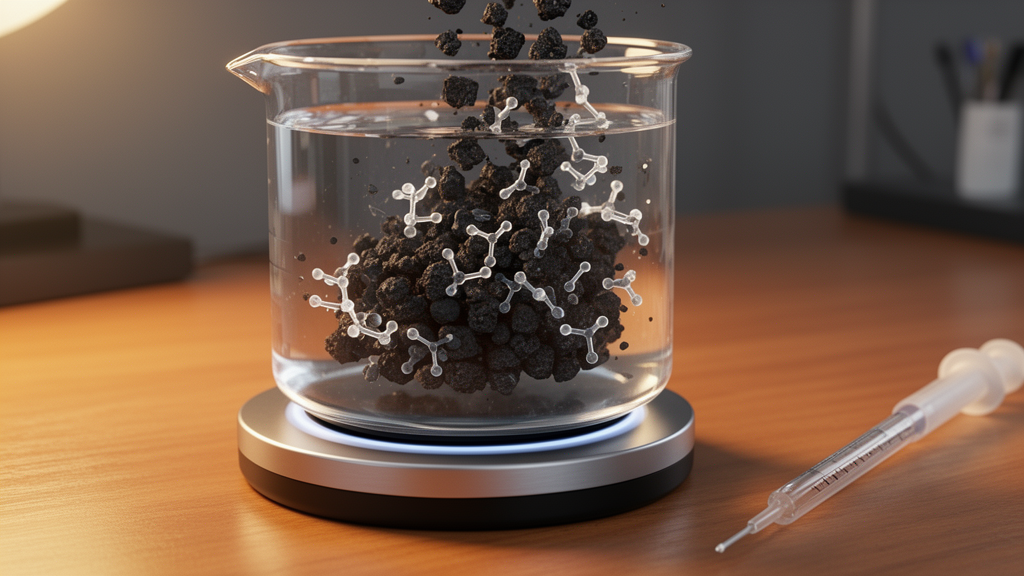
Dibutyl phthalate (DBP), a plasticizer that the study’s authors describe as a crucial component of microplastics and a serious threat to human health, is the target of a new adsorption strategy built from an unlikely raw material: walnut shells. In research published in Environmental Science and Pollution Research, a team led by Mengmeng Cheng and Yunchao Zhao converted walnut shells into biochar through pyrolysis, then treated the resulting carbon material in three different ways to see which pretreatment best equipped it to pull DBP out of solution. The approach taps agricultural by-products and waste streams, which have attracted growing attention as feedstocks for low-cost water-treatment materials.
The researchers prepared three variants of the walnut shell biochar, pretreating samples with water, hydrochloric acid (HCl), or sodium hydroxide (NaOH) after pyrolysis. They then characterized each material’s morphology, chemical composition, and porous structure. The acid-treated version came out ahead on one key metric: it displayed the highest specific surface area of the three, measuring 205.61 square meters per gram. Because adsorption onto porous carbons depends heavily on the amount of accessible surface, the authors expected this expanded area to promote the physical adsorption of DBP molecules onto the biochar surface.
Surface area, however, was not the whole story. When the team ran adsorption kinetics and isotherm experiments, it was the alkali-treated material that performed best overall. The NaOH-pretreated biochar achieved the largest adsorption capacity of the three variants, reaching 7.08 milligrams of DBP per gram of biochar. Just as important for any practical sorbent, the material held up under repeated use: its removal rate declined by only 8.2 percent after six regeneration and reuse cycles, suggesting the alkali treatment produced a structure that resists degradation across multiple rounds of contaminant capture.
Thermodynamic analysis offered a clue to why the NaOH-treated biochar outperformed its acid-treated counterpart despite having less surface area. The NaOH-pretreated material showed the minimized Gibbs free energy of the three variants, at −3.559 kJ mol−1 K−1 as reported in the study. The authors attribute this favorable thermodynamics to the joint effect of physical adsorption and chemical adsorption, meaning the material appears to combine pore-driven surface capture with chemical interactions rather than relying on a single mechanism. That dual pathway, they suggest, helps explain the gap between the two pretreatments: HCl treatment maximized the physical adsorption surface, while NaOH treatment balanced both mechanisms to deliver the highest capacity and the strongest driving force for DBP uptake.
The authors position the work as a step toward broader application of biochar-based materials in DBP removal, and the numbers reported here give that claim concrete support: a waste-derived sorbent with a measured capacity of 7.08 milligrams per gram, a surface area of 205.61 square meters per gram in its acid-activated form, and less than a ten percent loss in performance after six cycles. The findings remain laboratory-scale measurements of adsorption behavior rather than demonstrations in real wastewater systems, but they map out how a simple choice of chemical pretreatment can steer the same agricultural waste material toward different adsorption strengths.
Subject of Research: Biochar adsorption of the microplastic-related plasticizer dibutyl phthalate using chemically pretreated walnut shell-derived biochar
Article Title: Chemically activated walnut shell-derived biochar for enhanced adsorption of dibutyl phthalate
Article References: Cheng, M., Yang, X., Wang, H., Qiao, Z., & Zhao, Y. (2026). Chemically activated walnut shell-derived biochar for enhanced adsorption of dibutyl phthalate. Environmental Science and Pollution Research. https://doi.org/10.1007/s11356-026-38334-2
Image Credits: AI Generated
DOI: 10.1007/s11356-026-38334-2
Keywords: biochar, dibutyl phthalate, walnut shells, adsorption, water treatment, microplastics, Chemically, activated, walnut, shell-derived, enhanced, dibutyl
Cite Scienmag News
Russell Cooper. (October 26, 2026). Walnut Shell Biochar Engineered to Capture Plasticizer Dibutyl Phthalate. Scienmag. https://scienmag.com/walnut-shell-biochar-engineered-to-capture-plasticizer-dibutyl-phthalate/
Russell Cooper. "Walnut Shell Biochar Engineered to Capture Plasticizer Dibutyl Phthalate." Scienmag, 26 October 2026, https://scienmag.com/walnut-shell-biochar-engineered-to-capture-plasticizer-dibutyl-phthalate/. Accessed 26 October 2026.
Russell Cooper. "Walnut Shell Biochar Engineered to Capture Plasticizer Dibutyl Phthalate." Scienmag. October 26, 2026. https://scienmag.com/walnut-shell-biochar-engineered-to-capture-plasticizer-dibutyl-phthalate/


