


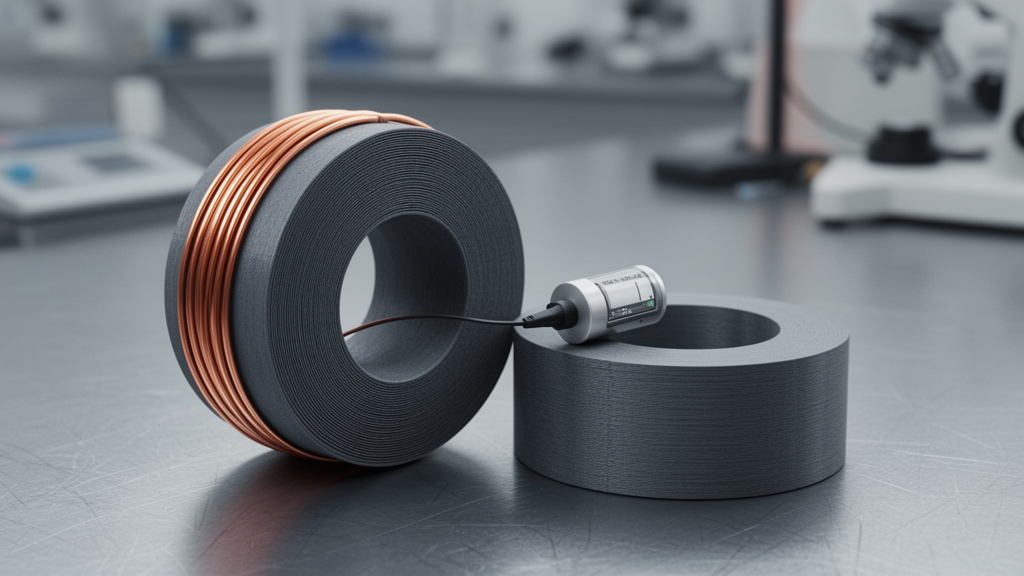
Researchers have fabricated and magnetically characterized a manganese-zinc (MnZn) soft ferrite toroidal core produced by additive manufacturing, reporting in Scientific Reports that the finished part reaches magnetic performance comparable to that of a conventional ferrite. The team describes the route as an original process for the production of soft ferrite parts, adding a magnetic ceramic to the set of materials that additive manufacturing can currently print for electrical engineering. The manufacturing route is described as PIM-like additive manufacturing, in which the 3D printing step is performed using polymer pellets filled with ferrite powder.
Once printed, the green part passes through debinding and sintering steps, after which the researchers obtained a dense core. According to the study, this dense core is what delivers magnetic performance comparable to a conventionally produced ferrite, rather than the part remaining a porous intermediate. Characterization of the printed component proceeded along two lines.
Microstructurally, the team determined the material's grain size. Magnetically, they measured the core's hysteresis loops and the associated power losses as a function of induction and frequency, the two operating variables along which the ferrite's behaviour is reported in the study. These measurements together establish the main magnetic properties of the printed material.
The combination of grain size, hysteresis loops, power losses and temperature behaviour forms the reported description of what the PIM-like printing route produces in a MnZn soft ferrite. The authors frame additive manufacturing as offering flexibility in terms of shapes while currently enabling the printing of a variety of materials for electrical engineering. Within that context, the demonstrated toroidal core serves as the case study for the process: a powder-filled-pellet printing step, followed by debinding and sintering, yielding a dense MnZn ferrite whose measured magnetic properties sit alongside those of a conventional ferrite.
The work is published as an open-access article in Scientific Reports, with the fabrication process and the full characterization dataset presented as the study's core contribution.
Subject of Research: PIM-like additive manufacturing and magnetic characterization of a MnZn ferrite toroidal core
Article Title: PIM-like additive manufacturing and characterization of a MnZn ferrite magnetic core
Article References: Sqalli, G., Martin, V., Gillon, F., Soupremanien, U., Najjar, D., Witz, J.-F., Benabou, A., & Hecquet, M. (2026). PIM-like additive manufacturing and characterization of a MnZn ferrite magnetic core. Scientific Reports. https://doi.org/10.1038/s41598-026-76367-2
Image Credits: AI Generated
DOI: 10.1038/s41598-026-76367-2
Keywords: PIM-like, additive, manufacturing, characterization, MnZn, ferrite, magnetic, core, scientific research
Cite Scienmag News
Denise Maddox. (October 26, 2026). 3D-Printed MnZn Ferrite Core Achieves Magnetic Performance Comparable to Conventional Parts. Scienmag. https://scienmag.com/3d-printed-mnzn-ferrite-core-achieves-magnetic-performance-comparable-to-conventional-parts/
Denise Maddox. "3D-Printed MnZn Ferrite Core Achieves Magnetic Performance Comparable to Conventional Parts." Scienmag, 26 October 2026, https://scienmag.com/3d-printed-mnzn-ferrite-core-achieves-magnetic-performance-comparable-to-conventional-parts/. Accessed 26 October 2026.
Denise Maddox. "3D-Printed MnZn Ferrite Core Achieves Magnetic Performance Comparable to Conventional Parts." Scienmag. October 26, 2026. https://scienmag.com/3d-printed-mnzn-ferrite-core-achieves-magnetic-performance-comparable-to-conventional-parts/


