


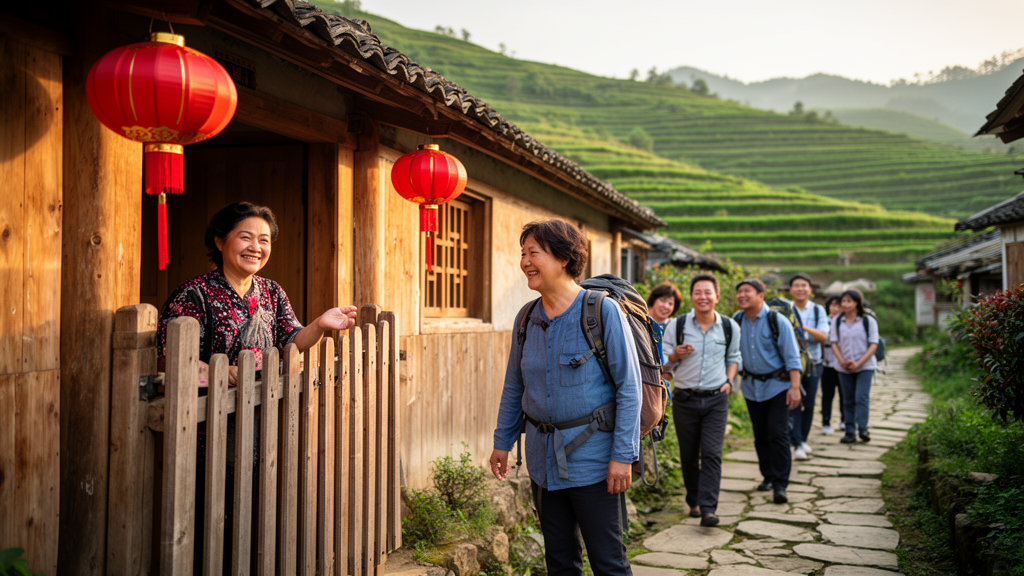
When households in the mountains of Shanxi Province turn to tourism to lift their incomes, the strongest statistical companions of their earnings are not only savings and loans but also something less tangible: confidence in their own ability to adapt, persevere through the off-season, and expect better days ahead. A new cross-sectional survey of 374 tourism-participating households around Yunqiu Mountain in the Yellow River Basin finds that psychological capital, a construct capturing self-efficacy, hope, resilience, and optimism, shows some of the largest standardized associations with household income among six dimensions of livelihood capital, performing on par with financial capital. The study, published in Frontiers in Sustainable Food Systems, extends the classic Sustainable Livelihoods Framework by adding psychological agency to the conventional five-capital toolkit and offers rare micro-level evidence from a resource-transformation mountain area where rural tourism has become a central livelihood strategy.
The backdrop is China’s sweeping rural revitalization agenda and the national strategy for ecological conservation and high-quality development in the Yellow River Basin. Rural tourism has emerged as a powerful engine for expanding livelihood opportunities in mountain areas undergoing resource transformation, offering households employment, business operation, agricultural product sales, and industrial integration beyond traditional farming. The scale is striking: according to estimates from the Data Center of the Ministry of Culture and Tourism, rural tourism in China received 3.157 billion visits in 2025, an increase of 9.3 percent year on year, generating RMB 1.81 trillion in revenue, up 9.6 percent, and employing 7.83 million people. Yet tourism benefits are not necessarily distributed evenly across households. Household resource endowments, modes of participation, and positions within the tourism industry all shape the ability to capture tourism gains, and the seasonality and market fluctuations inherent to tourism require households to adjust their livelihood strategies throughout the year.
Most previous research has examined whether households participate in tourism and how participation relates to income or livelihood transformation at an aggregate level. The research team, led by Xiaotao Liang, Yaowen Xue, Liming Xiao, and Meiling Du of Shanxi Normal University, argues that a binary participation indicator misses crucial heterogeneity among households that are already engaged in tourism. Participation encompasses different modes and degrees: employment in scenic areas, seasonal wage work, homestay and agritainment businesses, agricultural product supply, and equity participation through land or housing. These modes differ in labor requirements, asset needs, returns, managerial autonomy, and risk exposure. The team therefore focused on differences among participating households themselves, asking whether the degree of tourism participation is statistically associated with income outcomes, whether it is associated with six dimensions of livelihood capital, and whether those capital dimensions form indirect association pathways linking participation and income.
The study area comprises villages surrounding the Yunqiu Mountain Scenic Area in Guanwangmiao Township, Xiangning County, Linfen City, a national 5A-level tourist attraction with typical mountain-rural characteristics. As tourism has expanded around the mountain’s natural landscapes and traditional cultural resources, the surrounding area has developed a diversified industrial pattern centered on scenic-area operations, supplemented by household employment and business participation, with agricultural production combined with tourism services. The formal survey, conducted from August 13 to 20, 2025, covered four villages: Dahe, Banershang, Donggou, and Xiachuan. Using stratified random sampling based on village committee rosters supplemented by scenic-area employment, business registration, and cooperative participation records, the team distributed 400 questionnaires and, after screening out 26 for patterned responding, internal inconsistency, missing key items, or implausibly short completion times, retained 374 valid questionnaires, a 93.5 percent valid response rate. Trained interviewers conducted face-to-face household interviews in Mandarin, with dialect explanations when necessary, and documented informed consent before each interview.
The analytical framework builds on the Sustainable Livelihoods Framework, which classifies household resources into five forms of capital: human, natural, physical, financial, and social. The team added psychological capital as a sixth dimension, encompassing the positive psychological resources that individuals draw upon when facing tasks, challenges, and uncertainty. The distinction matters conceptually: human capital refers to production-related resources such as education and skills, social capital concerns access to resources through networks and trust, while psychological capital captures the internal resources of confidence, expectation, and coping capacity. Under tourism-market volatility and employment uncertainty, self-efficacy, development expectations, and coping capacity may be associated with both willingness to participate and income outcomes. The team modeled psychological capital as a distinct latent construct and verified its discriminant validity against the other capital dimensions, with all heterotrait-monotrait ratios below 0.85, Cronbach’s alpha values ranging from 0.76 to 0.87, and average variance extracted values from 0.65 to 0.77.
Tourism participation was measured as a composite index spanning three content dimensions: economic participation, participation breadth, and decision-making agency, covering nine items that range from providing management and visitor guiding services to supplying agricultural products, operating specialty homestays, contributing land or housing equity, using short-video and livestreaming platforms for promotion, and participating in village tourism development meetings. Income outcomes were assessed through multiple indicators: total annual household income in 2024 measured in six ordered categories from below RMB 30,000 to at least RMB 250,000, the share of tourism-related income in total income, the number of income sources, and subjective perceptions of income stability, relative position, sustainability, and satisfaction. Respondents’ income reports were cross-checked where possible against bankbooks, business records, homestay bookings, and cooperative dividends. The sample was predominantly young and middle-aged, with respondents aged 31 to 54 accounting for 75.1 percent, and employment-oriented participation was the most common mode at 37.9 percent, followed by business-oriented at 28.9 percent, supply-oriented at 20.3 percent, and equity-oriented at 12.9 percent.
The results are statistically robust. In an ordered logit model controlling for gender, age, years of education, household size, and the number of household laborers, the composite tourism participation index was significantly and positively associated with the household income category, with an odds ratio of 1.200, meaning that a one-unit increase in the participation index was associated with roughly a 20 percent increase in the odds of being in a higher income bracket. Supplementary analyses showed that participation was also positively associated with the share of tourism income in total household income, which averaged 45.6 percent, with the number of income sources, which averaged 2.35, and with all four subjective income perception indicators. Partial least squares structural equation modeling revealed that participation was significantly and positively associated with all six capital dimensions, with the largest standardized path coefficients for psychological capital at 0.675 and financial capital at 0.649. All six capital dimensions were in turn significantly and positively associated with income, again led by psychological capital at 0.247 and financial capital at 0.219.
The indirect pathway decomposition is where the architecture of the association becomes visible. All six capital dimensions formed statistically significant indirect association pathways between tourism participation and income, summing to a total indirect association of approximately 0.536. The psychological capital pathway accounted for 31.2 percent of the total and the financial capital pathway 26.5 percent, while human, social, physical/material, and natural capital pathways each contributed between 7.8 and 13.2 percent. Pairwise bootstrap comparisons with 5,000 resamples showed that the difference between the psychological and financial pathways was not statistically significant, so the study deliberately avoids ranking one above the other. Most differences among the remaining four capital dimensions were also statistically indistinguishable. Robustness checks strengthened confidence in the core association: removing potentially overlapping measurement items, excluding short-term participants and self-employed households, applying alternative income coding schemes, and adding fuller control variables all preserved the direction and significance, and a random permutation test yielded a mean association of only 0.024 under random matching, far below the observed total association of 0.718.
The authors are careful about what these numbers mean and what they do not. Because the design is cross-sectional, with all variables measured at the same time, the estimated relationships represent contemporaneous statistical associations rather than causal effects. The associations may be bidirectional: households with greater financial resources may find it easier to enter self-employment or asset-based participation, while higher-income households may have greater capacity to accumulate financial resources, and market conditions and business experience may simultaneously shape respondents’ psychological states. The sample includes only households already participating in tourism, excluding non-participants, households that have exited, and businesses that have failed, so the selection process underlying participation cannot be fully examined. Higher tourism participation also does not necessarily mean withdrawal from traditional agricultural livelihoods; households recombine tourism employment, self-employment, and farming across peak and off-peak seasons, and business projects requiring large initial investments carry financing needs and market risks that income indicators alone cannot capture.
Even with those caveats, the findings carry practical weight for policymakers and rural development practitioners. The results suggest that support for tourism-participating households should strengthen multidimensional livelihood capital in a coordinated way: training in tourism services, business management, and digital marketing for households with limited skills; financial services under manageable risk and voluntary participation for households with limited resources; and cooperative organizations, information platforms, and experience sharing to broaden access. The prominence of psychological capital, treated here as a psychological-resource state rather than a stable personality trait, hints that confidence, hope, and resilience deserve analytical attention in tourism livelihood research, though the authors caution that interventions targeting psychological capital should not be regarded as a deterministic means of increasing income. Diversified participation channels, benefit-sharing mechanisms, ecological protection linked to livelihood opportunities, and differentiated risk measures for employment-oriented, business-oriented, supply-oriented, and asset-based participation round out the implications. Future research, the team suggests, should employ longitudinal or panel data to establish temporal ordering, expand samples to non-participating households, and construct broader welfare indicators covering debt, land rights, and consumption.
Subject of Research: Rural tourism participation, livelihood capital structure, and household income outcomes in the Yunqiu Mountain Area, Yellow River Basin
Article Title: Relationships among rural tourism participation, livelihood capital structure, and household income outcomes: a cross-sectional survey of tourism-participating households in the Yunqiu Mountain Area, Yellow River Basin
Article References: Liang, X., Xue, Y., Xiao, L., & Du, M. (2026). Relationships among rural tourism participation, livelihood capital structure, and household income outcomes: a cross-sectional survey of tourism-participating households in the Yunqiu Mountain Area, Yellow River Basin. Frontiers in Sustainable Food Systems, 10, Article 1960260. https://doi.org/10.3389/fsufs.2026.1960260
Image Credits: AI Generated
DOI: 10.3389/fsufs.2026.1960260
Keywords: Relationships, rural, tourism, participation, livelihood, capital, structure, household, income, outcomes, cross-sectional, survey
Cite Scienmag News
Margaret Porter. (October 26, 2026). Confidence Rivals Cash in the Income Gains of China’s Rural Tourism Households. Scienmag. https://scienmag.com/confidence-rivals-cash-in-the-income-gains-of-chinas-rural-tourism-households/
Margaret Porter. "Confidence Rivals Cash in the Income Gains of China’s Rural Tourism Households." Scienmag, 26 October 2026, https://scienmag.com/confidence-rivals-cash-in-the-income-gains-of-chinas-rural-tourism-households/. Accessed 26 October 2026.
Margaret Porter. "Confidence Rivals Cash in the Income Gains of China’s Rural Tourism Households." Scienmag. October 26, 2026. https://scienmag.com/confidence-rivals-cash-in-the-income-gains-of-chinas-rural-tourism-households/


