


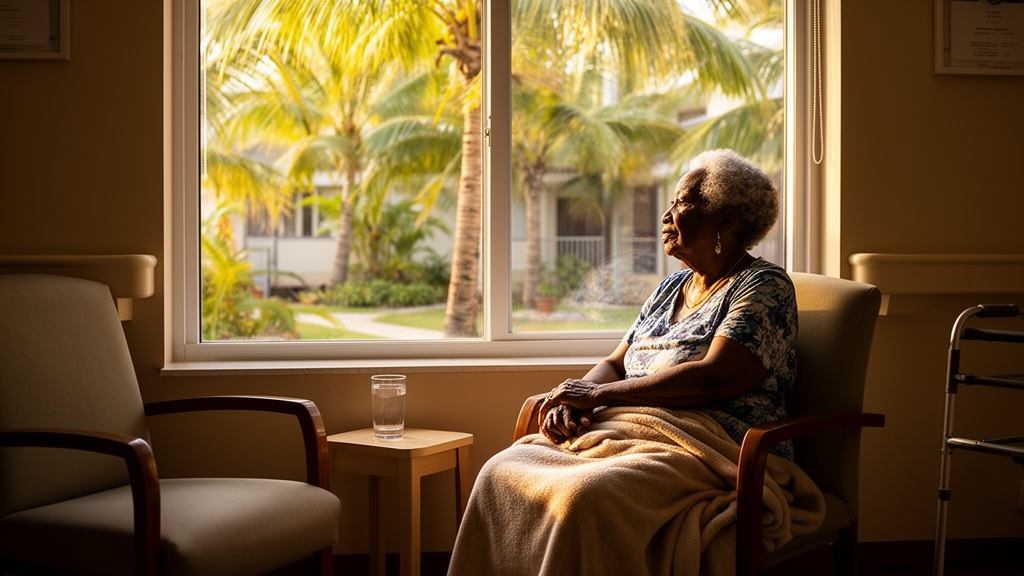
Loneliness affects nearly one in three nursing home residents in the French Caribbean and is associated with a sharply elevated risk of death within a year, according to a prospective observational study published in BMC Geriatrics. The research, a secondary analysis of the KASEHPAD cohort conducted over one year in six nursing homes, found that 31.0% of residents reported feeling lonely, and that those who did faced a more than fivefold higher hazard of mortality over the following twelve months, even after accounting for age, gender, dependency level, and depressive symptoms.
The study assessed loneliness using item 14 of the Center for Epidemiologic Studies Depression Scale (CES-D), which asks respondents whether they felt lonely. A total of 145 residents completed the questionnaire at baseline. Their mean age was 80.8 years with a standard deviation of 10.0 years, and 52.4% were men. After twelve months of follow-up, 14 residents—10.0% of the cohort—had died. Among residents who reported loneliness, the one-year mortality rate was 15.9%, compared with a lower rate among those who did not. In a Cox proportional hazards regression model including 139 residents and adjusted for age, gender, dependency, and depression, loneliness was associated with an increased risk of mortality, with a hazard ratio of 5.7 (95% confidence interval: 1.4–22.6; p = 0.013). The researchers emphasize that this is an observed association rather than proof of a causal effect, and the wide confidence interval reflects the modest number of deaths in the cohort.
Beyond its link to mortality, the study identified a distinct profile of factors associated with loneliness. Younger age, depressive symptoms, dissatisfaction with social support, lower self-rated quality of life, poor adjustment to the nursing home environment, anxiety, and nighttime behavioral disturbances were all significantly associated with reporting loneliness. Notably, several characteristics often assumed to drive isolation in institutional settings were not significantly associated with the feeling: dependency level, cognitive status, gender, childlessness, and major medical comorbidities showed no significant relationship. This dissociation between objective circumstances and subjective experience underscores that loneliness is defined as the perceived discrepancy between desired and actual social relationships—a subjective state that cannot be inferred from a resident’s clinical chart or family situation alone.
The authors conclude that loneliness was highly prevalent among the nursing home residents studied and could be associated with increased one-year mortality. They suggest that, beyond standard geriatric assessments, promoting institutional environments that foster social connectedness appears to be an essential component of comprehensive care for older adults living in Caribbean nursing homes. The findings are drawn from a prospective observational study registered as NCT04587466, and as a secondary analysis of a cohort limited to six nursing homes in one region, the results may not generalize to other settings. Nonetheless, the combination of a high loneliness prevalence and a strong adjusted association with mortality positions loneliness as a measurable and potentially modifiable marker of risk in long-term care populations, one that standard geriatric evaluations may currently overlook.
Subject of Research: Determinants of loneliness and its association with one-year mortality among nursing home residents in the French Caribbean
Article Title: Feeling of loneliness among nursing homes residents: determinants and 1-year mortality
Article References: Simo, N., Tabué-Teguo, M., Dramé, M., Dartigues, J.-F., & Boucaud-Maitre, D. (2026). Feeling of loneliness among nursing homes residents: determinants and 1-year mortality. BMC Geriatrics. https://doi.org/10.1186/s12877-026-08577-2
Image Credits: AI Generated
DOI: 10.1186/s12877-026-08577-2
Keywords: loneliness, nursing homes, older adults, mortality, CES-D, KASEHPAD cohort, French Caribbean, geriatrics, social connectedness, depressive symptoms, Cox regression, BMC Geriatrics
Cite Scienmag News
Phoebe Ingram. (October 26, 2026). Loneliness Tied to Higher One-Year Mortality in Nursing Home Residents, Caribbean Cohort Study Finds. Scienmag. https://scienmag.com/loneliness-tied-to-higher-one-year-mortality-in-nursing-home-residents-caribbean-cohort-study-finds/
Phoebe Ingram. "Loneliness Tied to Higher One-Year Mortality in Nursing Home Residents, Caribbean Cohort Study Finds." Scienmag, 26 October 2026, https://scienmag.com/loneliness-tied-to-higher-one-year-mortality-in-nursing-home-residents-caribbean-cohort-study-finds/. Accessed 26 October 2026.
Phoebe Ingram. "Loneliness Tied to Higher One-Year Mortality in Nursing Home Residents, Caribbean Cohort Study Finds." Scienmag. October 26, 2026. https://scienmag.com/loneliness-tied-to-higher-one-year-mortality-in-nursing-home-residents-caribbean-cohort-study-finds/


